
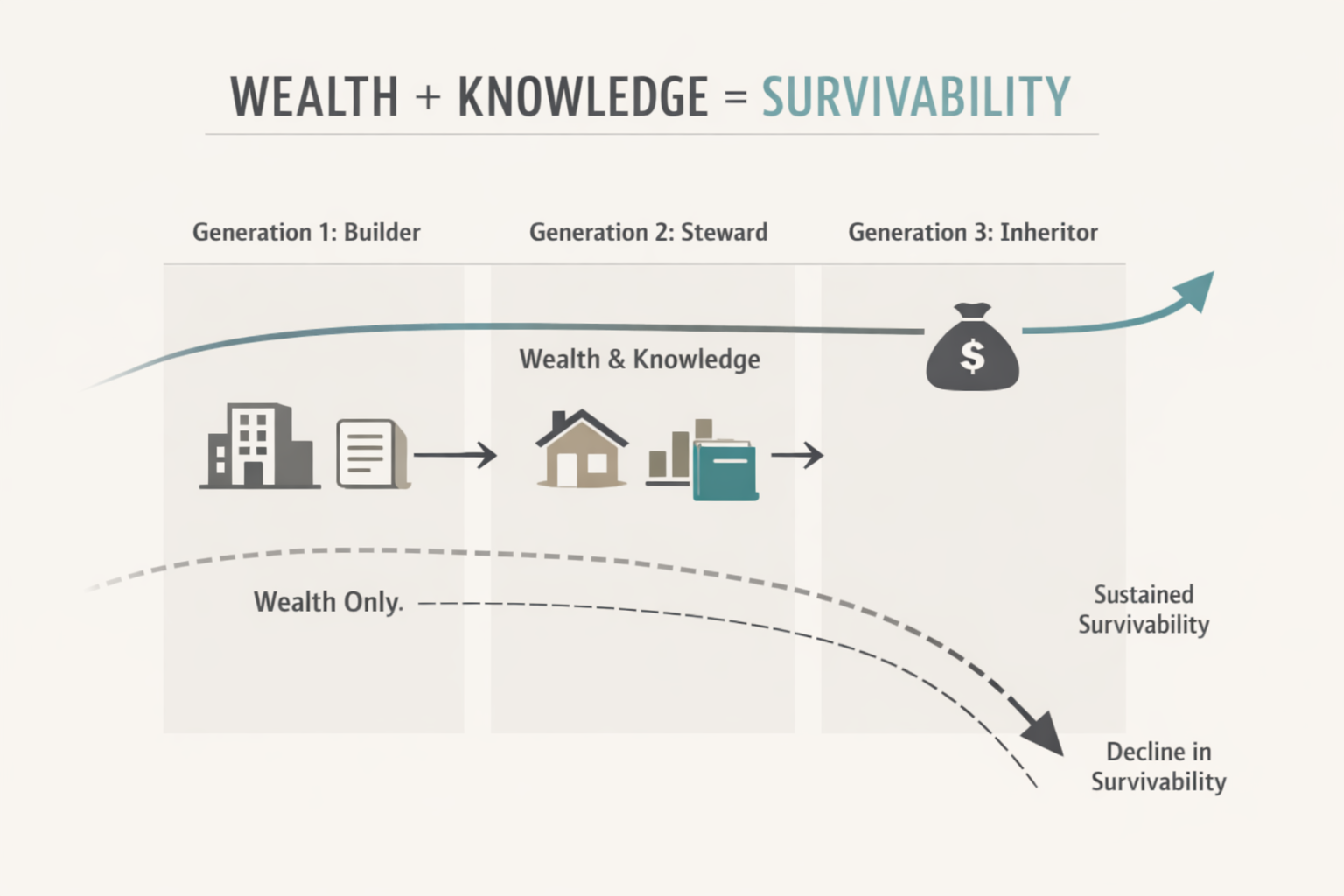
Generational financial literacy will determine whether the Great Wealth Transfer becomes lasting family stability or a historic dissipation event.
That is not a dramatic statement. It is a structural one.
Money can transfer in a legal document. Competence cannot. Assets can move through wills, trusts, beneficiary forms, real estate deeds, and brokerage accounts. But judgment, restraint, tax awareness, investment discipline, and stewardship require something slower.
They require education.
Generational financial literacy is the ability of a family to transfer not only wealth, but also the knowledge required to manage, grow, protect, and govern that wealth across generations.
Without that knowledge transfer, inheritance becomes fragile. The next generation may receive money, but not the operating system needed to sustain it.
What Is Generational Financial Literacy?
Generational financial literacy is different from personal finance.
Personal finance usually focuses on individual decisions. Budgeting. Saving. Debt. Investing. Retirement planning.
Generational financial literacy goes further. It asks whether a family can move financial knowledge across time.
That includes:
- understanding how assets work
- learning how wealth is protected
- knowing how taxes affect decisions
- understanding investment risk
- recognizing the cost of poor timing
- knowing when to use professional advisors
- developing the discipline to delay consumption
- learning how ownership becomes responsibility
This matters because inheritance is not just a financial event. It is a capability test.
A person can inherit a house and still lose it. A person can inherit a portfolio and still drain it. A person can inherit a business and still misunderstand the structure that made it valuable.
Assets create opportunity. Literacy creates survivability.
That is why this subject belongs inside Education & Skills. The wealth is the case study. The real issue is whether a family can teach competence before responsibility arrives.
Why Generational Financial Literacy Matters During the Great Wealth Transfer
Cerulli Associates projects that roughly $124 trillion will transfer through 2048. About $105 trillion is expected to move to heirs, while about $18 trillion is projected to move to charitable institutions.
The headline number is enormous. But the more important question is quieter.
Who has been prepared to receive it?
The Great Wealth Transfer is often framed as a story about Boomers, heirs, housing wealth, retirement accounts, and estate planning. All of that matters. But the deeper issue is educational.
Many younger heirs will inherit more complexity than previous generations faced. They may receive assets across brokerage accounts, retirement plans, real estate, insurance products, trusts, family businesses, and digital platforms.
That environment requires more than access. It requires interpretation.
Without preparation, heirs may not know:
- whether to sell or hold property
- how to evaluate a financial advisor
- how taxes affect inherited assets
- how to handle family disagreement
- how to preserve principal while using income
- how to distinguish liquidity from wealth
Financial literacy converts confusion into judgment.
Groundwork Daily often returns to the principle that structure builds freedom. Inheritance proves that principle under pressure. Money without structure can create stress. Money with structure can create durability.
Why Wealth Disappears Across Generations
A familiar pattern repeats across families.
One generation builds. The next generation maintains. A later generation dissipates.
People often explain this as entitlement. That explanation is too easy.
The deeper issue is informational decay.
The generation that builds wealth usually remembers the pressure that created it. They remember the sacrifices, risks, delays, mistakes, and corrections. They know which decisions mattered because they had to make them.
The next generation often receives the result without receiving the reasoning.
That gap becomes dangerous.
When a family does not explain how wealth was built, younger members inherit outcomes without understanding the systems behind them. A property becomes a thing to sell. A portfolio becomes money to access. A trust becomes paperwork. A business becomes a burden.
The asset remains visible. The discipline becomes invisible.
This is where wealth begins to weaken.
Money does not disappear only through overspending. It also disappears through poor sequencing, weak documentation, unmanaged taxes, emotional decision-making, family conflict, and maintenance neglect.
Those are education failures before they are financial failures.
That is why discipline before dollars is not just a personal finance slogan. It is a generational survival rule.
The Role of Knowledge Transfer in Wealth Survivability

Knowledge transfer cannot be handled through one conversation.
It has to become a system.
Many families avoid the subject until the moment becomes urgent. They wait until illness. They wait until estate documents need signatures. They wait until a parent dies. They wait until a child is already overwhelmed.
By then, education has become crisis management.
Generational financial literacy works better when younger family members are exposed to real decisions before they are expected to make them alone.
That does not mean children need access to every account. It means they need age-appropriate contact with the logic of stewardship.
They can learn why a family maintains emergency savings. They can sit in on a property maintenance discussion. They can review the difference between income and principal. They can learn why insurance exists. They can understand why taxes shape timing. They can see how advisors are questioned, not worshiped.
This is skill acquisition.
It is no different from any other form of capability. People learn through exposure, practice, correction, and repetition.
The same logic appears in Malik Rivers’ broader work on disciplined thinking. Strong judgment does not appear under pressure unless it has been practiced before pressure arrives.
Five Mistakes Families Make With Financial Literacy
Most families do not fail because they lack love.
They fail because they lack structure.
1. Waiting Too Long
Many parents delay financial conversations because they want to protect children from stress. That instinct is understandable. But silence often creates a larger burden later.
When heirs first encounter family finances during grief or crisis, their learning curve becomes brutal.
2. Keeping Money Secret
Privacy is not the same as secrecy.
Families can protect sensitive details while still teaching principles. Children do not need every account number to learn how assets, obligations, taxes, and maintenance work.
3. Assuming Heirs Will Figure It Out
People rarely rise to the level of an asset they do not understand.
If a person has never managed a budget, reviewed an investment statement, handled property costs, or discussed risk, inheritance will not magically create competence.
4. Teaching Concepts Without Decisions
Definitions are not enough.
Heirs need to see decisions. They need to understand tradeoffs. Why hold? Why sell? Why refinance? Why avoid debt? Why use a trust? Why wait?
5. Confusing Inheritance With Preparation
Leaving wealth is not the same as preparing someone to steward it.
One is transfer. The other is education.
The Four-Stage Financial Learning Model
Families need a learning model, not a lecture.
A practical model looks like this:
Stage One: Observation
Younger family members first learn by watching. They hear how adults talk about money. They see whether bills create panic or order. They notice whether wealth is treated as status, responsibility, or secrecy.
At this stage, the goal is exposure.
Stage Two: Explanation
Observation needs language.
Families should explain basic structures clearly. Income. Expenses. Savings. Debt. Investments. Taxes. Insurance. Estate documents. Ownership.
The point is not to overwhelm. The point is to build vocabulary before complexity arrives.
Stage Three: Participation
Participation turns knowledge into practice.
A teenager can manage a small budget. A young adult can help compare insurance quotes. A future heir can attend a planning meeting. A family member can help review rental property expenses.
Participation creates confidence because it connects ideas to action.
Stage Four: Stewardship
Stewardship begins when responsibility becomes real.
At this level, the next generation can make informed decisions, ask better questions, evaluate advisors, preserve documentation, and understand the long-term consequences of short-term choices.
This is the goal.
Not inheritance alone.
Stewardship.
How Families Build Financial Systems That Last
Wealth survives when families build repeatable systems around it.
That may include annual family meetings, shared financial education, written asset summaries, advisor introductions, estate planning reviews, and clear expectations around property, giving, business interests, and long-term goals.
These systems do not have to be elaborate.
They do have to be consistent.
A family meeting can answer simple questions:
- What assets require maintenance?
- What decisions are coming in the next year?
- What documents need review?
- What should younger members learn next?
- What values should guide financial decisions?
That final question matters.
Wealth without values becomes consumption. Wealth with values becomes stewardship.
This is where wealth structure strategy becomes more than financial planning. It becomes a family education system.
The Psychology of Receiving Wealth
Inheritance does not arrive in a vacuum.
It often arrives with grief, pressure, guilt, fear, family tension, or sudden visibility.
Some heirs feel unworthy. Some feel entitled. Some avoid decisions because they are afraid to make mistakes. Some spend quickly because the money feels unreal. Some freeze because the responsibility feels too large.
This psychological layer matters.
Financial literacy must prepare people not only for numbers, but also for pressure.
A person who can read an investment statement but cannot manage emotional urgency may still make poor decisions. A person who understands taxes but avoids family conflict may still delay necessary action. A person who inherits property but avoids maintenance may still lose value slowly.
That is why generational financial literacy must include discipline, attention, and emotional regulation. The mind must be trained before the money arrives.
Frequently Asked Questions About Generational Financial Literacy
What is generational financial literacy?
Generational financial literacy is the transfer of financial knowledge, judgment, and stewardship skills across generations. It helps families preserve assets by preparing heirs to understand and manage what they receive.
Why does family wealth disappear?
Family wealth often disappears because assets are transferred without the knowledge systems that created and protected them. Poor planning, weak communication, taxes, conflict, overspending, and lack of stewardship can all erode wealth.
When should families start teaching financial literacy?
Families should start early with age-appropriate lessons. The goal is not to expose children to every financial detail. The goal is to build vocabulary, habits, and judgment over time.
How do wealthy families teach heirs?
Durable families usually teach through staged responsibility. They combine conversations, observation, guided participation, advisor exposure, and clear expectations around ownership and stewardship.
Is financial literacy enough to preserve wealth?
No. Financial literacy is necessary, but it is not enough by itself. Families also need legal structure, tax planning, emotional maturity, communication, and disciplined decision-making.
The Discipline Transfer
Every inheritance transfers two assets.
The first is financial.
The second is intellectual.
The first can be measured quickly. The second determines whether the first survives.
That is the real meaning of generational financial literacy.
It is not a vocabulary test. It is not the ability to repeat financial terms. It is the practical ability to understand financial systems well enough to maintain them under pressure.
Families should stop asking only, “What are we leaving?”
They should also ask, “Who are we preparing?”
That question changes the work.
It turns inheritance from an event into a curriculum. It turns wealth from a possession into a system. It turns the next generation from recipients into stewards.
Wealth rarely survives because money moves forward.
It survives because discipline, judgment, and knowledge move with it.
Generational financial literacy is the bridge between inheritance and durability. Without it, wealth may arrive. With it, wealth has a better chance to last.
Receipts
→ Cerulli Associates: $124 Trillion Wealth Transfer Projection

Meet the Builder

Malik Rivers
Builder, Education & Skills
Malik Rivers builds Groundwork Daily’s Education & Skills territory, examining how disciplined thinking, physical capacity, and intentional technology use shape long-term human performance.
Through Mind as Discipline, Health as Discipline, and Tech as Discipline, Malik explores the systems that strengthen judgment, resilience, learning, recovery, and capability over time.