Article Map
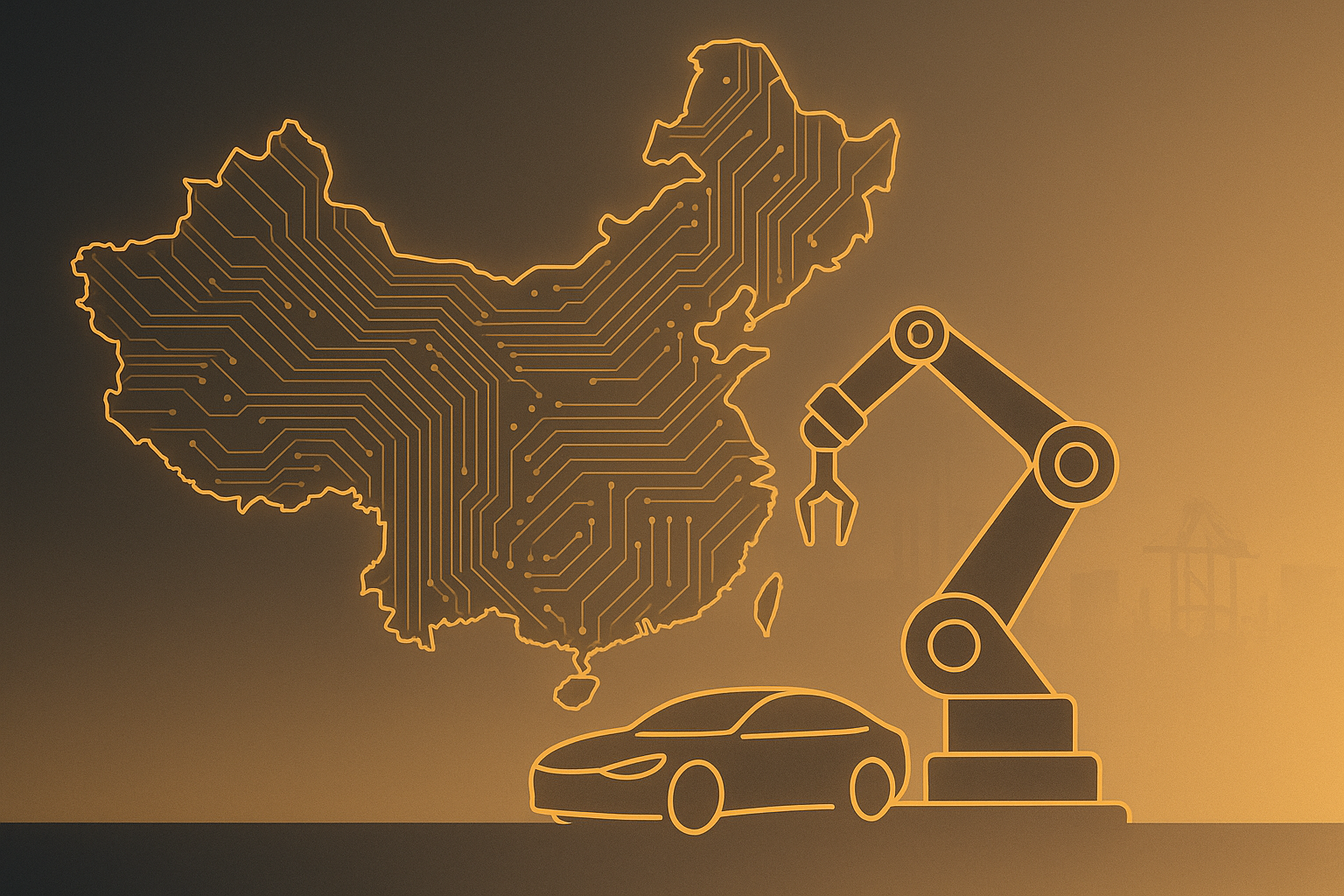
The Current Landscape: China’s Technological Acceleration
Nations rarely dominate emerging technologies because they invent first. They dominate because they scale faster, coordinate better, educate more deliberately, and build the industrial base needed to turn invention into production.
That is what China’s technological acceleration reveals.
The story is not only about China. China is the case study. The deeper subject is how nations build technological power.
Technological power is not one invention. It is an operating system made from factories, supply chains, engineers, capital, state strategy, private firms, export markets, education, energy, logistics, and long-term patience.
China’s position in robotics, electric vehicles, batteries, and AI education shows what happens when a country treats technology as a national capacity system rather than a collection of isolated companies.
Editorial Update: This System Update was revised in July 2026 to reflect current source checks and sharpen the article’s framing. The focus is now technological power as a system, with China serving as the primary case study.
System Updates Principle: Technological leadership depends less on invention alone and more on the institutions that convert invention into scale.
Scale Is the Advantage Most People Underestimate
Scale changes everything.
When a country produces at large volume, it learns faster. Costs fall. Suppliers mature. Workers gain experience. Engineers receive better feedback. Factories improve processes. Domestic firms compete harder. Export capacity expands.
Over time, scale becomes its own infrastructure.
Government Investment
↓
Industrial Capacity
↓
Mass Production
↓
Lower Costs
↓
Global Adoption
↓
Reinvestment
↓
Greater Industrial Capacity
This is the loop China is trying to dominate.
The country is not merely trying to win one technology market. It is trying to control the production environment that makes many technology markets cheaper, faster, and harder for competitors to enter.
Robotics Shows the Power of Industrial Depth
China is now the world’s largest industrial robotics market. International Federation of Robotics data show global industrial robot installations topped 500,000 units again in 2024, while CSIS analysis reported that China installed about 295,000 industrial robots that year, more than every other country combined.
That matters because robotics is not only a technology sector. It is a manufacturing multiplier.
More robots can mean more precision, higher output, lower unit costs, and faster factory learning. In addition, large domestic demand helps local robot makers improve through repeated deployment.
This creates a feedback loop. Factories buy robots. Robot makers improve. Costs fall. More factories automate. Then the entire manufacturing system becomes harder to compete against.
That does not mean China has solved every robotics problem. Humanoid robots remain difficult, expensive, and limited in many real-world settings. Recent reporting shows that hype has moved faster than practical deployment in some parts of the humanoid market.
Still, the broader industrial robotics pattern is clear. China is building the production base that gives automation a large domestic testing ground.
The EV and Battery Moat
Electric vehicles are not just cars. They are mobile battery platforms.
That distinction matters because batteries sit at the center of multiple strategic systems: transportation, robotics, drones, grid storage, logistics, shipping, defense, and automation.
China’s EV rise is therefore not only an auto story. It is an industrial power story.
CSIS estimated that Chinese government support for the EV sector totaled about $230.9 billion from 2009 through 2023. That support helped create demand, expand production, strengthen domestic firms, and accelerate learning across the value chain.
Meanwhile, many Western firms focused heavily on premium EV models. China placed greater emphasis on affordability, domestic adoption, charging ecosystems, and production scale.
That choice matters.
Affordable products create larger markets. Larger markets create larger data pools, supply chains, service networks, and production feedback. Over time, the lower-cost producer can shape global expectations.
The strategic moat is not just the vehicle. It is the battery, the supplier network, the mining relationships, the processing capacity, the charging infrastructure, and the manufacturing rhythm behind the vehicle.
Education Is Industrial Policy
The talent pipeline may be the most important part of the system.
China has moved toward a tiered AI education model across primary, junior high, and senior high school. Official Chinese state information channels have described plans to guide students from foundational AI concepts toward broader literacy and applied understanding.
That is not only education policy. It is industrial policy.
A country that teaches AI, coding, robotics, and computational thinking early is not simply preparing students for future jobs. It is preparing the workforce that future industries require.
AI Education
↓
Technical Literacy
↓
Engineering Talent
↓
Domestic Innovation
↓
Manufacturing Capacity
↓
Export Power
↓
National Leverage
This is where the United States should pay attention.
American AI education remains decentralized and uneven. Some schools offer advanced robotics and machine learning exposure. Others lack basic computer science capacity.
That unevenness creates a national capacity problem.
If technological competition depends on a broad base of technically literate citizens, then unequal AI education becomes an industrial weakness.
Industrial Policy Is Time Preference
Industrial policy is often discussed as subsidy or state intervention. That is too narrow.
At its core, industrial policy is time preference.
It asks whether a nation can make coordinated investments whose payoff may arrive five, ten, or twenty years later.
Quarterly markets reward speed. Election cycles reward visible wins. Industrial capacity rewards patience.
China’s advantage is not that every investment works. Many do not. Waste, overcapacity, debt, and duplication are real risks.
However, the strategic commitment is clear. The country is willing to use state policy, public procurement, education, infrastructure, and domestic market size to build capacity in sectors it considers critical.
That long horizon is difficult for more fragmented systems to match.
The Next Frontier Is Embodied AI
The next phase of competition is not only about software. It is about artificial intelligence that acts in the physical world.
This is often called embodied AI.
Embodied AI connects sensors, motors, chips, batteries, machine learning, manufacturing, and real-world operating environments. Robots, autonomous vehicles, drones, factory automation, and smart logistics all belong to this broader frontier.
That is why China’s combined position in batteries, robotics, EVs, sensors, and manufacturing matters.
The country is not building one advantage. It is stacking advantages that reinforce one another.
A battery advantage supports robotics. Robotics supports manufacturing. Manufacturing supports exports. Exports support capital accumulation. Capital supports further investment.
This is how industrial ecosystems compound.
Competing Models of National Development
The global competition is not simply authoritarian planning versus democratic innovation. That framing is too clean.
The real competition is between different models of national development.
China uses state coordination, industrial planning, public incentives, domestic demand, and manufacturing scale to accelerate priority sectors. The United States relies more heavily on private innovation, venture capital, universities, defense research, open markets, and decentralized experimentation.
Both models have strengths. Both have weaknesses.
China can move quickly at scale, but it can also overbuild, waste capital, suppress dissent, and prioritize control. The United States can generate breakthrough innovation, but it often struggles to coordinate supply chains, educate evenly, build infrastructure, and scale manufacturing domestically.
The risk for the United States is not that China invents everything first.
The risk is that China scales enough critical technologies cheaply enough to set global standards before others can respond.
Standards matter because they shape markets, data flows, norms, security expectations, and governance assumptions.
The U.S. Role: Compete Through Capacity
The United States does not need to copy China’s model. It should not.
However, it does need to learn the right lesson.
Technological leadership requires more than elite research labs and venture-backed companies. It requires national capacity.
That means stronger industrial strategy, deeper manufacturing investment, broader technical education, resilient supply chains, and faster public infrastructure delivery.
Three strategy levers matter most.
- Leapfrog in energy: invest in solid-state batteries, alternative chemistries, grid storage, and energy systems where current supply chains are not already locked.
- De-risk supply chains: diversify semiconductors, sensors, motors, critical minerals, and rare earth access through allied production networks.
- Build national AI and robotics literacy: establish clearer education standards, workforce training pathways, and safe deployment frameworks.
The goal is not panic. Panic produces bad strategy.
The goal is disciplined capacity building.
Individual Action Still Matters
Individuals cannot build national industrial strategy by themselves.
That does not mean individuals are powerless.
Citizens can demand better AI literacy in schools. Parents can ask whether students are learning practical technology skills. Workers can build durable technical capacity. Local leaders can support workforce training. Consumers can understand supply chains before buying technology. Voters can evaluate whether leaders understand industrial power or merely repeat slogans.
Civic literacy is now technology literacy.
A public that does not understand AI, batteries, robotics, semiconductors, supply chains, or industrial policy will struggle to evaluate national strategy.
That is the practical lesson.
Do not fear technology from a distance. Learn the system well enough to judge it.
The System: Updated
China’s technological acceleration is not only a geopolitical headline.
It is a systems lesson.
Nations build technological power by aligning education, manufacturing, supply chains, capital, infrastructure, and long-term industrial strategy.
Invention matters. However, invention without scale rarely defines the future.
The country that can produce, deploy, improve, and export technology at scale gains leverage that pure research cannot match.
The United States remains powerful. It still leads in many areas of research, software, universities, capital markets, and advanced innovation.
However, leadership is not guaranteed by legacy. It has to be rebuilt through capacity.
The system has updated. The race is no longer only about who invents the next technology. It is about who can turn technology into a national operating system.
Recognition Skill
After reading this System Update, you should now be able to recognize that technological leadership depends less on invention alone than on sustained industrial capacity, coordinated investment, workforce development, supply-chain control, and manufacturing scale.
When evaluating future technology competition, ask not only who built the breakthrough. Ask who can produce it, teach it, finance it, deploy it, maintain it, and export it at scale.
Further Groundwork
Receipts
- International Federation of Robotics: World Robotics 2025 industrial robot data
- CSIS ChinaPower: China’s industrial robotics market and installations
- CSIS: Chinese EV subsidies and industrial support
- State Council Information Office: China’s AI education curriculum expansion
- Stanford Center on China’s Economy and Institutions: EV battery firm learning and policy support
- Reuters: China’s humanoid robotics push and deployment challenges
Stay Grounded
Get the weekly Groundwork Daily digest for systems thinking, civic clarity, and practical structure.
Meet the Builder

Langston Reed
Builder, Civic Power & Policy
Langston Reed helps readers understand how institutions, governance, and public policy shape everyday life. His work develops institutional literacy by translating complex civic systems into practical frameworks that remain useful long after the news cycle has moved on.
“Institutions reveal themselves not through what they promise, but through the incentives they create and the outcomes they consistently produce.”
Continue Learning
System Updates is Groundwork Daily’s civic analysis series led by Langston Reed. It studies how policies, institutions, and infrastructure shape everyday life, translating complex systems into practical insight for accountable progress.