

Real Talk Blueprint · Digital Life & Attention
Real Talk Blueprint examines what happens when ordinary public behavior meets cameras, audiences, distribution, and consequences that can travel far beyond the original moment.
Public behavior can become digital evidence faster than people can explain it. Visibility creates consequences, but it does not give the crowd unlimited permission to punish.
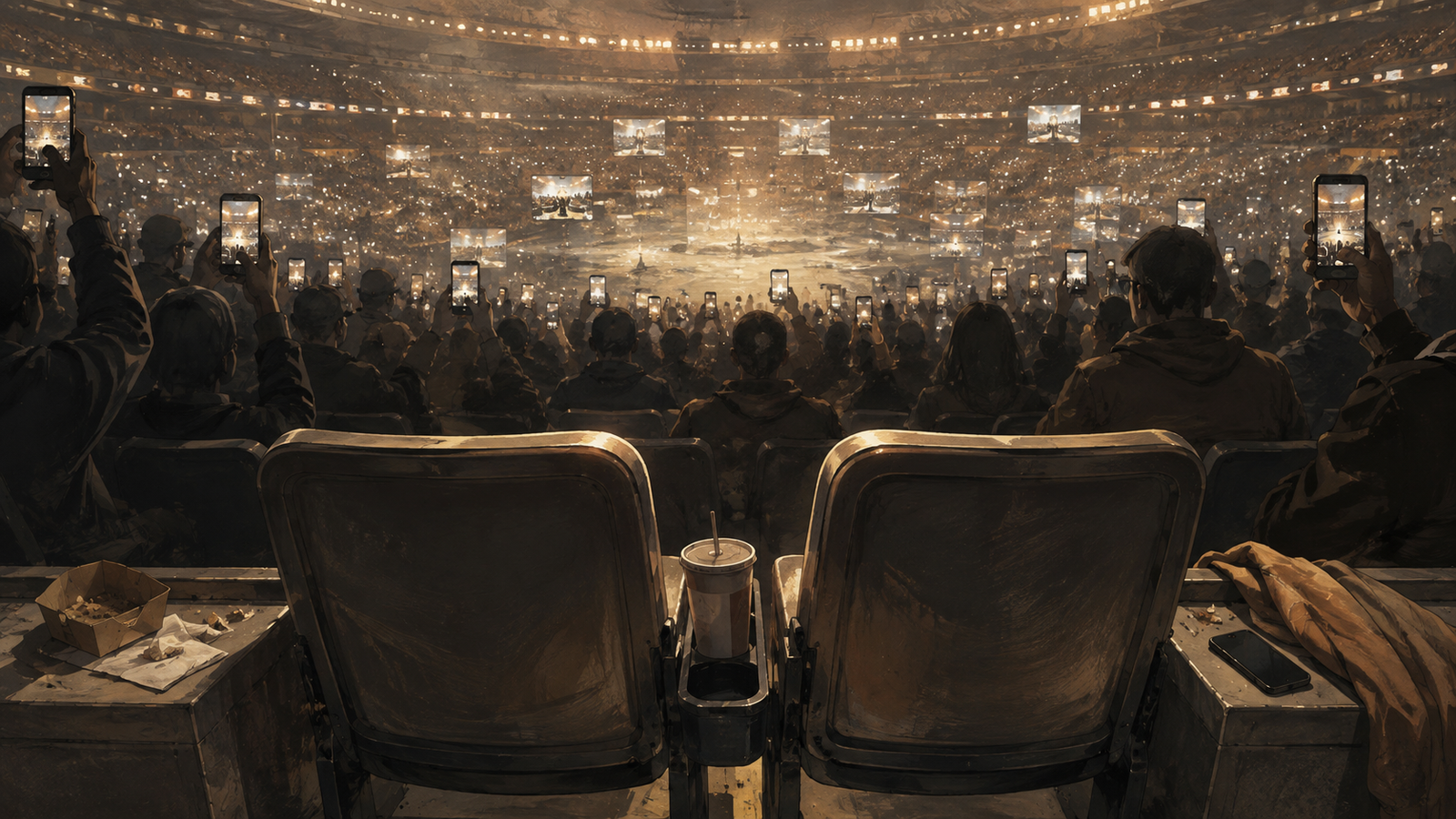
Internet consequences start with a reality people keep learning the hard way: a public moment can outlive the moment itself. Do something reckless in a stadium packed with thousands of people holding phones, and you’re not operating with much control over who sees it, records it, sends it, reposts it, or decides what it means.
That doesn’t mean every public interaction is a press conference. It means the old assumption, that a moment disappears once the people involved walk away, isn’t reliable anymore. Somebody’s uncle is recording the field. Somebody’s cousin is filming the crowd. Somebody two rows back is pretending to answer a text while absolutely catching whatever just happened in front of them.
Then the clip moves. One recording becomes three angles, three angles become a reaction video, and by the time the people involved understand what happened, strangers may already know the section number, a backstory somebody guessed at, and several facts that were never facts in the first place.
That’s the part people underestimate about internet consequences. The original behavior happens once. Distribution keeps happening.
The internet didn’t invent the action. It just took attendance.
What Are Internet Consequences?
Internet consequences are the real-world effects that can follow when behavior, statements, images, or interactions are recorded, distributed, interpreted, and preserved online. The important part isn’t just that somebody saw what happened. It’s that other people can now carry the moment somewhere you never intended it to go.
That changes the scale of ordinary mistakes. A bad decision at a party used to belong mostly to the people in the room. An argument at dinner stayed with the tables nearby. An embarrassing stadium moment might have become a story somebody told on Monday morning.
Now the witness can become a distributor. The person standing nearby doesn’t need a television crew, a newsroom, or a publishing contract. They need a phone, a connection, and enough curiosity to hit upload.
Once that happens, context gets harder to control. The person who recorded the moment chooses the beginning and the end. Another person writes the caption. Someone else adds commentary. A third person reposts it with a different interpretation entirely. Before long, the audience may know the clip better than it knows the event.
That’s the structural difference. Internet consequences aren’t only about visibility. They’re about losing control over distribution and interpretation.
Public Does Not Mean Consequence-Free
People sometimes behave in public as though anonymity comes standard with the ticket price. It doesn’t.
A crowded stadium isn’t a private room with forty thousand extras who agreed not to look at you. A restaurant isn’t a sealed conference. A sidewalk isn’t your living room. When you enter a shared public environment, other people can observe what happens around them, and plenty of them are carrying devices capable of preserving what they see.
That should affect behavior. If an action would create a serious problem should your spouse, employer, client, parent, neighbor, congregation, or group chat see it, the solution isn’t developing supernatural faith in everybody else’s discretion.
The stronger solution is behavioral. Move like visibility is possible. That’s not paranoia. It’s situational awareness.
A public action can create a private consequence.
A recording can create an audience you never chose.
A caption can create a story you never told.
Foresight matters before the upload, not after it.
But Public Visibility Is Not Unlimited Permission
There’s a sloppy version of this argument that says, “Well, they were in public, so anything that happens afterward is fair.” That logic confuses visibility with permission.
Yes, people should understand that public conduct may be observed or recorded. At the same time, being visible doesn’t make every form of harassment, distortion, doxxing, mockery, stalking, or indefinite punishment legitimate. Those are different questions.
The first question is whether the person acted carelessly, dishonestly, recklessly, or without enough awareness of the environment. The second question is what the audience does with that behavior once it’s been captured. Both can require accountability, but they’re not the same accountability.
A person can make a foolish public decision, and the crowd can also turn that foolish decision into a punishment campaign far larger than the original conduct warrants. One fact doesn’t cancel the other.
This distinction matters because Real Talk Blueprint isn’t interested in replacing accountability with pity. If somebody betrayed trust, lied, cheated, acted abusively, or behaved recklessly, a camera didn’t create the underlying behavior. But the existence of evidence doesn’t automatically justify every reaction that follows.
Internet Consequences Change When the Audience Takes Over
A public mistake starts becoming a digital event when spectators stop being witnesses and become participants. They repost. They comment. They identify. They speculate. They search. They connect old information to new information, and then other people evaluate whether joining the reaction feels socially acceptable.
A 2025 study published in the Journal of Medical Internet Research examined how people responded to online public-shaming content. Researchers found that when participants viewed a social-media post as more socially acceptable, they were more likely to report intentions to like, share, and comment on it.
That doesn’t prove everybody joins a pile-on for the same reason, but it does show why audience behavior matters. Once participation feels normal, participation gets easier. The crowd gives the crowd permission.
One person posts the video. Another makes a joke. A third adds a screenshot. Soon, people who had no relationship to the original event are contributing because the event has become a public object. The behavior isn’t only being judged anymore. It’s producing content.
Attention Can Outgrow the Original Conduct
This is where proportion starts disappearing. The original action might deserve criticism, yet the reaction keeps expanding because each new response creates another opportunity for attention. A person who made one bad decision can become the subject of hundreds of independent posts, jokes, theories, and moral judgments.
By that point, people may no longer be reacting to the event. They’re reacting to the reaction. That’s how a moment becomes a spectacle.
The Internet Does Not Need Your Explanation First
One of the hardest parts of internet consequences is sequencing. Your explanation is usually slower than the clip.
You may need time to understand what happened, talk to the people involved, verify facts, call your family, speak to an employer, or decide whether responding publicly is even wise. Meanwhile, the content is already moving. The internet doesn’t wait for discovery. It starts the trial during opening statements.
That’s why “there’s more context” often shows up after the audience has already formed an opinion. Context can matter deeply, but the digital system doesn’t guarantee it travels at the same speed or scale as the original recording. A twenty-second clip is easy to share. A six-paragraph explanation is work. Guess which one travels faster.
That asymmetry should change how people think about public conduct. If your defense depends entirely on strangers eventually hearing the full story, you’ve built a fragile strategy. Better behavior is cheaper than emergency context.
Purposeful Embarrassment Is Already Part of Online Life
The consequences don’t stop at reputation. Online exposure can also slide into harassment.
Pew Research Center’s 2020 survey of U.S. adults found that 41% had personally experienced at least one form of online harassment. Within Pew’s framework, 26% said someone had tried to purposefully embarrass them online, while other respondents reported more severe experiences including threats, stalking, sexual harassment, and sustained harassment.
That evidence doesn’t mean every viral clip becomes harassment. It does establish that purposeful embarrassment is already a recognizable part of digital behavior, and that should matter when we decide what accountability requires.
If the relevant facts are established, the harmed parties have been informed, and the necessary consequence is clear, what exactly is the 30,000th joke accomplishing? Sometimes the answer is nothing. Sometimes the audience is simply enjoying the fact that somebody else is having the worst week of their life.
That’s not a reason to excuse the original behavior. It’s a reason to examine ours.
Groundwork Principle
Accountability Is a Form of Strength
Accountability means owning behavior even when the explanation is uncomfortable. If a public recording exposes something real, blaming the camera doesn’t erase what the camera captured.
At the same time, accountability requires proportion. Consequences should have a relationship to the conduct, and correction should have an objective beyond keeping a person trapped inside one moment forever.
Strength means holding both standards at once. The person who acted has responsibility for the action. The audience still has responsibility for what it does next.
What it means here: Visibility can expose behavior, but accountability should still know the difference between consequence and spectacle.
Better Public Behavior Starts Before the Camera Finds You
You can’t control every camera, every stranger, every caption, or every person willing to repost something with confidence they didn’t earn. You can control more than people like to admit, though, and it starts with the first decision.
Assume Public Means Observable
This doesn’t require acting terrified every time you leave home. It means accepting that crowded public environments contain witnesses, cameras, and people who may preserve what they see.
If you need absolute discretion for the behavior to survive, a stadium is a poor operational environment. So is a restaurant. So is a convention. So is the office holiday party somebody decided needed an Instagram story.
Ask What the Behavior Would Look Like Without Your Explanation
This is a useful test, because strangers usually encounter evidence before context. If the image, recording, message, or behavior would look damaging on its own, that doesn’t automatically mean it’s wrong. It does mean you should understand the communication risk before acting.
Foresight asks a better question than “will anyone see me?” It asks, “what happens if they do?”
Do Not Build Your Strategy Around Nobody Recording
That isn’t a strategy anymore. People carry cameras because cameras are built into the devices they already use for everything else. Recording can happen casually, accidentally, deliberately, or because someone thought a different part of the event mattered until something else entered the frame.
You don’t need to be famous to become visible. You just need to be interesting for twelve seconds.
When You Get It Wrong, Deal With the Behavior First
If the recording is accurate, start there. Don’t spend the first three days attacking the person who recorded you when the real issue is what the recording shows. Don’t turn “I shouldn’t have been filmed” into a substitute for “I shouldn’t have done that.” Those are separate conversations, and ownership comes first.
Once that’s handled, you can address distortion, harassment, privacy concerns, false claims, or disproportionate punishment where those things actually exist.
Internet Consequences Are Really About Control
The deepest lesson here isn’t that everybody should live afraid of the internet. It’s that digital life changed who controls the lifespan of public behavior.
Before widespread networked cameras, the person who made a mistake could often count on time, distance, and limited witnesses to shrink the moment. Today, another person can preserve it before you’ve even processed it. That doesn’t mean every mistake becomes permanent. It means permanence is no longer entirely your decision.
This is why internet consequences require more than media literacy. They require behavioral literacy.
Know where you are. Know what you’re doing. Know what the behavior would communicate without the explanation in your head. And know that if your plan depends on forty thousand people minding their business, you don’t actually have a plan.
The Real Talk
The internet didn’t make you do it. The camera didn’t create the decision. And the stranger who uploaded the clip isn’t responsible for every choice that happened before the phone came out.
That’s your accountability.
But visibility doesn’t make a person community property either. A public mistake isn’t an unlimited license for strangers to harass, threaten, expose families, invent facts, contact employers for sport, or turn punishment into a hobby.
That’s ours.
The internet can reveal behavior and distort proportion at the same time. Mature people should be able to understand both.
Move like cameras exist. Judge like context matters. And remember that consequences should still have a purpose after the clip starts moving.
Continue Building
Keep Going From Here
Accountability Is a Form of Strength
Go deeper on why ownership, consequence, correction, and changed behavior matter more than excuses or performance.
Keep examining what behavior reveals when explanations, public performance, accountability, and evidence stop matching.
Follow the wider Groundwork conversation about digital behavior, cultural incentives, public conduct, media, and modern social performance.
Receipts
Evidence Behind the Framework
- Pew Research Center: The State of Online Harassment . National survey research examining online harassment in the United States, including offensive name-calling, purposeful embarrassment, threats, stalking, sustained harassment, and sexual harassment.
- Pew Research Center: Personal Experiences With Online Harassment . Pew reported that 41% of U.S. adults surveyed had experienced at least one measured form of online harassment, including 26% who reported attempts to purposefully embarrass them online.
- Journal of Medical Internet Research: Audience Responses to Online Public Shaming in Online Environments . A 2025 mixed-methods study examining how perceived social acceptability and emotional responses relate to intentions to like, share, and comment on online public-shaming content.
Evidence Note: These sources support the narrower propositions that purposeful embarrassment and other forms of online harassment are documented digital behaviors, and that perceptions of social acceptability can influence engagement with public-shaming content. They do not prove that every recorded public moment becomes harassment, determine the motives of every person who shares a clip, or establish that all public recording is unethical.
Real Talk Blueprint
See the pattern before it becomes the habit.
Groundwork Daily examines relationships, culture, accountability, communication, and the behavior underneath the performance.


About the Builder
Rochelle “Ro” Hayes
Rochelle “Ro” Hayes is the Groundwork Daily builder behind Real Talk Blueprint, a series focused on culture, relationships, accountability, communication, and the behavior people often explain away before they examine it.
Ro works primarily inside Culture, Media & Leadership, with strong overlap into relationship systems, public behavior, gender expectations, attention incentives, and modern social performance.
Real talk creates structure where avoidance creates confusion.
Ro builds frameworks that make ordinary behavior harder to ignore. The work is direct, observational, and culturally grounded, naming the pattern, identifying the incentive, and asking what people are really protecting instead of performing outrage.
Real Talk Blueprint examines the gap between what people say they value and what their behavior actually reinforces.
Meet Rochelle “Ro” Hayes · Explore Real Talk Blueprint · Explore Culture, Media & Leadership