
Jobs AI can’t replace is an irresistible search phrase because it promises something the labor market cannot honestly give you: certainty.
No occupation comes with an immunity certificate. Technology changes tasks, tools, workflows, staffing, productivity, and eventually the economics surrounding entire careers. Skilled trades are not standing outside that transformation.
Still, some work has a structural advantage.
Artificial intelligence is remarkably good at moving through information. It can summarize, classify, generate, compare, recognize patterns, retrieve knowledge, produce drafts, assist with diagnostics, and automate parts of work that once required a person sitting in front of a screen.
However, the physical world is less cooperative.
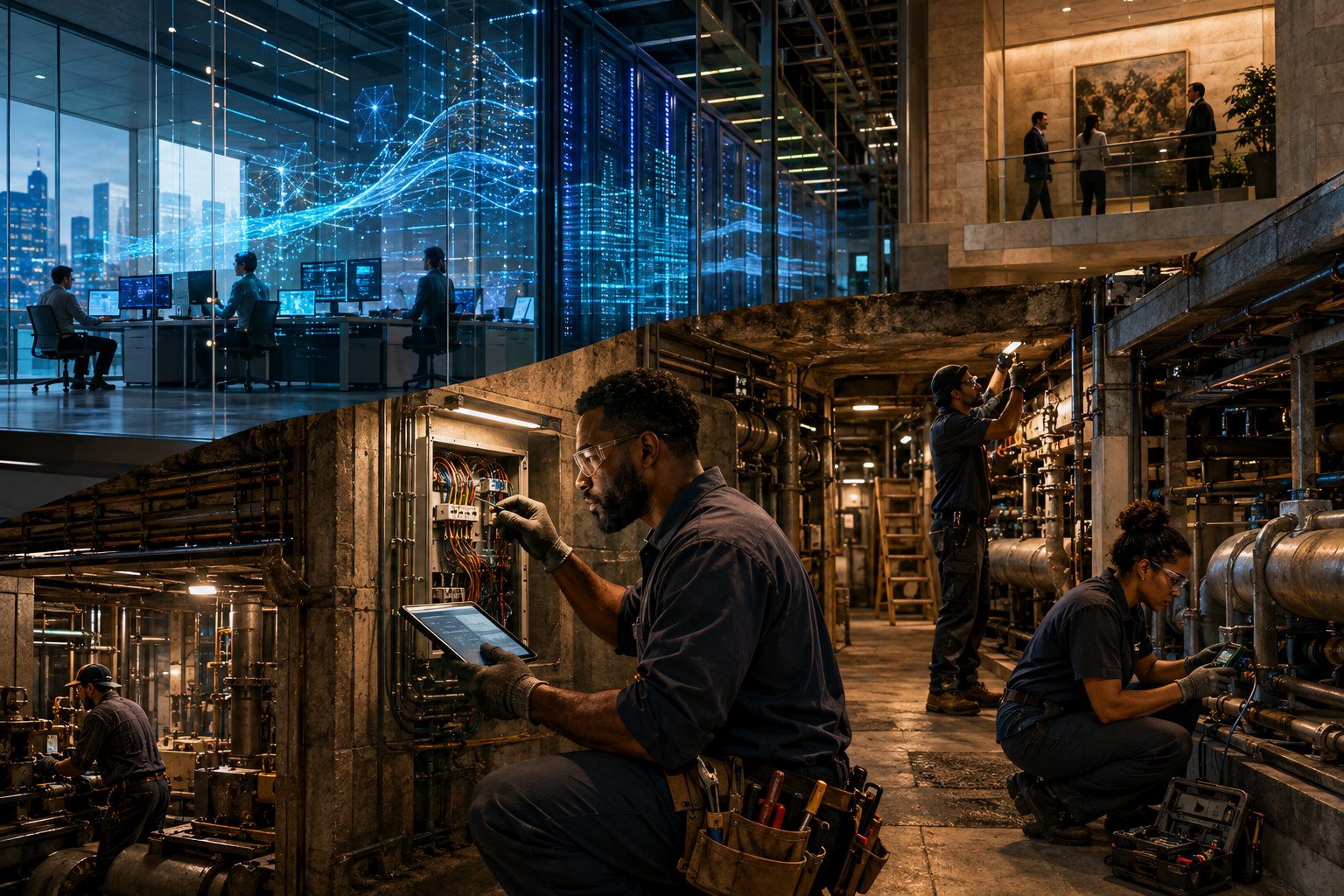
A breaker panel is where the building put it. A pipe leaks where the pipe fails. A compressor behaves according to its actual condition, not the clean diagram in the manual. Existing buildings contain decades of modifications. Equipment gets installed incorrectly. Parts corrode. Access is awkward. Codes matter. Safety matters. Customers matter.
Eventually, somebody still has to enter the environment, determine what is actually happening, manipulate physical objects, accept responsibility for the result, and leave the system working.
That distinction may become one of the more important cultural repricings of the AI era.
AI can move information at extraordinary speed. The physical world still has to be diagnosed, entered, handled, repaired, and made to work.
What if some of the jobs AI can’t replace easily are the same forms of work culture spent decades teaching people to overlook?
That is the Culture Ledger question.
Jobs AI Can’t Replace Is the Wrong Binary Question
Search culture likes binaries.
Will AI replace accountants? Will it replace programmers? What about electricians? Which occupations are safe? Which degrees are dead? Which career wins?
Reality is less theatrical.
Occupations are bundles of tasks. Technology can automate some tasks, accelerate others, create new ones, change staffing ratios, and alter what employers are willing to pay for without eliminating the occupation itself.
Therefore, asking only for jobs AI can’t replace can hide the more useful analysis. A worker needs to know which parts of an occupation are exposed, which parts are amplified, and which parts remain stubbornly difficult to remove from a human operator.
AI Usually Reaches Tasks Before It Reaches Entire Occupations
The distinction matters because exposure is not the same as elimination.
For example, a professional may use AI to draft a report while still owning the judgment behind the recommendation. A technician may use automated diagnostics while still determining whether the suggested fault matches the equipment in front of them. Likewise, a manager may automate scheduling without automating leadership.
In practice, technology often rearranges the work before it removes the worker.
That gives us a better question:
Which parts of my work can technology perform, and which parts remain difficult to separate from human judgment, responsibility, relationships, or physical presence?
Once the question is framed that way, skilled trades become much more interesting.
Groundwork Definition
Physical-World Friction: the resistance to automation created when useful work requires a system to perceive, enter, navigate, manipulate, diagnose, repair, verify, and accept responsibility inside an irregular physical environment.
Physical-World Friction is not permanent protection.
Instead, it is a structural obstacle. Some occupations contain considerably more of it than others.
Why Many Jobs AI Can’t Replace Easily Live in the Physical World
Consider the difference between producing instructions and completing the job.
An AI system may help identify likely causes of an HVAC fault. That is useful. Yet the technician still has to determine whether those causes fit the actual equipment in front of them.
The unit may be old. Its installation may be nonstandard. Documentation may be incomplete. A previous repair may have created a new problem. In addition, the component could be difficult to access, a sensor could be producing misleading information, or the building could have operating constraints that never appear in a general troubleshooting model.
Information Still Has to Become Action
After diagnosis comes execution.
Someone must isolate the system safely, reach the component, handle the tool, replace or repair the part, reassemble the equipment, test the outcome, verify correct operation, and finally take responsibility when the customer asks whether the system is safe to use.
Consequently, the whole chain is harder to compress into software.
The same logic appears across electrical work, plumbing, industrial maintenance, line work, mechanical repair, fabrication, installation, building systems, and other skilled physical occupations.
The advantage is not simply that these workers use their hands.
The advantage is that intelligence has to survive contact with reality.
Why Real Environments Create Automation Friction
Digital environments can often be standardized. Physical environments resist that convenience.
A house built in 1955 and renovated three times does not behave like a clean simulation. Neither does an industrial plant with custom machinery, a utility system damaged by weather, or a commercial building whose mechanical room has accumulated decades of repairs.
Because physical conditions vary, workers must constantly update the model in their head.
First they observe. Then they test. Next they isolate causes. Afterward they decide what can safely be changed. Finally, they verify whether the repair actually solved the problem.
That sequence helps explain why many jobs AI can’t replace easily contain diagnostic work rather than repetitive physical work alone.
The hard part is often not knowing what should happen. It is figuring out what is actually happening in a physical environment that refuses to behave like the model.
The AI Resistance Test for Jobs AI Can’t Replace Easily
A list of supposedly AI-proof careers expires quickly.
A framework travels farther.
Therefore, instead of asking whether an occupation appears on somebody’s list of jobs AI can’t replace, evaluate the structure underneath the work.
The Groundwork AI Resistance Test
1. Physical Presence
Does the useful outcome require a person or machine to physically reach the place where the problem exists?
2. Environmental Variability
Does the work happen in homes, buildings, machines, job sites, infrastructure, or other environments that differ substantially from one case to the next?
3. Dexterity
Does success depend on manipulating physical objects, tools, materials, wiring, fasteners, components, controls, surfaces, or equipment in uncontrolled conditions?
4. Diagnostic Judgment
Must the worker interpret incomplete, conflicting, noisy, or misleading evidence before deciding what action is appropriate?
5. Consequence
Can a bad decision create meaningful safety, property, legal, financial, or operational harm?
6. Human Trust
Does a customer, employer, inspector, team, or public institution need a responsible person who can explain the decision and stand behind the result?
7. Credential Friction
Do licensing, codes, certifications, apprenticeship requirements, safety rules, inspections, or regulated standards create additional barriers to simple substitution?
No Single Factor Creates an AI-Proof Job
Physical presence by itself is not enough.
For instance, a highly repetitive task requiring little judgment may eventually become easier to automate with robotics. By contrast, a task requiring substantial judgment but occurring entirely inside a standardized digital environment may become more exposed to software automation.
The structural advantage appears when several factors stack together.
Physical presence plus environmental variability creates one layer. Dexterity adds another. Diagnostic judgment increases complexity. High consequences raise reliability requirements. Human trust creates accountability. Finally, credential friction can slow substitution even further.
As a result, replacing the whole worker becomes a much larger engineering and institutional problem.
The Robot Problem Is Harder Than the Chatbot Problem
Popular AI conversation is remarkably screen-centered.
Generative AI improved rapidly because enormous amounts of human knowledge and work already existed in digital form. Text, code, images, documents, databases, and structured information gave machine-learning systems an environment they could enter directly.
Robotics faces a different operating environment.
Software Can Scale Without Entering the Building
A digital system can be updated centrally and distributed across millions of users.
A physical system needs perception, mobility, manipulation, force control, spatial judgment, durability, safety, power, maintenance, and enough reliability for people to trust it around homes, businesses, employees, customers, vehicles, infrastructure, and expensive equipment.
Moreover, every new physical environment introduces additional variation.
Robotics will keep improving. Nevertheless, deployment across millions of irregular real-world environments does not have to move at the same speed as software deployment.
A chatbot can be updated centrally.
A physical machine has to survive Tuesday in somebody’s basement.
That is a different innovation problem.
Jobs AI Can’t Replace Easily: Skilled Trades With Structural Advantages
The occupations below are not guaranteed winners.
Instead, they show how the AI Resistance Test applies to real work.
Electricians: A Strong Example of Jobs AI Can’t Replace Easily
Electrical work combines technical knowledge, physical access, codes, safety, diagnostics, installation, repair, and significant consequences when something goes wrong.
AI can improve design, load calculations, documentation, troubleshooting, estimating, scheduling, code retrieval, and diagnostics.
However, it cannot presently make the existing building conform to the drawing.
The U.S. Bureau of Labor Statistics projects electrician employment to grow 9 percent from 2024 through 2034, with about 81,000 openings per year on average over the decade.
More importantly, the work illustrates the layered resistance model: the electrician must interpret information and then successfully modify a real physical system.
HVAC Technicians: Diagnosis Meets Physical Execution
Heating, ventilation, air-conditioning, and refrigeration work lives at the intersection of electrical systems, mechanical systems, controls, airflow, refrigerants, diagnostics, customer environments, and installation conditions.
AI-assisted diagnostics may become a substantial advantage to technicians. Even so, diagnostic information still has to be converted into physical repair.
BLS projects HVACR employment to grow 8 percent between 2024 and 2034, with roughly 40,100 openings per year on average.
In other words, this is not a case of technology versus technician. The more plausible near-term model is technology increasing the capability of the technician who knows how to use it.
Plumbers and Pipefitters: Every Building Has Its Own History
Water, drainage, gas, steam, process piping, fixtures, valves, building conditions, codes, routing constraints, and existing construction create significant physical variability.
A plumbing problem can begin with a symptom in one room and originate somewhere else entirely.
Therefore, the difficult part is often discovering what the building is actually telling you before deciding what to open, replace, reroute, or repair.
This combination of diagnosis, access, physical manipulation, and consequence puts plumbing among the kinds of jobs AI can’t replace easily even though AI can improve many parts of the workflow.
Industrial Maintenance: Automation Creates More Machinery to Maintain
Factories and industrial systems are becoming more automated, which initially sounds like a threat to maintenance work.
Then the second-order effect appears.
Automated equipment also has to be maintained.
Industrial machinery mechanics increasingly work around sensors, controls, robotics, computerized equipment, preventive maintenance, and complex production systems.
Consequently, automation can change the skill stack while simultaneously increasing the value of workers who can keep automated systems operating.
Power-Line Installers and Repairers: High Consequence, High Friction
Grid work adds additional difficulty through outdoor conditions, heights, safety, heavy infrastructure, storms, public consequence, coordination, and the physical reality of electricity distribution.
BLS projects employment of electrical power-line installers and repairers to grow 7 percent from 2024 to 2034, with about 10,700 openings per year on average.
Still, automation resistance is only one part of the career ledger. Line work can involve serious physical danger and difficult operating conditions.
Therefore, a job being difficult to automate does not automatically make it a good career for every person.
Jobs AI Can’t Replace Will Still Be Changed by AI
This is where the “AI-proof trades” narrative usually collapses.
The trades are not protected from technology. In fact, skilled trades already use technology constantly.
Digital diagnostics exist. Building information modeling exists. Computerized maintenance systems exist. Remote monitoring exists. Smart building controls exist. Machine vision exists. Predictive maintenance exists. Automated estimating and scheduling exist.
AI will likely make many of those systems more capable.
Automation Can Remove Friction Without Removing the Worker
As tools improve, workers may spend fewer hours searching documentation, preparing estimates, identifying probable failures, ordering components, writing reports, documenting jobs, scheduling work, or performing standardized diagnostic tasks.
However, reducing administrative friction is not the same thing as removing the worker who understands the physical system.
Instead, the technology may change what a good technician can accomplish in a day.
Watch This
Hard to replace does not mean unchanged. Skilled workers who reject new tools may surrender advantage to skilled workers who combine field competence with AI-assisted diagnostics, documentation, planning, estimating, and information retrieval.
Domain Competence Plus AI Is the Stronger Position
The more durable career position may therefore be neither technical traditionalism nor technological enthusiasm.
It may be domain competence plus technological leverage.
A worker who understands the system, recognizes when the model is wrong, knows the physical constraints, and uses better information tools can become harder to substitute because that worker operates both sides of the interface.
For that reason, the strongest jobs AI can’t replace may still reward people who learn how to use AI better than their competitors.
AI May Raise the Value of Verification
As machines generate more recommendations, designs, instructions, estimates, diagnostics, and documentation, verification may become more valuable rather than less.
Someone still has to determine whether the output applies to the actual condition.
That person needs domain knowledge.
An Answer Is Not the Same Thing as a Verified Decision
Consider the difference between receiving an answer and knowing whether the answer deserves to be acted upon.
In a low-consequence setting, occasional error may be tolerable.
By contrast, electrical systems, gas systems, industrial equipment, structural environments, refrigeration, power infrastructure, and other physical systems can punish confident mistakes.
As a result, workers who can inspect reality rather than merely process information about reality may become more valuable.
This is an important distinction when evaluating jobs AI can’t replace: the most defensible roles often involve not only producing an answer, but verifying that the answer works safely in the world.
Jobs AI Can’t Replace Still Need Real Labor-Market Demand
Automation resistance by itself is not enough.
A durable career also needs customers, employers, infrastructure, replacement demand, or some other reason for the economy to keep paying for the skill.
Current projections do not support the idea that skilled installation, repair, and maintenance work is fading from the economy.
BLS projects about 608,100 openings per year across installation, maintenance, and repair occupations from 2024 through 2034.
Replacement Demand Matters as Much as Growth Rates
Those openings do not come from one giant boom across every occupation.
Instead, labor demand reflects a combination of employment growth and the need to replace workers who leave occupations or exit the labor force.
This distinction matters because a career does not require explosive percentage growth to create substantial hiring demand.
Large existing occupations can generate significant opportunities simply because people retire, move, or transition elsewhere.
Apprenticeship Growth Shows the Training Pipeline Is Active
Training infrastructure is responding as well.
Apprenticeship.gov reports that construction Registered Apprenticeship programs served 480,399 apprentices in 2025, a 28 percent increase over five years.
Again, those figures do not prove a universal trade shortage.
They do show that the physical economy continues recruiting and training people at significant scale.
AI Infrastructure Creates a Physical-Work Paradox
There is a particularly useful irony underneath the AI boom.
Artificial intelligence feels weightless because most people encounter it through a screen.
Its infrastructure is anything but weightless.
The Cloud Still Has a Physical Address
Computing requires data centers. Data centers require power. Power requires generation and transmission. Facilities require cooling. Cooling requires mechanical equipment.
Meanwhile, electrical distribution requires installation and maintenance. Buildings require construction. Equipment requires technicians. Grid expansion requires physical labor and engineering.
Therefore, the more sophisticated the digital layer becomes, the more important some physical systems underneath it can become.
That creates the paradox:
The screen economy still sits on concrete, copper, steel, cooling systems, substations, transmission infrastructure, equipment, and people who know how to work on them.
Some of the jobs AI can’t replace easily may therefore benefit indirectly from the infrastructure required to make AI itself possible.
Jobs AI Can’t Replace Are Forcing a Cultural Repricing of Work
This article belongs in Culture Ledger because the larger story is not simply occupational demand.
It is cultural valuation.
For years, American culture often treated work closer to information as more sophisticated than work closer to matter.
The office signaled advancement. The laptop signaled modernity. A degree signaled intelligence. Meanwhile, the physical job site could be framed as something ambitious people were expected to escape.
That hierarchy was always too simple.
Now AI is stress-testing it.
Technology Is Exposing the Difference Between Status and Scarcity
Some highly credentialed knowledge workers are watching machines perform pieces of work that once helped justify the exclusivity of their role.
At the same time, work requiring entry into a physical environment remains constrained by material reality.
The lesson should not be that blue-collar workers were secretly smarter than office workers.
That would simply reverse one bad hierarchy and call it insight.
The better conclusion is that intelligence comes in different forms, and culture does not always price those forms the same way the economy eventually does.
Culture Ledger
Cultural Repricing: the process by which new economic, technological, social, or institutional conditions force public perception back toward underlying value after status and fundamentals have drifted apart.
AI may become one repricing catalyst.
Not because every skilled trade wins, but because automation forces people to inspect the capability underneath the occupational label.
The Prestige Premium on Screen Work Is Getting Harder to Defend
Culture can attach status to the setting where work occurs rather than the difficulty of the work itself.
For example, a person solving a complicated problem in an office is assumed to be using intelligence. A person solving a complicated problem inside a mechanical room may simply be described as “working with their hands.”
That language quietly separates cognition from physical competence.
Skilled Physical Work Is Still Cognitive Work
A capable technician does not leave their brain in the truck.
Diagnosis is reasoning. Troubleshooting is reasoning. Sequencing is reasoning. Interpreting codes is reasoning. Reading a system is reasoning. Recognizing an abnormal pattern is reasoning. Deciding when not to act is reasoning.
The material environment simply forces the reasoning to prove itself.
As AI changes white-collar workflows, that distinction becomes harder to ignore.
Consequently, the search for jobs AI can’t replace may end up changing not only career choices, but the cultural status assigned to different forms of competence.
Do Not Replace One Career Myth With Another
Every repricing cycle produces opportunists.
One decade says everyone needs a four-year degree. Another says everyone should become an electrician.
Both claims are lazy.
Automation Resistance Does Not Erase Physical Costs
Skilled trades can involve serious downsides.
Physical wear matters. Injury risk matters. Weather matters. Schedules matter. Geography matters. Licensing matters. Training time matters.
Moreover, some workers will earn strong incomes while others will not. Certain workers may move into supervision or ownership; others may spend decades trading time and physical capacity for wages.
Some trades are cyclical. Some tasks will automate. Meanwhile, technological changes may reduce headcount in particular areas even while they increase productivity.
The goal is not to find a career with no downside.
The goal is to price the downside correctly.
How to Evaluate Jobs AI Can’t Replace Before Choosing One
Automation risk is only one dimension of career quality.
Therefore, anyone choosing between supposedly future-proof careers needs several ledgers operating at once.
The Groundwork Career Durability Test
AI Exposure
Which tasks can software or robotics plausibly automate, accelerate, or commoditize?
Demand
Is the occupation needed in the markets and regions where you can realistically work?
Economics
What are the actual wages, benefits, overtime patterns, training costs, and advancement paths?
Physical Burden
What does the work ask your body to carry over ten, twenty, or thirty years?
Skill Transfer
Can your expertise travel across employers, industries, geographic markets, or adjacent technical roles?
Credential Portability
Are licenses and certifications portable, respected, or geographically constrained?
Technology Leverage
Can better tools make you more productive rather than simply making your skill less necessary?
Ownership Potential
Can experience eventually support contracting, specialized services, equipment ownership, supervision, training, or a business that produces value beyond your own labor hours?
Ownership Can Change the Ceiling
A skill can produce wages.
However, a skill combined with systems, reputation, customer relationships, people, equipment, and capital may eventually produce an enterprise.
Ownership is not guaranteed. Running a company introduces an entirely new risk stack involving taxes, insurance, hiring, customers, cash flow, operations, and liability.
Even so, ownership changes what the capability can become.
That matters when comparing jobs AI can’t replace because an occupation with durable demand and a credible ownership pathway may offer a different long-term equation from a role that remains permanently dependent on one employer and one wage.
The Best Skilled Worker May Be an AI-Augmented One
The cultural conversation often stages technology and labor as enemies.
That framing leaves money on the table.
Imagine an experienced tradesperson who uses AI to retrieve technical documentation faster, prepare clearer customer explanations, build estimates, document inspections, identify possible diagnostic pathways, organize maintenance histories, train apprentices, plan inventory, create standard operating procedures, and handle administrative work more efficiently.
Technology Can Multiply Expertise Instead of Replacing It
In that scenario, AI has not erased the expertise.
Instead, it has removed friction around the expertise.
The combination can create a stronger worker and, potentially, a stronger business.
The same dynamic has happened with many technologies before. Often, the tool changes who has leverage inside an occupation before it eliminates the occupation.
Therefore, the worker who refuses the tool may end up competing against the worker who learned how to govern it.
What Young Workers Should Actually Take From Jobs AI Can’t Replace
Do not chase a trade because somebody on social media told you college is dead.
Likewise, do not chase college because somebody told you physical work means you failed.
And do not chase AI because everybody suddenly calls himself an AI strategist.
Inspect the Fundamentals Before the Status Signal
Inspect the work.
Then inspect your abilities, the economics, the training path, the physical demands, the market, and the way technology is changing the actual tasks.
After that, decide what kind of capability you want to own.
A durable career is rarely built from one cultural slogan.
The search for jobs AI can’t replace should therefore lead to better judgment, not another prestige stamp.
Frequently Asked Questions About Jobs AI Can’t Replace
What jobs can AI not easily replace?
Jobs tend to be harder to automate completely when they combine physical presence, variable environments, dexterity, diagnostic judgment, safety consequences, human trust, and regulatory or credential requirements. Skilled trades often contain several of these features at once.
Are skilled trades jobs AI can’t replace?
Not absolutely. “AI-proof” is too strong. AI can automate or accelerate administrative work, diagnostics, planning, documentation, estimating, monitoring, and other tasks inside skilled occupations. The stronger claim is that many trades contain physical and judgment-intensive tasks that make complete occupational replacement more difficult.
Will AI replace electricians?
AI will likely change electrical work more readily than eliminate the need for electricians. Software can assist with design, calculations, troubleshooting, code retrieval, documentation, and estimating. Physical installation, inspection, repair, verification, safety responsibility, and adaptation to existing conditions still require substantial real-world capability.
Will AI replace HVAC technicians?
AI can improve fault detection, predictive maintenance, monitoring, documentation, and diagnostic support. However, technicians still need to inspect equipment, interpret actual conditions, access components, perform repairs, handle refrigerants and electrical systems appropriately, and verify performance in real environments.
Are trade jobs safer from automation than office jobs?
Some are structurally harder to automate because physical work introduces robotics, mobility, dexterity, safety, and deployment problems that do not exist in purely digital workflows. Nevertheless, exposure varies by occupation and task. “Trade” and “office” are too broad to serve as reliable automation categories by themselves.
Should I learn a trade because I am looking for jobs AI can’t replace?
AI exposure can be one reason to investigate a trade, but it should not be the only reason. Evaluate demand, compensation, training, physical requirements, working conditions, advancement, geographic portability, technology exposure, and whether the work fits your abilities and goals.
What skills become more valuable as AI improves?
Domain expertise, verification, diagnostic judgment, physical-world competence, communication, accountability, system understanding, adaptability, and the ability to use AI without surrendering judgment may all become more important. The exact mix depends on the occupation.
Can AI create more demand for skilled trades?
Potentially, in some areas. Digital infrastructure still requires physical facilities, electricity, cooling, construction, installation, maintenance, equipment, and grid capacity. Growth in computing infrastructure can therefore create or reinforce demand for parts of the physical workforce supporting it.
What This Means
The advantage of jobs AI can’t replace easily is not immunity from technology. It is friction against complete substitution. The physical world is variable, consequential, and stubborn enough that information still needs a competent human bridge into action.
Receipts: Evidence Behind Jobs AI Can’t Replace
International Labour Organization — Generative AI and Jobs: A 2025 Update
Evidence: The ILO’s updated occupational-exposure framework finds substantial exposure to generative AI across parts of the labor market, with clerical and highly digitized work among the most exposed areas. The organization emphasizes that exposure does not equal automatic job elimination and that transformation is generally the more appropriate lens.
Why it matters: The evidence supports rejecting a simplistic division between jobs AI can’t replace and jobs AI will eliminate. AI changes task bundles before anyone can confidently declare the fate of entire occupations.
View source →
U.S. Bureau of Labor Statistics — Installation, Maintenance, and Repair Occupations
Evidence: BLS projects about 608,100 openings per year, on average, across installation, maintenance, and repair occupations from 2024 through 2034.
Why it matters: Physical technical work remains a large labor-market category with substantial replacement and growth demand even as automation expands elsewhere in the economy.
View source →
U.S. Bureau of Labor Statistics — Electricians
Evidence: BLS projects electrician employment to grow 9 percent from 2024 to 2034, with about 81,000 openings per year on average over the decade.
Why it matters: Electrical work combines current labor demand with several forms of Physical-World Friction: installation, diagnosis, codes, safety, dexterity, field conditions, and responsibility for real systems.
View source →
U.S. Bureau of Labor Statistics — Heating, Air Conditioning, and Refrigeration Mechanics and Installers
Evidence: BLS projects HVACR employment to grow 8 percent from 2024 to 2034, with about 40,100 openings per year on average.
Why it matters: HVAC illustrates why information and execution are different assets. Digital diagnostics can improve the work while physical inspection, repair, installation, verification, and responsibility remain essential parts of the occupation.
View source →
U.S. Bureau of Labor Statistics — Electrical Power-Line Installers and Repairers
Evidence: BLS projects employment of electrical power-line installers and repairers to grow 7 percent from 2024 to 2034, with about 10,700 openings per year on average.
Why it matters: Line work demonstrates both sides of the ledger. Physical-world difficulty can create automation resistance, while dangerous working conditions remind us that automation resistance alone does not define a good career.
View source →
U.S. Department of Labor — Construction Registered Apprenticeship
Evidence: Apprenticeship.gov reports 480,399 apprentices served in the construction industry in 2025, representing a 28 percent increase over the previous five years.
Why it matters: The training pipeline is expanding alongside renewed attention to skilled physical work. Apprenticeship also shows that competence can be built through paid, structured work-based learning rather than one educational pathway alone.
View source →
Evidence note: These sources support current labor demand, occupational projections, apprenticeship activity, and the distinction between AI exposure and automatic job elimination. They do not prove that skilled trades are immune to AI, guarantee future labor shortages, establish that every trade will outperform white-collar work, or determine which career is best for an individual worker. Those claims are intentionally not made here.
The Groundwork: Build Capability Beyond the Jobs AI Can’t Replace List
The worst career strategy in the AI era may be trying to predict exactly where technology stops.
The boundary will keep moving.
Therefore, build capability that can move with it.
Learn Enough to Challenge the Tool
Learn the fundamentals deeply enough to recognize when the tool is wrong.
At the same time, learn the new tools well enough that somebody else does not use them to outperform you.
Develop judgment. Strengthen communication. Understand systems. Know what the physical environment is telling you.
Build Portability, Not Just Protection
Earn credentials where the market requires them. Preserve your body if your work depends on it. Learn the economics of the occupation, not merely the wage advertised at the entrance.
Additionally, understand how competence could eventually become supervision, specialization, training, contracting, or ownership if that path fits you.
Most importantly, stop allowing cultural prestige to make the career decision before the fundamentals enter the room.
The next labor market will not divide neatly into humans and machines.
Instead, it will divide more subtly between tasks technology can absorb, tasks technology can amplify, and capabilities the economy still needs people to carry into reality.
The winning question is not whether you found one of the jobs AI can’t replace. It is whether you are building the kind of capability that remains valuable after AI changes the work anyway.
Groundwork Principle
Build What Holds
Careers are structures too. A strong one should carry economic load, survive pressure, remain maintainable as technology changes, allow capability to transfer, and preserve useful value beyond the conditions that made the original skill attractive.
Load. Pressure. Maintenance. Transfer. Durability.
Apply those tests before calling any occupation future-proof.
The durable worker is not the one technology never touches. It is the one whose capability keeps finding useful work after technology does.
Further Groundwork
→ Why Skilled Trades Are Rising Again
Follow the labor-market forces bringing renewed economic attention to skilled physical work.
→ Why Apprenticeships Are Growing Again
Examine the paid training architecture connecting work, technical instruction, credentials, and employer demand.
→ When Work Became Embarrassing
Trace how physical work acquired a cultural status discount that economic dependence never fully justified.
→ The Status Collapse of the College Economy
Examine why credentials are becoming less reliable as automatic proxies for economic security, capability, and status.
→ More from Culture Ledger
Follow the gap between cultural price and underlying value across work, status, credentials, competence, ownership, media, leadership, institutions, and technology.
Explore Culture, Media & Leadership
Culture helps determine which work looks ambitious, intelligent, modern, prestigious, or worth pursuing. Technology can expose the distance between those signals and the capabilities the economy actually needs.
→ Explore Culture, Media & Leadership
→ Explore Culture Ledger
Keep the Ledger
See what culture is overpricing before you build your life around it.
Attention can masquerade as value. Intensity can masquerade as connection. Prestige can hide weak fundamentals. Culture Ledger follows those gaps and asks what is actually carrying the weight.
Get the next Groundwork analysis on work, technology, culture, incentives, leadership, ownership, and the systems underneath what we are taught to value.

Meet the Builder
André Toussaint
Culture Ledger | Culture, Media & Leadership
André Toussaint is the Builder behind Groundwork Daily, where he examines what sits beneath everyday outcomes—and what might work better. In Culture Ledger, he follows the gap between what culture teaches us to value and what actually produces durable value.