

Economy & Ownership · Power & Price
Who keeps paying after system failure is not a rhetorical question. It is a map of power because systems often survive failure by transferring the remaining burden to whoever still has enough capacity to keep them functioning.
A System Can Fail Without Stopping
Failure is often imagined as a clean break.
The bridge closes. The company collapses. The department stops functioning. The household can no longer pay its obligations.
Yet many systems fail more quietly.
Continuity Can Hide Failure
Work still gets done. Bills still get covered. Services remain available. Children still get raised. Deadlines are still met.
However, the structure may be functioning only because another part of the system has absorbed what failed.
That absorption is not free.
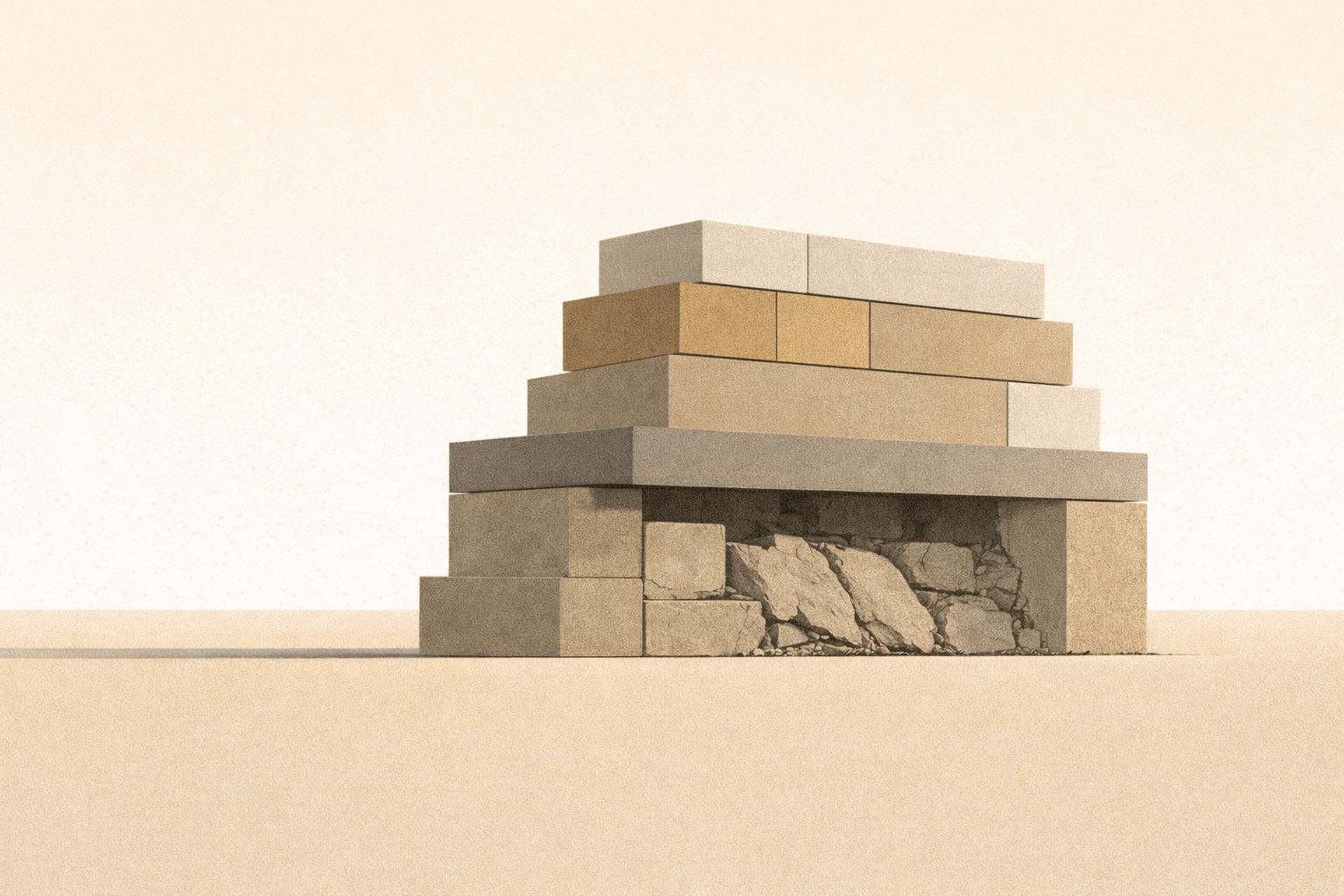
Failure Does Not Always Remove the Obligation
A failed function still leaves work behind.
If a position disappears, the work may remain. If infrastructure deteriorates, people still need to travel. When a household loses income, rent and food do not stop costing money.
The Work Usually Has to Go Somewhere
That is the first structural question after failure.
Who inherits the obligation?
Sometimes the transfer is explicit. A department is reorganized and another team receives the work.
More often, the transfer is informal. People simply begin doing what is necessary to stop the larger system from collapsing.
Burden Transfer Is How Failure Can Remain Hidden
A failed system can appear surprisingly functional when the burden moves faster than the institution repairs the cause.
Frontline Workers Can Inherit Institutional Failure
A vacant role may remain unfilled while its responsibilities are distributed across the remaining team.
At first, the arrangement may look efficient. Payroll falls, while output continues.
Yet the efficiency may be artificial if the organization is spending human capacity that it is not measuring.
Future Budgets Can Inherit Today’s Failure
Deferred maintenance works through a similar mechanism.
The immediate budget avoids the full repair cost. However, the physical obligation remains and can grow more expensive over time.
GAO reported in 2025 that the estimated federal building repair backlog more than doubled from fiscal years 2017 through 2024, reaching about $370 billion. GAO also warned that continued deterioration can lead to premature replacement that may cost substantially more than timely maintenance.
The failure did not disappear.
Its payer moved forward in time.
The People Doing the Holding Create an Endurance Subsidy
Power & Price needs a name for this mechanism.
The Endurance Subsidy is the hidden support a system receives when people, teams, households, or future budgets absorb obligations that the formal structure has failed to carry.
The Subsidy Can Look Like Loyalty
Workers stay late. Managers fill vacant roles. Relatives cover another bill. Residents tolerate another service failure.
Sometimes those choices are generous and rational.
The danger begins when the system starts treating that generosity as permanent capacity.
What Looks Like Resilience Can Become Extraction
Resilience means a system can absorb pressure and recover.
Extraction is different. It occurs when one part of the system repeatedly absorbs pressure so another part does not have to change.
Leverage Helps Decide Who Keeps Paying
Burden does not distribute itself evenly.
It tends to move toward whoever has fewer options to refuse it.
People With Exit Options Can Push Back
A well-capitalized supplier may refuse unfavorable terms. A highly mobile worker may leave. An institution with reserves may absorb a temporary shock without transferring it downward.
People With Fewer Options Often Absorb More
Other participants may need the paycheck, housing arrangement, service, relationship, or institution too badly to refuse the new burden immediately.
Therefore, capacity can become vulnerability when the system knows someone will continue holding the structure together.
The Second Failure Begins When the Base Reaches Overload
Burden transfer can preserve output for a while.
Eventually, however, capacity becomes finite.
Workload Can Exceed the Resources Available to Carry It
NIOSH defines job stress partly through a mismatch between job requirements and a worker’s capabilities, resources, or needs. Its work-organization guidance also identifies overload, inadequate staffing, long hours, low control, unclear roles, and poor infrastructure among potential workplace stressors.
That matters because overload is not simply a problem of attitude.
It can be a design problem.
The People Carrying the Failure Can Begin Failing Too
Fatigue rises. Attention narrows. Turnover becomes more attractive. Error risk can increase, while trust in leadership weakens.
At that point, the system has created a second failure.
The first failure weakened the structure.
The second failure weakens the people compensating for it.
The Endurance Subsidy
Groundwork Daily uses the Endurance Subsidy to make the burden-transfer sequence visible.
The Framework Distinguishes Recovery From Dependence
Temporary burden transfer can be reasonable during an emergency.
The warning sign appears when the transfer becomes the operating model.
If the same people must keep absorbing the same failure without relief, the system is no longer recovering.
It is financing continuity with somebody else’s capacity.
Language Can Hide the Transfer
Institutions rarely describe burden transfer in those terms.
Instead, they may call it teamwork, flexibility, resilience, commitment, adaptation, shared sacrifice, or doing more with less.
Those Words Are Not Automatically Dishonest
Teams sometimes do need to stretch. Emergencies sometimes require unusual effort.
However, language becomes misleading when temporary sacrifice is used to normalize permanent structural deficiency.
Ask What Changes After the Sacrifice
Does staffing improve? Does the repair happen? Is the missing capacity restored? Does the budget change? Are roles redesigned?
If nothing changes, the sacrifice may not be bridging a crisis.
It may be subsidizing avoidance.
Discipline Forces the Burden Back Into View
This is where Discipline Before Dollars becomes relevant.
Discipline asks who owns the outcome.
It distinguishes emergency effort from permanent dependence. Likewise, it separates a temporary workaround from a structural plan.
The Burden Needs an Owner
If additional work exists, name it.
If staffing is insufficient, measure the gap. When maintenance is deferred, record the liability. If one household member is carrying an unsustainable share, stop treating endurance as proof that the arrangement works.
Visibility is the beginning of accountability.
Repair Means Removing the Need for the Endurance Subsidy
The goal is not to make people less generous, committed, or resilient.
The goal is to stop building systems that require extraordinary endurance as a permanent input.
Restore Capacity
Fill critical roles. Repair deteriorating assets. Clarify ownership. Build reserves. Reduce unnecessary workload. Replace workarounds with functioning systems.
Price the Failure Honestly
Do not compare the cost of repair against an old system whose hidden labor, deferred maintenance, turnover, and future obligations were never fully counted.
The stronger comparison is total cost against total cost.
Give Relief Before the Base Cracks
A system should not wait for the people carrying the burden to fail before admitting that the burden was excessive.
Power & Price Has Been Following This Bill the Whole Time
How Costs Move explains how burdens migrate through systems.
Silence as Infrastructure explains how strain can remain hidden.
The Price of Stability examines the carrying cost of keeping weak systems upright.
Reform Is Not Free examines what happens when hidden obligations finally become visible operating work.
This article identifies the people and budgets that often keep paying between failure and repair.
The People Who Keep Paying Are Usually the People Doing the Holding
That is the uncomfortable truth.
A system can remain open, productive, solvent, connected, or outwardly stable because somebody continues absorbing what failed.
Continuity Is Not Proof of Health
Sometimes continuity simply proves that the burden found somewhere else to land.
Therefore, the sharper question is not only whether the system survived.
Ask what the survival consumed.
Endurance Has a Limit
Workers, households, communities, and future budgets are not infinite reserves.
If the institution keeps drawing from them without restoring capacity, the base eventually becomes the next failure point.
At that point, what looked like resilience reveals itself as deferred repair.

Stop Calling Permanent Burden Transfer Resilience
First, identify what failed.
Then identify who inherited the work.
Measure the Endurance Subsidy
Count additional workload, deferred maintenance, repeated exceptions, temporary fixes, turnover, overtime, and responsibilities that moved without corresponding resources.
Restore the Missing Capacity
The purpose of repair is not merely to keep the system alive.
It is to remove the need for the same people to keep subsidizing the failure with their endurance.
If continuity depends on exhausting the people doing the holding, the system is not stable. It is borrowing against its own foundation.
Where This Article Sits
This article examines the hidden burden transfer that can keep a damaged system functioning after formal capacity has already failed.
Its governing principle is Structure Is Mercy, while its governing condition is Overload.
Structure Is Mercy
Good structure prevents essential work from depending indefinitely on individual sacrifice.
It distributes responsibility, restores capacity, and reduces the need for the same people to absorb recurring failure simply because they are still capable of carrying it.
Overload
Overload appears when the obligations placed on a person, team, budget, or system exceed the capacity available to carry them sustainably.
After failure, overload can be hidden temporarily because committed people keep compensating for what the structure no longer provides.
Explore the Full Groundwork Architecture
Core Principles: Structure Builds Freedom · Stillness Is Strategy · Discipline Is Emotional Governance · Structure Is Mercy · Discipline Before Dollars · Accountability Is a Form of Strength · Build What Holds
Conditions: Capacity · Discernment · Alignment · Pressure · Overload · Recovery · Clear
Browse the complete Groundwork Daily Core Principles and The Conditions architecture.

Meet the Builder
Samual Drayton
Samual Drayton examines the structure beneath economic activity: who owns the asset, who controls access, who sets the terms, who absorbs the cost, and where value remains after money moves.
Through Power & Price, he follows pricing, leverage, markets, institutions, supply systems, ownership, and capital retention to reveal the difference between economic activity and durable economic position.
Signature philosophy: Follow the money past the transaction. The structure tells you who controls the terms, who carries the cost, and where the value settles.
Sources & Supporting Evidence
- U.S. Government Accountability Office. Federal Real Property: Disposing of Unneeded Facilities Could Help Reduce Maintenance Backlog. GAO reported that the estimated federal building repair backlog more than doubled from fiscal years 2017 through 2024 to roughly $370 billion, and warned that deferred work can contribute to deterioration and more costly premature replacement. Review the GAO report .
- National Institute for Occupational Safety and Health. Stress and Work. NIOSH defines job stress partly as a mismatch between job requirements and the capabilities, resources, or needs of workers and studies organizational interventions designed to improve working conditions. Review NIOSH guidance .
- National Institute for Occupational Safety and Health. Psychosocial Hazards. NIOSH identifies work overload, inadequate staffing, unclear roles, mandatory overtime, inadequate infrastructure, and management practices among potential psychosocial hazards. Review the NIOSH material .
- National Institute for Occupational Safety and Health. Fatigue and Work. NIOSH notes that fatigue can be associated with long or nonstandard hours, stress, and demanding work, and can affect attention, concentration, memory, and judgment. Review the NIOSH guidance .
- Groundwork Daily. Structure Is Mercy. The governing Core Principle for this article’s argument that good structure prevents recurring institutional need from depending indefinitely on individual sacrifice. Explore Structure Is Mercy .
- Groundwork Daily. Overload. The governing Condition for this article’s analysis of what happens when obligations exceed the sustainable capacity available to carry them. Explore Overload .
- Groundwork Daily. Silence as Infrastructure. Companion Power & Price analysis examining how strain can remain hidden when difficult information becomes costly to surface. Read the article .
- Groundwork Daily. The Price of Stability. Companion analysis examining the carrying cost created when systems preserve continuity through workarounds and containment. Read the article .
- Groundwork Daily. Reform Is Not Free. Companion analysis examining why repair, accountability, oversight, and new operating standards require actual capacity. Read the article .