The peace of enough begins when more is no longer the automatic answer to every form of discomfort.
More money.
More recognition.
More certainty.
More progress.
More proof that the life being built is finally worthy of respect.
There is nothing inherently wrong with wanting to grow. Healthy ambition can create stability, opportunity, skill, and meaningful change. The problem begins when desire loses proportion.
Then every achievement becomes temporary.
Every milestone moves the finish line.
Every blessing becomes ordinary before gratitude has time to recognize it.
The peace of enough does not ask you to stop building. It asks whether the building still serves a purpose or whether expansion has become a habit that no longer knows how to stop.
The Peace of Enough
The peace of enough is not a rejection of growth.
It is a refusal to let growth become an appetite without governance.
Enough does not mean that every dream has been completed. It does not mean that every problem has disappeared. It does not mean you stop improving, earning, learning, repairing, or reaching.
Enough means you can recognize value before everything becomes larger.
It means your life does not have to remain permanently incomplete in your own eyes.
Many people struggle with this because modern life rewards expansion. Bigger numbers look like evidence. More attention looks like relevance. Greater access looks like success. Constant movement looks like ambition.
However, a life can keep expanding while becoming less peaceful.
It can gain more options while losing clarity.
It can collect more possessions while creating more anxiety.
It can become impressive without becoming whole.
That is why enough is not a weak word.
Enough is a boundary around desire.
Why More Rarely Feels Like Enough
More rarely feels like enough because desire adapts quickly.
What once felt extraordinary becomes normal. What once looked like arrival becomes the new starting point.
The first raise creates relief. Soon, the larger income supports larger expectations.
The first opportunity creates gratitude. Soon, recognition becomes something you believe should continue.
The first achievement creates confidence. Soon, confidence depends on achieving again.
This does not make people ungrateful by nature. It reveals how quickly the mind adjusts to improvement.
Without deliberate reflection, progress can disappear into expectation.
Then the question changes.
Instead of asking, “What has this made possible?” we ask, “What comes next?”
Instead of noticing what is stable, we notice what is missing.
Instead of allowing success to deepen gratitude, we allow it to increase appetite.
The peace of enough interrupts that pattern.
It pauses long enough to see what constant pursuit keeps overlooking.
Enough is not the absence of growth.
It is the presence of proportion.
Contentment Is Not Complacency
Any serious conversation about contentment must confront the obvious concern.
Does accepting enough make people complacent?
It can, if enough becomes an excuse to avoid necessary effort.
But that is not contentment.
Complacency says improvement is unnecessary.
Contentment says improvement is not the source of worth.
Complacency resists responsibility.
Contentment carries responsibility without allowing it to consume every measure of peace.
Complacency can ignore what needs repair.
Contentment can recognize what is already good while still addressing what is not.
The difference is movement with proportion.
A content person can still pursue excellence. The pursuit simply comes from purpose rather than panic.
There is less desperation to prove something.
There is less fear that one missed opportunity will erase every other good thing.
There is less need to turn every interest into income, every talent into recognition, and every season into visible progress.
Contentment does not end ambition.
It disciplines ambition.
The Architecture of Endless Expansion
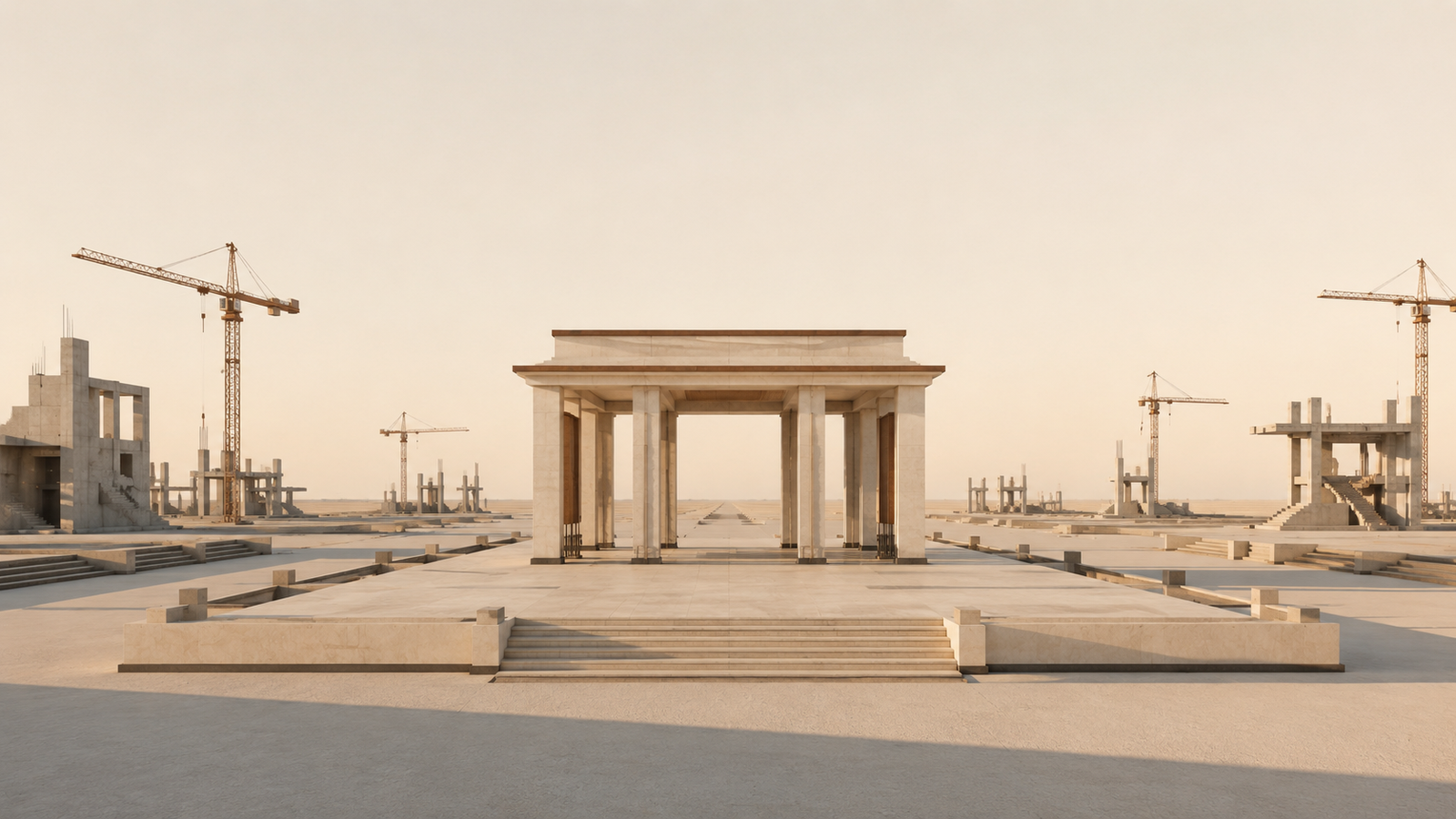
The featured image for this reflection shows one completed pavilion surrounded by unfinished construction.
The central structure is balanced.
Nothing appears missing.
Nothing appears excessive.
Around it, additional foundations, corridors, stairs, and towers continue outward. Cranes stand over projects that never seem to resolve.
The contrast is not between ambition and laziness.
It is between completion and endless expansion.
The pavilion does not need to become larger in order to become more complete.
That distinction matters because many people treat scale as the only evidence of success.
A business must become larger.
A platform must attract more attention.
A home must hold more.
A career must climb higher.
A life must become increasingly visible.
Yet scale does not guarantee meaning.
Some things become stronger through expansion. Other things become diluted.
Wisdom asks which is happening before growth becomes an unquestioned obligation.
Comparison Moves the Line
Comparison is one of the strongest forces working against enough.
You may feel satisfied until you see what someone else has.
You may feel proud of your progress until another person moves faster.
You may feel grateful for your home until you see a larger one.
You may feel secure in your work until someone else receives more recognition.
Nothing about your life changed.
Only the reference point changed.
This is why The Mirror That Lies belongs inside this conversation. Comparison changes the reflection without changing the truth.
It enlarges what belongs to someone else while shrinking what has already taken root in your own life.
Once comparison becomes the measuring system, enough becomes impossible.
There will always be someone with more money, more reach, more beauty, more access, more speed, or more visible success.
A life built around winning comparison has no natural stopping point.
The target will keep moving because the world will keep supplying another person to measure against.
The peace of enough begins when another person’s abundance stops functioning as an indictment of your own.
Enough Requires the Courage to Be Misunderstood
Choosing enough may confuse people.
Some may assume you lack ambition.
Others may think you are wasting potential.
A culture built around visible growth often mistrusts anyone who refuses endless expansion.
Declining an opportunity may look foolish.
Protecting your time may look uncommitted.
Choosing stability over status may look small.
Refusing to turn every gift into a product may look inefficient.
That is where The Courage to Be Misunderstood becomes part of this arc.
Not everyone will understand why a quieter life may be a better one.
Not everyone will understand why enough money, enough visibility, enough responsibility, or enough access can be more valuable than continued accumulation.
Some people only recognize success when it keeps getting larger.
However, your life does not need universal approval to become proportionate.
Sometimes peace requires disappointing people who have confused growth with constant escalation.
Moment of Wisdom
“Enough is as good as a feast.”
English proverb
Rest Reveals Whether Enough Exists
One of the clearest tests of enough is whether you can stop.
Can you finish a day without believing you should have done more?
Can you complete a project without immediately needing another one?
Can you enjoy what has been built before asking how to expand it?
Can you rest without treating recovery as lost ground?
These questions connect directly to When Rest Feels Like Failure.
If rest feels morally wrong, enough may feel emotionally impossible.
The person who believes worth must be earned through constant activity will always find another task.
The person who believes peace must follow complete accomplishment will rarely experience peace because responsible lives are never completely finished.
There is always more work.
There is always another improvement.
There is always another possibility.
Enough does not deny that reality.
It decides that possibility will not erase presence.
Enough Is a Form of Gratitude
Gratitude is not pretending everything is perfect.
It is allowing what is good to remain visible even while something else needs attention.
That sounds simple, but it requires discipline.
The mind often notices risk more quickly than stability. It notices what is missing, unfinished, uncertain, or threatened.
Gratitude restores proportion.
It says the unfinished part is real, but it is not the whole story.
The difficult part matters, but it does not erase every form of support.
The next goal may be worthwhile, but it does not make the current life worthless.
Enough is gratitude with structure.
It is the decision to recognize what has already arrived.
It is not passive appreciation.
It is an active refusal to let desire make every blessing invisible.
Some Ambition Is Fear in Formal Clothing
Ambition often receives automatic respect.
It sounds disciplined.
It looks serious.
It appears responsible.
However, not all ambition comes from purpose.
Some ambition comes from fear.
Fear of being ordinary.
Fear of losing relevance.
Fear of becoming financially vulnerable.
Fear that slowing down will reveal emptiness beneath achievement.
Fear that without the next accomplishment, others may stop paying attention.
That does not make ambition false. It means ambition needs examination.
A goal can be reasonable while the emotional structure beneath it remains unstable.
The peace of enough asks a hard question:
Would this desire still matter if no one else could see the result?
If the answer is yes, the desire may be rooted in purpose.
If the answer is no, the goal may be serving an audience more than a life.
Enough Is Different in Every Season
Enough is not a fixed number that applies forever.
A young family may need to build greater financial stability.
A person leaving a harmful situation may need more resources, more safety, and more support.
A growing organization may need new capacity.
A student may need more training before entering a field.
Enough changes because responsibilities change.
That is why the concept requires discernment rather than slogans.
Enough cannot become an excuse for refusing necessary growth.
It also cannot remain so vague that every desire gets renamed a necessity.
The practical question is not simply, “Do I want more?”
The better questions are:
- What responsibility would this growth help me carry?
- What problem would more actually solve?
- What cost would this expansion create?
- What am I already neglecting while pursuing the next level?
- Will this increase capacity or merely increase appetite?
These questions create governance around desire.
The Quiet Work of Becoming Enough
Sometimes the search for more is really a search for internal completion.
We hope another achievement will resolve insecurity.
We hope another relationship will settle loneliness.
We hope another purchase will create confidence.
We hope another public success will quiet private doubt.
But external accumulation cannot complete internal formation.
This is where The Quiet Work of Becoming remains relevant. Some transformation happens below the surface. It cannot be rushed through acquisition.
There are things only time, honesty, healing, practice, and reflection can build.
More may distract from that work.
Enough creates room for it.
It allows you to stop collecting evidence and begin becoming someone who no longer requires constant proof.
How to Practice the Peace of Enough
Name What Is Already Working
Do not begin with what is missing.
Begin with what currently holds.
What relationship remains trustworthy?
What habit is becoming steady?
What responsibility are you carrying well?
What problem no longer governs your life the way it once did?
Recognition protects progress from becoming invisible.
Define the Purpose of More
Before pursuing expansion, name its purpose.
More money for what?
More visibility for what?
More responsibility for what?
More access for what?
A desire without a purpose will continue growing because nothing tells it when the work is complete.
Create a Stopping Rule
Decide what enough looks like before appetite makes the decision for you.
This may involve money, work hours, commitments, possessions, or public visibility.
A stopping rule gives desire a boundary.
It transforms enough from a feeling into a structure.
Let Something Remain Unoptimized
Not everything needs to generate income, attention, influence, or measurable progress.
Some activities may remain private.
Some gifts may remain gifts.
Some moments may exist without becoming content.
Some spaces may remain quiet.
A life needs areas that are not constantly converted into output.
Three Truths to Carry This Week
Contentment is not complacency.
You can appreciate what exists while still building what is needed.
More is not always progress.
Expansion without purpose can increase pressure without increasing meaning.
Enough requires proportion.
A healthy desire knows what it serves and when to stop.
A Quiet Practice
Choose one area of your life where the finish line keeps moving.
It may be money.
Work.
Recognition.
Appearance.
Possessions.
Productivity.
Ask what you once believed would be enough.
Then ask why it stopped feeling sufficient.
Did your responsibilities change?
Did comparison move the line?
Did fear enter the decision?
Did the goal lose its purpose?
Finally, name one form of abundance that your pursuit of more has made difficult to see.
Let gratitude return it to view.
A Closing Blessing
May your ambition remain wise enough to accept a boundary.
May gratitude keep what is good from becoming invisible.
May comparison lose its authority over the meaning of your life.
May you recognize when growth serves purpose and when it only feeds appetite.
And may you discover that enough is not a smaller life.
It is a life no longer ruled by permanent lack.
The Groundwork
The peace of enough does not require abandoning desire.
It requires governing desire.
It asks what more is for.
It asks what expansion will cost.
It asks whether growth is building capacity or simply moving the finish line again.
Enough is not a ceiling placed over your life.
It is the foundation that keeps desire from becoming disorder.
You can keep learning.
You can keep building.
You can keep improving.
But you do not have to treat every present blessing as inadequate simply because another possibility exists.
Peace begins when more is no longer the only answer.
Further Groundwork
Continue the Journey
Receive thoughtful reflections on wisdom, discernment, purpose, and everyday growth delivered directly to your inbox.