
Community requires commitment, although community sounds much better before the signup sheet arrives.
Everybody wants community.
At least that is what we say.
We want connection. Shared space. Familiar faces. People who notice when we are missing. A place where children know the adults, elders are remembered, neighbors speak, and somebody always seems to have an extra plate.
Beautiful.
Then somebody asks who can arrive early to set up the room.
The energy changes.
The announcement gets likes.
The volunteer signup gets viewed.
The reminder gets a thumbs-up from someone who is not coming.
And the person who organized the whole thing starts unfolding chairs alone while everybody else is still texting, “What time does it start again?”
That is usually the part we leave out when talking about building community.
Community sounds like belonging.
In practice, it often looks like extension cords, folding tables, grocery receipts, follow-up calls, trash bags, calendars, keys, and one person quietly wondering why the same six names keep appearing on every list.
Community feels meaningful once the room is full.
It feels much less poetic when somebody has to bring the chairs.
Everybody Wants the Feeling
People like the feeling of community because the feeling is generous.
It offers familiarity without demanding explanation. It gives people a place to land. It makes ordinary life feel less private and less fragile.
Community means somebody notices.
Somebody remembers your name.
Somebody knows your child.
Somebody asks where you have been.
Somebody brings food when things go wrong.
That matters.
But the feeling can hide the machinery.
Every welcoming room was opened by somebody.
Every shared meal involved a list.
Every neighborhood cleanup required bags, gloves, coordination, and at least one person who arrived with supplies while everyone else arrived with opinions.
Every reunion has a cousin who made the calls.
Every church dinner has someone who knows which cabinet holds the serving spoons.
Every block party has a person who understands permits, folding tables, weather backups, and why the speaker cannot plug into the same outlet as everything else.
We enjoy the outcome because someone else carried the details.
That arrangement can work for a while.
It becomes a problem when contribution stays concentrated and belonging stays distributed.
Everybody belongs.
Four people have keys.
Three people know the password.
Two people brought food.
One person is still there forty-five minutes after everyone leaves.
Community feels shared.
The labor often is not.
The Chairs Are Never Just Chairs
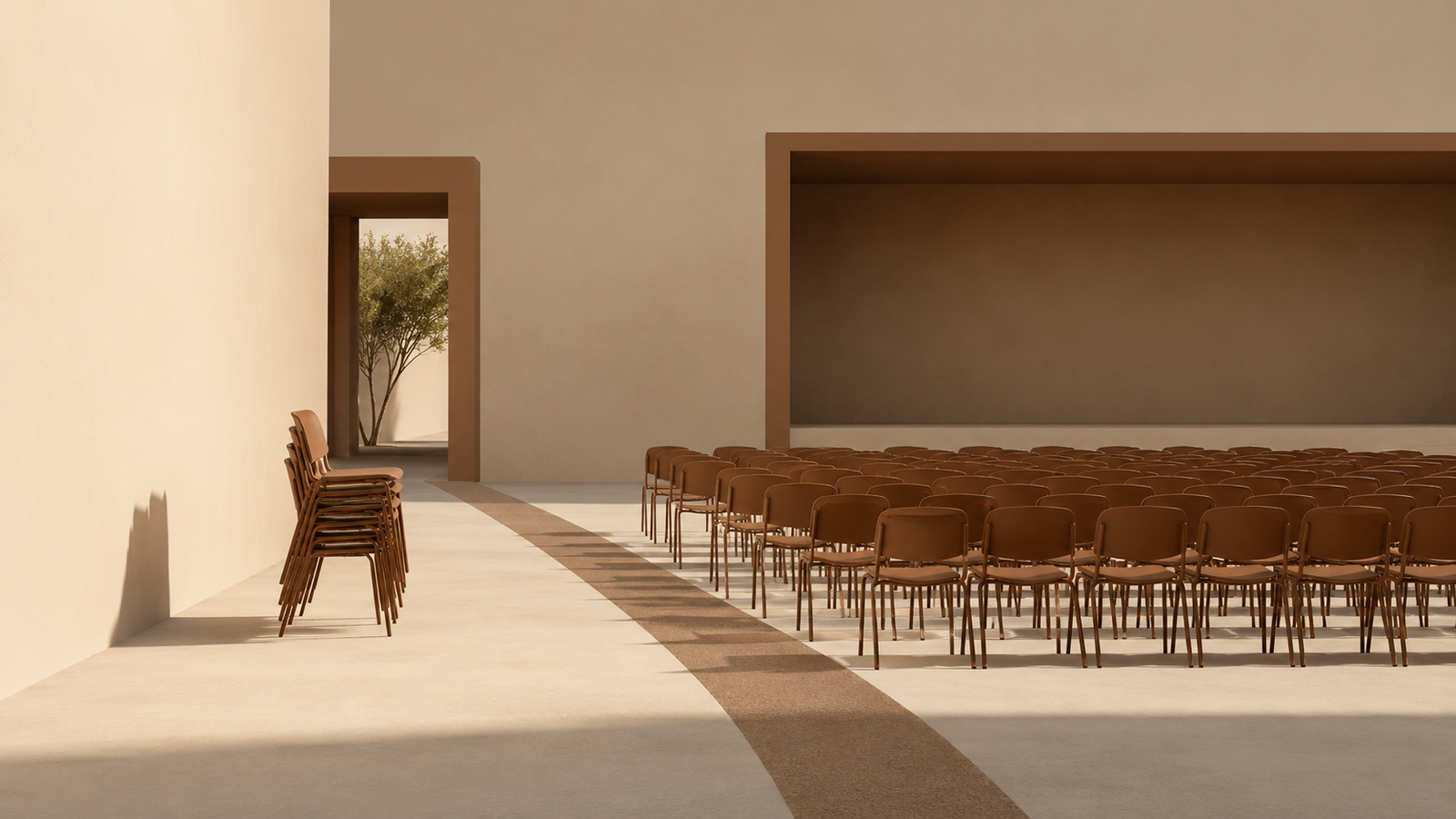
The chairs are planning.
They are follow-through.
They are the difference between saying something should exist and helping it exist.
That is why the title lands harder than it first appears.
Everyone wants community until it is their turn to bring the chairs.
The chairs represent the unremarkable part.
They do not create a good photograph. They do not make the speech. They do not receive applause. Once people sit down, nobody thinks about them again.
Unless there are not enough.
Then suddenly everybody becomes a seating consultant.
That is how invisible work usually operates. When it succeeds, it disappears. When it fails, it becomes the entire event.
Nobody compliments the unlocked door.
They notice when it is locked.
Nobody celebrates the clean bathroom.
They remember when it is not.
Nobody applauds the accurate headcount.
They become very interested when the food runs out.
The work becomes visible only after it stops working.
That creates a strange incentive.
The better people are at maintaining community, the easier it becomes for everyone else to assume the community maintains itself.
The gathering feels natural.
The event feels effortless.
The tradition feels permanent.
Meanwhile, somebody is making another spreadsheet.
Community participation often declines because the finished result hides the cost of creating it.
People see the room.
They do not see the thirty-seven messages required to fill it.
They see the food.
They do not see the person who checked three stores because the first one did not have enough trays.
They see the program.
They do not see the person who corrected the spelling, printed the copies, found the tape, and brought extra pens because experience has taught them what optimism forgets.
That person rarely becomes the face of the community.
Usually, that person becomes the infrastructure.
The Same People Keep Becoming the System
Most communities have regulars.
Not regular attendees.
Regular carriers.
The people who answer.
The people who know.
The people who stay.
The people who can be trusted with the key, the money, the list, the children, the cleanup, the last-minute change, and the mildly panicked phone call that begins with, “Quick question.”
It is rarely a quick question.
Still, they answer.
At first, this looks like reliability.
Over time, it can become dependency.
The community stops building systems because dependable people keep covering the gaps. Why create a process when Denise remembers everything? Why train anyone else when Marcus always arrives early? Why document the setup when someone has been doing it for twelve years and appears immortal?
Very efficient.
Until Denise gets tired.
Until Marcus moves.
Until the person who “always handles it” decides they would like to attend the event once instead of producing it.
Then the room discovers that reliability was never distributed.
It was personalized.
That is where wanting community and maintaining community begin to separate.
People may sincerely value the group. They may care about the tradition. They may want the event to continue. They may even be surprised when it disappears.
But sincere appreciation does not create capacity.
Gratitude is not a staffing plan.
Applause does not distribute the load.
A thank-you post does not replace the person who stayed to sweep.
Eventually, volunteer burnout appears.
Not always because the work became too hard.
Often because the same people realized everyone considered the work important, but not important enough to share.
That distinction matters.
People can carry heavy work when it feels collective.
Even light work becomes exhausting when it feels assigned by silence.
No one directly said, “You will keep doing this forever.”
Everyone simply kept not volunteering.
Remarkably clear system.
Belonging Needs Maintenance
Community is not only a feeling.
It is a maintenance schedule.
That sentence may not fit on a welcome banner, but it is true.
Relationships require follow-up.
Traditions require planning.
Shared spaces require cleaning.
Neighborhood trust requires repetition.
Organizations require records.
Gatherings require people who remember what happened last time.
Without maintenance, community becomes a series of emotional peaks separated by long stretches of neglect.
People gather when there is a crisis.
They gather for the anniversary.
They gather for the big moment.
Then the ordinary work goes quiet.
That is where community starts weakening.
Not because people stopped caring.
Because caring remained emotional while maintenance remained optional.
That pattern appears in families too.
Everybody values the reunion.
Few people want to call the hotel.
Everybody wants the holiday meal.
Few people ask who is buying the groceries.
Everybody loves the family group chat until somebody starts asking for firm headcounts.
Then suddenly people need time to check their schedules.
The same pattern appears at work.
Everybody values culture.
Few people want to write the process.
Everybody supports collaboration.
Few people want to take notes, send the follow-up, or clarify who owns the next step.
The meeting ends with strong alignment.
Nobody knows what happens next.
Agreement is emotionally satisfying.
Maintenance is administratively specific.
That is why agreement wins the room while responsibility waits for volunteers.
The same contradiction appears in relationships. People want closeness, but closeness requires attention. People want trust, but trust needs consistency. People want care, but care eventually becomes practical.
As explored in the difference between appearing supportive and carrying weight, the signal is easier than the service.
Community has the same problem.
Support sounds good.
Maintenance shows up early.
This Is More Human Than Evil
None of this means people are selfish monsters wandering through community spaces looking for unpaid labor.
Usually, people are tired.
They have work. Children. Aging parents. Long commutes. Health concerns. Money pressure. Overloaded calendars. Relationships that need care. Homes that need maintenance. Bodies that occasionally insist on being included in the planning process.
That is real.
People also assume somebody else is better equipped.
Somebody more organized.
Somebody with more time.
Somebody who already knows how things work.
Somebody who seems to enjoy bringing the chairs.
That last assumption has done serious damage.
Competence gets mistaken for preference.
Because someone does a task well, people assume they want permanent custody of it.
The organizer becomes “the organizing person.”
The cook becomes responsible for every meal.
The person with a truck becomes public transportation.
The person who answers emails becomes communications.
The reliable friend becomes the default planner.
The person with emotional range becomes the unpaid department of human concern.
Then everybody wonders why the dependable people eventually become less available.
This is where automatic agreement begins turning into quiet overload.
The people carrying the work may also contribute to the pattern.
They may find it easier to do the task than explain it.
They may correct everything instead of teaching anyone.
They may reject help because the help is slower.
They may insist on a standard only they understand, then feel abandoned when nobody meets it.
That is human too.
Sometimes the people bringing the chairs have made chair-bringing unnecessarily proprietary.
Not always.
But sometimes.
Community responsibility can fail in both directions.
People avoid taking ownership.
Other people avoid releasing it.
Then everybody becomes tired in a system that has no succession plan and far too many folding chairs.
The Groundwork
The answer is not guilt.
Guilt may fill one signup sheet.
It rarely builds a durable community.
The better movement is visibility.
Make the work visible before it becomes a crisis.
Name what the gathering requires.
Separate appreciation from participation.
Give people small, clear ways to contribute before the whole system depends on heroic volunteers.
And perhaps most important, stop treating reliable people like renewable resources.
People do not need to perform every role.
They do need to know the room did not prepare itself.
The Groundwork
- Notice which people repeatedly carry the invisible work.
- Make contribution specific enough that people can actually say yes.
- Build shared responsibility before reliability becomes exhaustion.
Every successful gathering has somebody who arrived before the room looked ready.
Somebody stayed after the room looked empty.
The rest of us usually remember the speaker, the food, the conversation, and whether parking was difficult.
Community does not disappear because people stop believing in it.
Sometimes it disappears because everybody quietly assumed someone else was bringing the chairs.
And yes.
That’s still us.
Further Groundwork
Meet the Builder
Micah Green
Builder, This Is Us (But Funnier)
Some truths become easier to recognize once you laugh.
Micah Green explores the ordinary moments that quietly reveal how people think, connect, and build community. Through careful observation, understated humor, and thoughtful storytelling, he uncovers the patterns hiding inside everyday conversations, family traditions, workplace habits, neighborhood life, and the small contradictions that make us unmistakably human.
His essays are not about making fun of people. They are about helping readers notice themselves with a little more honesty, humility, and grace. Beneath every smile is a practical insight about relationships, culture, and the everyday structures that quietly shape our lives.