
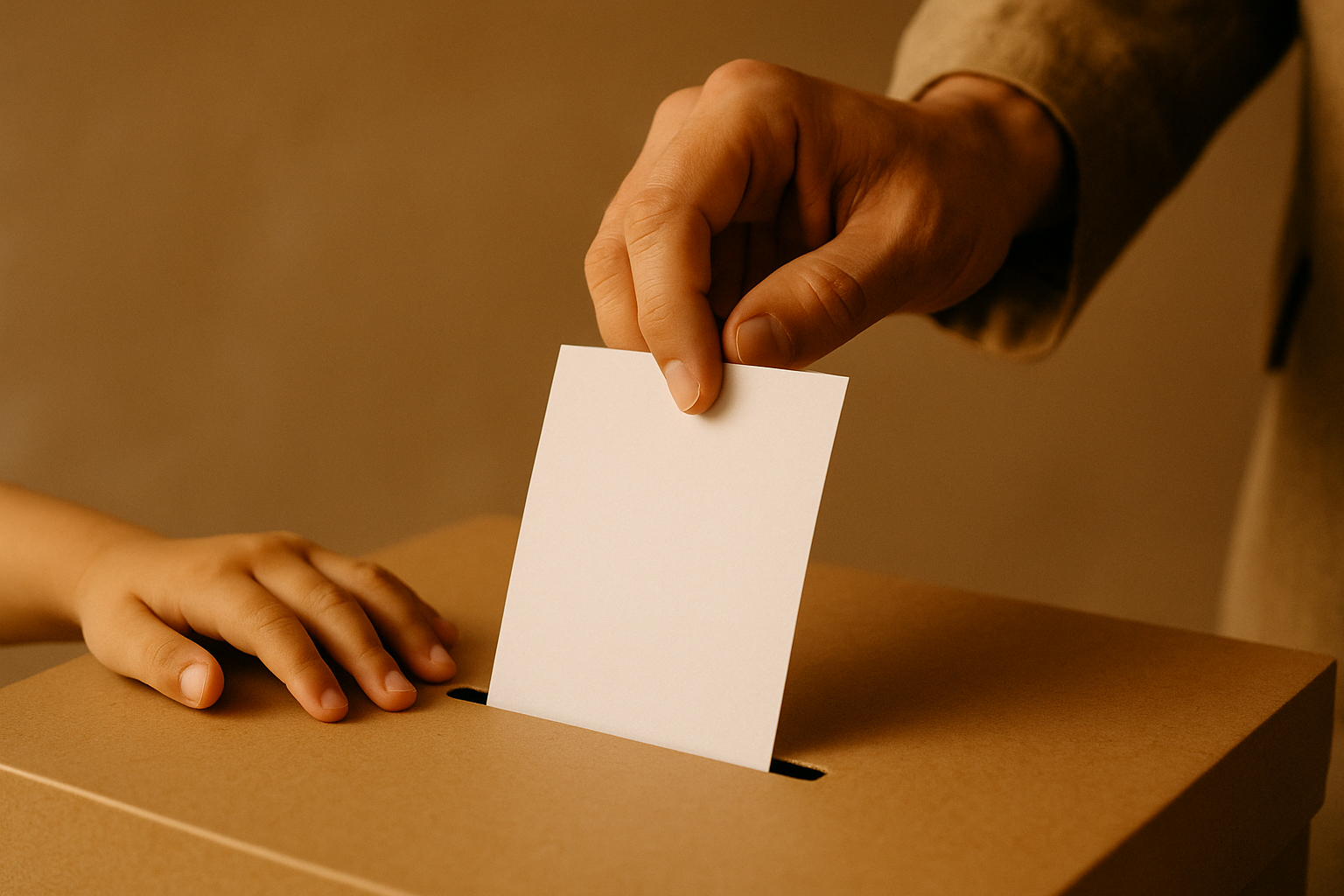
Progress is proof of care.
Voting as care for the next generation is not about treating a ballot as a symbolic gesture. It is about recognizing that private concern for the future eventually meets public systems. Families can prepare children for life, save money, teach discipline, build stability, and pass down values. But the next generation will also inherit institutions, public rules, infrastructure, budgets, and civic norms that no household controls alone.
The Structural Question
If care means preparing the future, then civic participation is one way private concern becomes participation in public decision-making.
Care Has a Public Dimension
We usually recognize care when it is close enough to touch.
A parent puts money aside for college. A family creates an emergency fund. Someone checks on an aging relative. A neighbor makes sure a child gets home safely. These actions make sense because the connection between preparation and consequence is visible.
Civic care is harder to see because the mechanism is larger.
No individual voter writes an entire budget, operates a public agency, manages a transportation network, sets every school policy, or controls every law. Public authority is distributed across institutions, jurisdictions, elected offices, administrative agencies, courts, legislatures, and levels of government.
That scale can make participation feel distant from daily life.
But distance does not make the system irrelevant.
The systems that govern public life still shape the environment in which private decisions succeed, struggle, or collide with constraints. Civic participation is one mechanism for entering that larger decision structure.
What the Next Generation Actually Inherits
Inheritance is usually discussed as property.
A house. Savings. Investments. Insurance. Land. A business. Education. Family knowledge.
Those things matter.
But every generation also inherits a public environment.
It inherits the quality of institutions that already exist, the condition of shared infrastructure, the fiscal obligations created before it arrived, the effectiveness of government administration, the rules governing land and development, and the civic expectations surrounding public participation.
Some of those systems will be strong. Others may be fragile, outdated, underfunded, poorly designed, or difficult to navigate.
That means stewardship cannot be defined only by what one household transfers to another.
Children inherit assets from families. They inherit systems from everyone.
The second inheritance deserves attention too.
Where the Ballot Enters the System
Voting does not give one citizen control over government.
It gives eligible citizens a formal mechanism for participating in specific public decisions established by law. Depending on the election and jurisdiction, voters may choose among candidates for public office or decide questions placed on a ballot.
That distinction matters.
A ballot is not the government. It is one input into the process that determines who receives certain forms of public authority and, in some elections, how particular public questions are resolved.
In the 2024 presidential election, the U.S. Census Bureau reported that 65.3 percent of the citizen voting-age population voted. Pew Research Center, using validated turnout records, found that only 41 percent of adult citizens old enough to participate in the 2020, 2022, and 2024 national elections voted in all three.
Those figures reveal something larger than the outcome of any single election. Participation is not automatically continuous. Many citizens move in and out of the electorate depending on the year, the contest, their circumstances, or their level of engagement.
Civic capacity therefore involves more than knowing that voting exists. It requires knowing when elections occur, what offices are being selected, what authority those offices actually possess, and what happens after the votes are counted.
Local Government Is Where Structure Becomes Daily Life
National elections receive enormous attention, but public authority does not exist only at the national level.
State and local elections may occur at different times throughout the year. Depending on the jurisdiction, voters may elect governors, state legislators, mayors, county executives, council members, judges, and other officials. Some ballots also include proposed state or local laws and policies.
The responsibilities attached to these offices vary by state, county, and municipality. Local legislative bodies, for example, may exercise authority over areas that include budgets, zoning, land use, tax rates, and other local initiatives.
This is why civic literacy matters.
Participation without understanding jurisdiction can turn politics into theater. People may demand action from officials who do not possess the relevant authority while overlooking institutions that actually control the decision.
The more useful question is not simply, “Who is on the ballot?”
It is:
What authority does this office actually hold, and what system will that authority enter?
That is the difference between consuming politics and studying governance.
A Ballot Is Not the Whole Civic System
Voting matters because elections allocate specific forms of public authority.
But voting should not be confused with complete civic participation.
Government continues operating after Election Day.
Budgets are developed. Agencies implement policy. Legislatures meet. Rules are interpreted. Contracts are awarded. Public hearings occur. Administrative decisions are made. Officials exercise discretion within the limits of their offices.
A citizen who votes and then completely disengages may have participated in the selection of authority without following how that authority is used.
That is why civic responsibility has a longer time horizon.
Elections matter. So do oversight, public meetings, reliable information, communication with public offices, community organizations, public records, and understanding which institution is responsible for which decision.
None of these activities guarantee a preferred outcome. Democratic institutions process competing interests, legal constraints, public preferences, administrative limits, and constitutional rules.
The point is not that participation guarantees control.
The point is that withdrawal means less participation in the process.
What Civic Care Looks Like in Practice
Care becomes useful when it produces habits.
For voting, that can begin with a simple discipline: do not meet the ballot for the first time inside the voting booth.
Before an Election
- Confirm registration requirements and deadlines through the appropriate election authority.
- Review the sample ballot when one is available.
- Identify the offices being contested.
- Learn what authority each office actually possesses.
- Read ballot questions carefully and consult official explanatory materials where available.
- Separate claims about government from the actual jurisdiction of the office involved.
After an Election
- Know which officials now hold the relevant authority.
- Follow major decisions connected to the issues that matter to you.
- Learn where public meetings, agendas, budgets, and records are published.
- Distinguish campaign promises from powers an office can legally exercise.
- Maintain civic attention between election cycles.
None of this requires constant political consumption.
It requires enough structure to know when attention matters.
The Longer View
The question is not only what we want government to do for us now. It is what kind of civic system we are helping the next generation understand, enter, maintain, and eventually govern.
The Groundwork: Stewardship Has a Longer Time Horizon
A ballot does not build the future by itself.
It helps determine who receives some of the authority to build it.
The rest requires attention after Election Day: understanding institutions, following decisions, recognizing jurisdiction, maintaining public accountability, and refusing to treat civic life as something that appears only during campaign season.
Care for the next generation cannot stop at what we leave in a bank account, a house, a business, or a will.
They will inherit institutions too.
Our ballots are quiet tools of construction. The Groundwork is to treat the public inheritance with the same seriousness as the private one.
Continue Building
Read Democracy Depends on Daily Order for the broader Groundwork argument that civic systems depend on habits, participation, and institutional maintenance beyond a single election.
Build What Holds
Groundwork Daily examines the systems beneath public life, economic stability, culture, relationships, institutions, and community.
Subscribe to Groundwork DailyBuilder
Langston Reed
Langston Reed examines civic power, public systems, institutional authority, and the structures that determine how policy moves from intention to implementation. His work focuses on helping readers understand where authority sits, how institutions function, and why durable outcomes require more than political language.
Receipts
- U.S. Census Bureau. 2024 Presidential Election Voting and Registration Tables . Census reported that 65.3 percent of the citizen voting-age population voted in the 2024 presidential election.
- Pew Research Center. Voter Turnout in the 2020 and 2024 Elections: A Detailed Analysis . Pew’s validated-voter analysis found that 41 percent of adult citizens old enough to participate in the 2020, 2022, and 2024 national elections voted in all three.
- USAGov. State and Local Elections . Federal guidance on state and local election timing, elected offices, government responsibilities, and ballot measures.