
Building Institutional Literacy
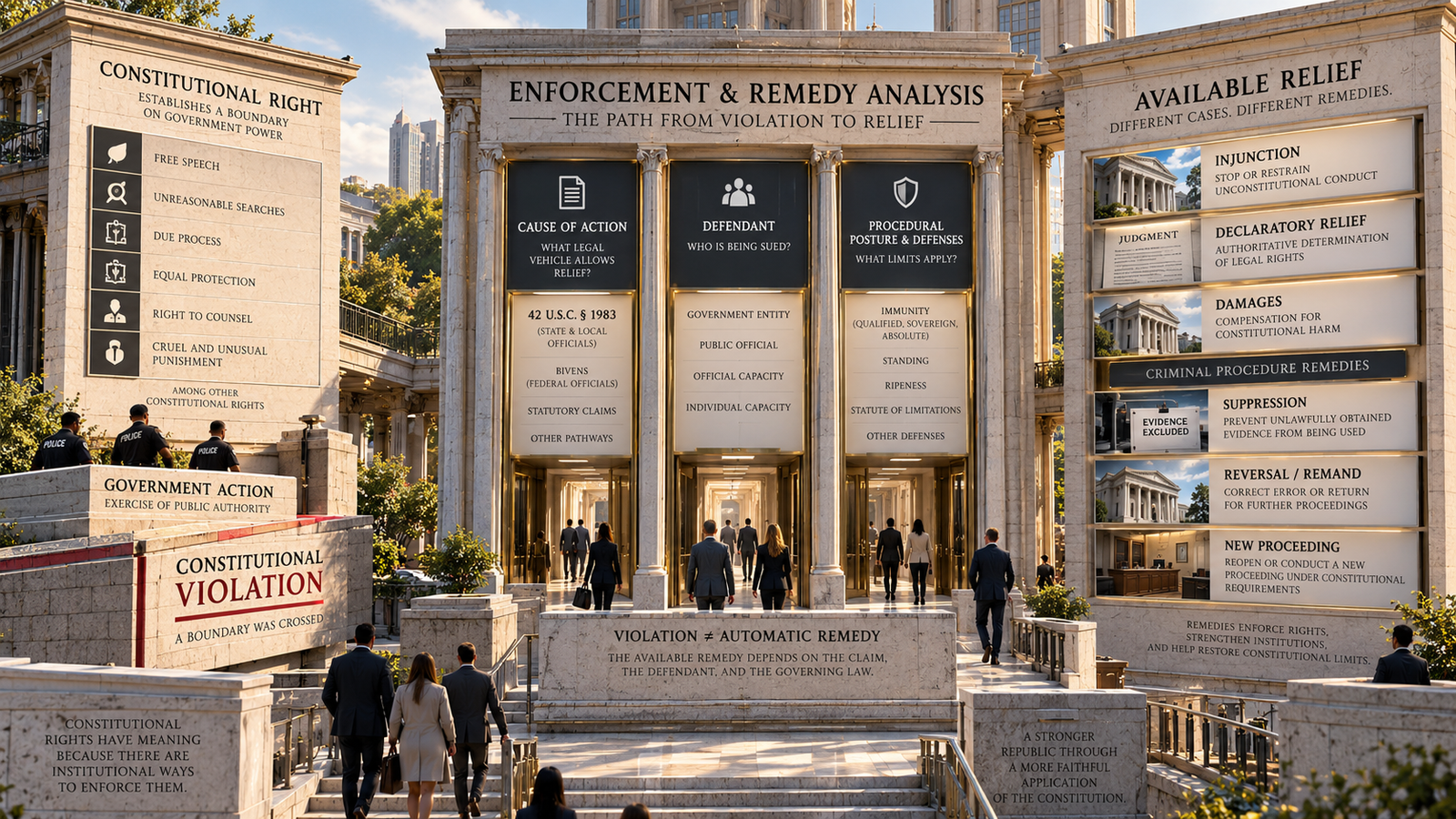
Constitutional remedies answer a different question from constitutional rights. A right establishes a boundary on government power. A violation establishes that government crossed that boundary. A remedy determines what the legal system can actually do about it.
Those questions are connected, but they are not interchangeable. A court can conclude that government violated the Constitution without automatically awarding money, excluding evidence, invalidating an entire law, or ordering a government official to act differently.
What Are Constitutional Remedies?
Constitutional remedies are forms of judicial relief used to address constitutional violations or prevent unconstitutional government action. Depending on the claim and legal setting, a remedy may stop government conduct, declare legal rights, compensate an injured person, exclude evidence, reverse a judgment, or require a new proceeding.
The path to relief matters just as much as the constitutional violation itself. Courts may have to identify an appropriate cause of action, determine who can be sued, evaluate immunity or other defenses, establish whether the requested relief is available, and decide whether procedural requirements have been satisfied.
That produces one of the most important distinctions in constitutional law: a constitutional violation does not automatically determine the constitutional remedy.
Critical Legal Note
This guide is educational, not legal advice. Constitutional remedies depend on the right involved, government actor, defendant, cause of action, jurisdiction, procedural posture, immunity rules, timing, controlling precedent, and requested relief. A constitutional violation does not automatically create a damages claim or guarantee any particular remedy. Anyone facing an active legal dispute should consult qualified counsel.
Groundwork Guide
Right, Violation, and Remedy Are Three Different Questions
Constitutional disputes become much easier to understand when three questions are separated. First, what constitutional right exists? Second, did government violate that right? Third, if a violation occurred or is threatened, what relief can a court lawfully provide?
The first question identifies the constitutional boundary. The second applies constitutional doctrine to government conduct. The third moves into enforcement, procedure, defendants, causes of action, defenses, and judicial power.
Consider an unlawful search. The Fourth Amendment supplies the constitutional protection. A court may determine that government conducted an unreasonable search. But what follows depends on the case.
In a criminal prosecution, the dispute may concern whether evidence should be suppressed. In civil litigation, a person may seek damages or prospective relief under an available cause of action. Different doctrines govern those remedies, even though the underlying constitutional issue may arise from the same government conduct.
Finding the violation tells you which constitutional boundary government crossed. Remedies doctrine tells you what the legal system is authorized to do next.
The Groundwork Constitutional Remedies Framework
The remedy question can be mapped as an institutional sequence. Not every case travels through every step in exactly the same order, but these questions expose the structure behind constitutional enforcement.
This framework prevents a common analytical shortcut. It keeps the existence of a constitutional right from being treated as proof of a violation, and it keeps a constitutional violation from being treated as an automatic entitlement to a particular remedy.
A Right Still Needs an Enforcement Pathway
Constitutional rights do not all arrive in court through one universal procedural vehicle. The mechanism depends on the government involved, the nature of the claim, the relief requested, and the legal authority permitting the court to act.
Sometimes the remedy question arises inside an existing criminal case. Sometimes a person files a civil action. In other situations, a party seeks prospective relief against unconstitutional government enforcement or challenges a government decision through another established judicial process.
Section 1983 Is an Enforcement Vehicle
One of the most important federal civil-rights statutes is 42 U.S.C. § 1983. It provides a cause of action against a person who, under color of state law, deprives someone of rights secured by the Constitution or federal law.
Section 1983 does not create the constitutional right being enforced. The underlying right might come from the First Amendment, Fourth Amendment, Fourteenth Amendment, or another enforceable federal protection. Section 1983 supplies a statutory vehicle through which certain violations involving state or local actors can be litigated.
Keep the layers separate: the Constitution supplies the right. Constitutional doctrine determines whether that right was violated. An enforcement mechanism such as Section 1983 may provide a pathway for seeking judicial relief.
Federal Officials Present a Different Structure
Section 1983 addresses action under color of state law. It is therefore not a general damages statute for constitutional claims against federal officials.
The Supreme Court has recognized damages actions against federal officials in a small set of contexts associated with Bivens v. Six Unknown Named Agents. However, later decisions have sharply limited expansion of that judicially implied remedy into new contexts.
That distinction matters. A person cannot assume that every constitutional violation by a federal official carries the same damages pathway available in litigation involving state or local officials.
The Major Forms of Constitutional Relief
Constitutional remedies perform different institutional jobs. Some prevent future government action. Some establish legal status. Some compensate for completed injuries. Others operate inside criminal proceedings or appellate review.
| Remedy | Institutional Function | Typical Context |
|---|---|---|
| Injunction | Orders a party to stop, refrain from, or sometimes undertake conduct as authorized by law. | Preventing or correcting ongoing or threatened unconstitutional government action. |
| Declaratory Relief | Declares the legal rights or obligations of parties in an actual controversy. | Clarifying whether government action, a law, or an enforcement position violates constitutional requirements. |
| Damages | Provides monetary relief when a legally available damages action and its requirements are satisfied. | Certain civil-rights actions involving completed constitutional injuries. |
| Suppression | Prevents certain unlawfully obtained evidence from being used under applicable exclusionary-rule doctrine. | Criminal proceedings involving particular search-and-seizure violations and related doctrines. |
| Reversal or Vacatur | Sets aside or alters a lower decision when appellate law requires that result. | Appellate review of constitutional error. |
| Remand | Returns a matter to a lower court or tribunal for further proceedings consistent with the reviewing court’s ruling. | Cases requiring additional proceedings after legal error or unresolved issues. |
| New Proceeding | Requires a constitutionally defective process to be repeated or corrected when governing law provides that consequence. | Trials, hearings, administrative processes, or other adjudicative settings. |
These categories are not exhaustive, and they do not operate interchangeably. The remedy must fit the claim, procedural setting, governing law, and court’s remedial authority.
Injunctions: Stopping Unconstitutional Government Action
Some constitutional litigation is primarily about preventing harm rather than compensating for past injury. In an appropriate case, a court can issue an injunction directing government officials to stop or refrain from conduct that violates constitutional requirements.
This makes injunctive relief especially important when unconstitutional action is ongoing or sufficiently threatened. The institutional goal is prospective: keep government inside the constitutional boundary.
An Injunction Is Not Automatic
A plaintiff does not receive an injunction merely by identifying unlawful government conduct. Federal courts apply requirements governing equitable relief, including whether the plaintiff faces the kind of injury that prospective judicial intervention can address.
Standing is particularly important. A past injury may support some forms of litigation without necessarily establishing the real and immediate threat needed for prospective relief. The Supreme Court’s decision in City of Los Angeles v. Lyons is a prominent illustration of that distinction.
Remedy changes the standing inquiry: a person asking a court to prevent future government action must establish the requirements associated with prospective relief, not merely point to something that happened in the past.
Declaratory Relief: Establishing the Legal Relationship
Declaratory relief performs a different job. Rather than primarily awarding compensation or commanding a party to stop specific conduct, a declaratory judgment can establish the legal rights and obligations of parties in an actual controversy.
Congress authorized federal declaratory judgments through the Declaratory Judgment Act. The statute allows a federal court, in a case of actual controversy within its jurisdiction, to declare the rights and legal relations of interested parties.
The requirement of an actual controversy remains important. Federal courts do not use declaratory judgments to issue abstract constitutional advice disconnected from a live judicial dispute.
Declaration and Injunction Are Not the Same Remedy
A declaration states the legal relationship. An injunction directs or restrains conduct. A case may involve one form of relief, the other, or both when legal requirements are satisfied.
Separating them makes the remedial system clearer. Courts have more than one institutional tool for addressing unconstitutional government action, and those tools do different work.
Damages: When Constitutional Injury Can Produce Monetary Relief
Money damages are among the most familiar legal remedies, but they are also one of the easiest constitutional remedies to oversimplify. A constitutional violation does not itself mean that a plaintiff can recover money from any government institution or official involved.
A damages claim requires a legally available cause of action. The identity of the defendant matters. Immunity may matter. Municipal liability rules may matter. Causation and proof of injury may matter. The governing statute and precedent determine how those pieces fit together.
Section 1983 and State or Local Officials
Section 1983 is central to many damages actions involving state or local government actors. Yet even within Section 1983 litigation, the defendant cannot be treated as an interchangeable part of “the government.”
Claims against individual officials can raise different questions from claims against municipalities. A municipality is not automatically liable under Section 1983 simply because it employed a person who committed a constitutional violation. Under Monell v. Department of Social Services, municipal liability requires the legally relevant connection between the constitutional injury and municipal policy or custom.
Damages Measure Injury, Not Merely Constitutional Importance
The fact that a constitutional right is fundamental does not by itself establish the amount of damages. Damages doctrine asks what legally compensable injury resulted and what forms of monetary relief governing law permits.
In some circumstances, nominal damages may recognize the violation of a legal right even without proof of substantial compensable injury. Other cases can involve compensatory damages when actual injury is established. Additional rules govern punitive damages and particular defendants.
“My constitutional rights were violated” is a merits claim. “Therefore this defendant owes me money” is a separate legal conclusion that requires additional analysis.
Suppression: A Remedy Inside the Criminal Process
Suppression illustrates why remedies cannot be understood as one universal response to unconstitutional conduct. In criminal procedure, the exclusionary rule can prevent certain evidence obtained through unconstitutional searches or seizures from being used against a defendant.
The remedy is tied to the operation of the criminal justice system. It is not a general damages award, and it does not mean every Fourth Amendment violation automatically causes every piece of evidence connected to the case to disappear.
The Exclusionary Rule Has Its Own Doctrine
Courts have developed rules governing when exclusion applies, how derivative evidence is treated, and when doctrines such as attenuation, independent source, inevitable discovery, or good-faith principles affect suppression.
The remedial analysis therefore continues after a Fourth Amendment violation is identified. The court may still need to determine whether suppression is the legally appropriate consequence.
Suppression Is Not the Remedy for Every Constitutional Right
The exclusionary rule is especially associated with particular criminal-procedure violations. It should not be treated as the generic remedy whenever government violates the Constitution.
That distinction is another reason to classify the claim before discussing relief. The constitutional right and litigation setting shape the available remedy.
Reversal, Remand, and New Proceedings
Constitutional violations can also arise during trials, hearings, sentencing, administrative proceedings, or other adjudicative processes. When a reviewing court identifies constitutional error, the remedy may affect the underlying proceeding rather than produce a separate damages judgment.
An appellate court may reverse or vacate a judgment, remand the case for additional proceedings, or require a new proceeding when governing law calls for that result.
Not Every Constitutional Error Automatically Reverses a Judgment
Appellate doctrine distinguishes among different kinds of error. Many constitutional errors are subject to harmless-error analysis, meaning a reviewing court considers whether the error requires reversal under the applicable standard.
Some constitutional errors are treated differently because they affect the framework within which a trial proceeds. The precise remedial consequence therefore depends on the constitutional violation and the appellate doctrine governing that type of error.
Once again, the pattern is consistent: identifying the constitutional violation begins the remedial inquiry. It does not necessarily finish it.
Who the Defendant Is Can Change the Remedy
Constitutional litigation often uses broad language about “the government,” but remedies doctrine requires greater precision. A state, municipality, agency, officer, judge, prosecutor, school official, or federal officer may occupy a different legal position.
The requested remedy matters as well. A claim seeking damages from an individual official presents different questions from a suit seeking prospective relief against official conduct.
Individual Capacity and Official Capacity Are Different
In civil-rights litigation, the capacity in which an official is sued can affect what the lawsuit legally represents and what relief is available. An individual-capacity damages claim is not the same thing as an official-capacity claim involving government action.
Those distinctions are not mere labeling. They can affect defenses, liability, sovereign-immunity questions, and the institutional target of the remedy.
Municipalities Have Their Own Liability Rules
Local governments can qualify as “persons” under Section 1983, but municipal liability is not ordinary employer vicarious liability. The constitutional injury must satisfy the rules connecting it to an official policy, custom, or other recognized basis for municipal responsibility.
This is why identifying who committed the unconstitutional act is not always enough. Remedies analysis asks which defendant the law makes responsible for the particular injury and requested relief.
Immunity Can Affect Relief Without Erasing the Constitutional Violation
Immunity doctrines are among the clearest examples of why merits and remedies must remain separate. A court may confront whether a government official violated the Constitution and whether that official can nevertheless invoke an immunity doctrine against a particular claim for relief.
Those are analytically distinct questions. An immunity defense does not rewrite the constitutional boundary. It concerns whether the law permits a particular remedy against a particular defendant under the circumstances.
Qualified Immunity
Qualified immunity can protect certain government officials from civil damages liability unless the governing legal requirements for overcoming that immunity are satisfied. The doctrine is associated with damages claims against officials performing discretionary functions.
Qualified immunity should not be translated into the statement that government officials are “immune from the Constitution.” Nor does it mean every kind of judicial relief is blocked whenever qualified immunity applies.
Other Immunities Operate Differently
Sovereign immunity, judicial immunity, prosecutorial immunity, and other doctrines arise from different legal foundations and operate in different settings. They should not be collapsed into one generic concept of government immunity.
Ask two questions separately: did government violate the Constitution, and does the law authorize this remedy against this defendant? The answers do not always travel together.
Past Injury and Future Restraint Require Different Thinking
One of the most useful ways to classify constitutional remedies is to ask whether the litigation is primarily retrospective or prospective.
Retrospective relief looks backward toward completed injury. Damages are the clearest example. Prospective relief looks forward and seeks to prevent or restrain unconstitutional conduct that is ongoing or sufficiently threatened.
| Orientation | Central Question | Possible Remedy |
|---|---|---|
| Retrospective | What legally cognizable injury resulted from completed unconstitutional conduct? | Damages or relief affecting a completed proceeding, where authorized. |
| Prospective | Is unconstitutional conduct ongoing or sufficiently threatened such that forward-looking judicial relief is available? | Injunction or declaratory relief, depending on the case. |
| Criminal Procedural | What consequence does constitutional error have inside the prosecution or adjudication? | Suppression, reversal, remand, or another procedure-specific remedy. |
This distinction also explains why someone who experienced unconstitutional conduct in the past does not automatically have standing to obtain an injunction controlling future government behavior. The requested remedy shapes what injury and future risk must be established.
Why There Is No Single Remedy for a Constitutional Violation
Constitutional law regulates many different forms of public power. Police searches, speech restrictions, discriminatory classifications, defective hearings, criminal trials, prison conditions, school policies, and government enforcement actions do not all create the same institutional problem.
A remedy has to respond to the legal setting in which the violation occurred. Suppressing evidence can matter inside a criminal prosecution but may make little sense in a dispute about an unconstitutional licensing rule. Damages can address some completed injuries but cannot always prevent a threatened constitutional violation. An injunction can restrain future conduct but does not automatically compensate past harm.
Remedies Have Institutional Consequences
Remedies do more than benefit an individual litigant. They also shape how courts interact with executive officials, legislatures, state governments, municipalities, police departments, schools, agencies, and other public institutions.
Courts therefore operate within doctrines governing judicial authority, federalism, sovereign immunity, equitable relief, statutory causes of action, and separation of powers. Constitutional enforcement is powerful, but it is institutionally structured.
That structure is why the remedy question cannot be reduced to “What should happen because a right was violated?” The legal question is narrower and more disciplined: what relief does the law authorize this court to provide, through this claim, against this defendant, on these facts?
How to Analyze a Constitutional Remedy
When a constitutional dispute reaches the remedy stage, begin with classification rather than assumption. The following diagnostic separates the major institutional questions.
Institutional Diagnostic
Nine Questions to Ask
- What constitutional right is involved? Identify the actual protection rather than referring generally to “constitutional rights.”
- What was the constitutional violation? Identify the specific government action that crossed the constitutional boundary.
- Is the injury completed, ongoing, or threatened? That distinction can shape the type of relief a court may consider.
- What enforcement pathway exists? Determine whether the claim arises through Section 1983, a criminal proceeding, an equitable action, appellate review, or another legally recognized mechanism.
- Who is the defendant? Distinguish among individual officials, municipalities, states, federal officials, agencies, and other institutional actors.
- What remedy is being requested? Damages, an injunction, a declaration, suppression, reversal, remand, and other remedies perform different functions.
- What defenses or immunity doctrines apply? Analyze them separately from the underlying constitutional merits.
- Does the claimant satisfy the requirements for that remedy? A valid constitutional claim does not eliminate remedy-specific standing, causation, procedural, or equitable requirements.
- What can the court legally order? The final question concerns the scope of judicial remedial authority in the actual case.
This diagnostic prevents constitutional analysis from stopping too early. It traces the dispute from the constitutional boundary all the way through the institutional machinery that determines whether and how that boundary can be enforced.
Common Myths About Constitutional Remedies
Myth: “If the government violated my constitutional rights, I can sue for damages.”
Not automatically. A damages claim requires an available cause of action, a proper defendant, satisfaction of the claim’s legal elements, and navigation of applicable defenses or immunity doctrines.
Myth: “Section 1983 is a constitutional right.”
No. Section 1983 is a federal statute that provides an enforcement vehicle for certain federal rights against persons acting under color of state law. The underlying constitutional right comes from another source.
Myth: “Section 1983 is how you sue any government official.”
No. Section 1983 addresses action under color of state law. Claims involving federal officials require different analysis, and the availability of constitutional damages actions against federal officials is substantially constrained.
Myth: “Qualified immunity means the official did nothing unconstitutional.”
No. The constitutional-merits question and immunity from a particular damages claim are analytically distinct.
Myth: “Unconstitutionally obtained evidence is always suppressed.”
No. The exclusionary rule has its own doctrine, limits, and exceptions. A constitutional violation does not automatically resolve the suppression question.
Myth: “If a court says a law is unconstitutional, the only remedy is to erase the entire law.”
No. The proper remedy can depend on the claim, parties, statutory structure, severability, scope of the constitutional defect, and the court’s remedial authority.
Myth: “Every constitutional error requires a new trial.”
No. Many constitutional errors are subject to harmless-error analysis, while particular errors can receive different treatment under governing appellate doctrine.
Myth: “The strongest remedy is always the best remedy.”
Courts do not choose constitutional relief by ranking remedies according to severity. The remedy must be legally available, connected to the injury, and appropriate within the governing procedural and institutional framework.
Synthesis
The Groundwork
Constitutional rights matter because they create enforceable boundaries on public power. Yet enforcement requires more than recognizing the boundary. Courts need legal mechanisms capable of translating constitutional principle into institutional consequence.
That consequence can take different forms. An injunction can restrain unconstitutional government action. A declaratory judgment can clarify legal rights. Damages can compensate certain injuries when a valid damages pathway exists. Suppression can affect evidence in a criminal proceeding. Appellate relief can correct constitutional error through reversal, vacatur, remand, or another legally authorized response.
The Remedy Must Be Traced, Not Assumed
Start with the right. Identify the violation. Then keep going.
What enforcement pathway exists? Who is the proper defendant? Is the requested relief prospective or retrospective? Do immunity or other defenses matter? Does the plaintiff satisfy the requirements for that particular remedy? What is the court legally empowered to order?
Those questions reveal something larger about constitutional government. Rights do not enforce themselves. Institutions translate constitutional boundaries into consequences through statutes, judicial doctrine, procedure, causes of action, defenses, and remedies.
A constitutional violation tells you that government crossed the line. Constitutional remedies tell you which institutional mechanisms can respond, against whom, and with what legally authorized relief.
Constitutional Remedies FAQ
What is a constitutional remedy?
A constitutional remedy is judicial relief used to address or prevent unconstitutional government action. Depending on the legal context, remedies can include injunctions, declaratory relief, damages, suppression of evidence, reversal, remand, or a new proceeding.
Does every constitutional violation result in damages?
No. Damages require a legally available cause of action and satisfaction of additional requirements. The identity of the defendant, immunity doctrines, causation, injury, and other rules can affect whether damages are available.
What is the difference between a constitutional right and a constitutional remedy?
A constitutional right establishes a protection or boundary on government power. A constitutional remedy is the judicial relief available when government violates or threatens that protection.
What is Section 1983?
42 U.S.C. § 1983 is a federal statute that provides a cause of action for certain deprivations of federal rights committed under color of state law. It is an enforcement vehicle rather than the source of the underlying constitutional right.
Can Section 1983 be used against federal officials?
Section 1983 addresses conduct under color of state law and is not the general vehicle for constitutional damages claims against federal officials. Federal-official claims require a different legal analysis.
What is an injunction?
An injunction is a court order that directs or restrains conduct. In constitutional litigation, it can sometimes be used to prevent ongoing or threatened unconstitutional government action when the legal requirements for prospective relief are satisfied.
What is declaratory relief?
Declaratory relief allows a court, in an appropriate actual controversy, to declare the legal rights and obligations of the parties. It differs from an injunction because a declaration establishes legal status rather than itself functioning as an order to stop or undertake conduct.
Is suppression a constitutional remedy?
Suppression can operate as a remedy in criminal proceedings when exclusionary-rule doctrine requires certain unlawfully obtained evidence to be excluded. It is not the automatic remedy for every constitutional violation.
Does qualified immunity mean no constitutional violation occurred?
No. The constitutional-merits inquiry and the immunity inquiry are distinct. Qualified immunity concerns whether certain officials can be held liable for civil damages under the governing legal standard.
Can a municipality be liable when one of its employees violates the Constitution?
Sometimes, but not merely because it employed the person who committed the violation. Section 1983 municipal liability is governed by doctrines requiring the constitutionally relevant connection to municipal policy, custom, or another recognized basis for municipal responsibility.
Does every constitutional error require reversal?
No. Many constitutional errors are subject to harmless-error analysis, while other errors may receive different treatment. The consequence depends on the type of error and governing appellate doctrine.
Can courts prevent a constitutional violation before it happens?
In appropriate cases, prospective remedies such as injunctions can restrain threatened unconstitutional conduct. The plaintiff must still satisfy standing and the other requirements governing prospective judicial relief.
Learning Path
Continue Building
Remedies sit at the end of a longer constitutional sequence. These guides let you trace that sequence backward from relief to the constitutional structures that determine whether government crossed a legal boundary in the first place.
Foundation
Constitutional Rights
Start with the larger map of constitutional protections, government power, institutional boundaries, judicial review, and enforcement.
Government Threshold
State Action Doctrine
Learn when conduct can be attributed to government for constitutional purposes before many constitutional restrictions can apply.
Federalism
Incorporation Doctrine
See how most Bill of Rights protections became enforceable against state and local government through the Fourteenth Amendment.
Judicial Analysis
How Courts Decide Whether a Constitutional Right Was Violated
Trace the stage immediately before remedies: right, government action, governing test, facts, application, and constitutional determination.
Applied Remedy
Fourth Amendment Rights
Follow constitutional analysis into searches and seizures, where remedy questions can include suppression as well as separate civil enforcement pathways.
Process
Due Process Clause
Examine what government owes when it deprives a person of protected life, liberty, or property interests and how procedural failures become constitutional questions.

Meet the Builder

Langston Reed
Builder, Civic Power & Policy
Langston Reed examines how institutions, governance, public policy, infrastructure, incentives, and authority shape everyday life. His work builds institutional literacy by tracing the systems operating beneath visible outcomes.
Research Trail
Receipts
This guide is grounded in federal statutes and Supreme Court decisions defining major constitutional enforcement pathways and remedial limits. The sources below are selected for the specific doctrines developed in this article.
Section 1983 and Civil Rights Enforcement
Federal Officials and Constitutional Damages
Prospective and Declaratory Relief
Suppression and the Exclusionary Rule
Constitutional Error and Appellate Remedy
Immunity and Damages
Research note: Constitutional remedies are highly claim-specific. The categories in this guide are an institutional map, not an exhaustive statement of available relief. Causes of action, standing, immunity, sovereign immunity, municipal liability, exclusionary-rule doctrine, appellate standards, statutes of limitation, and other procedural rules can materially change the result. External source locations may change over time.