

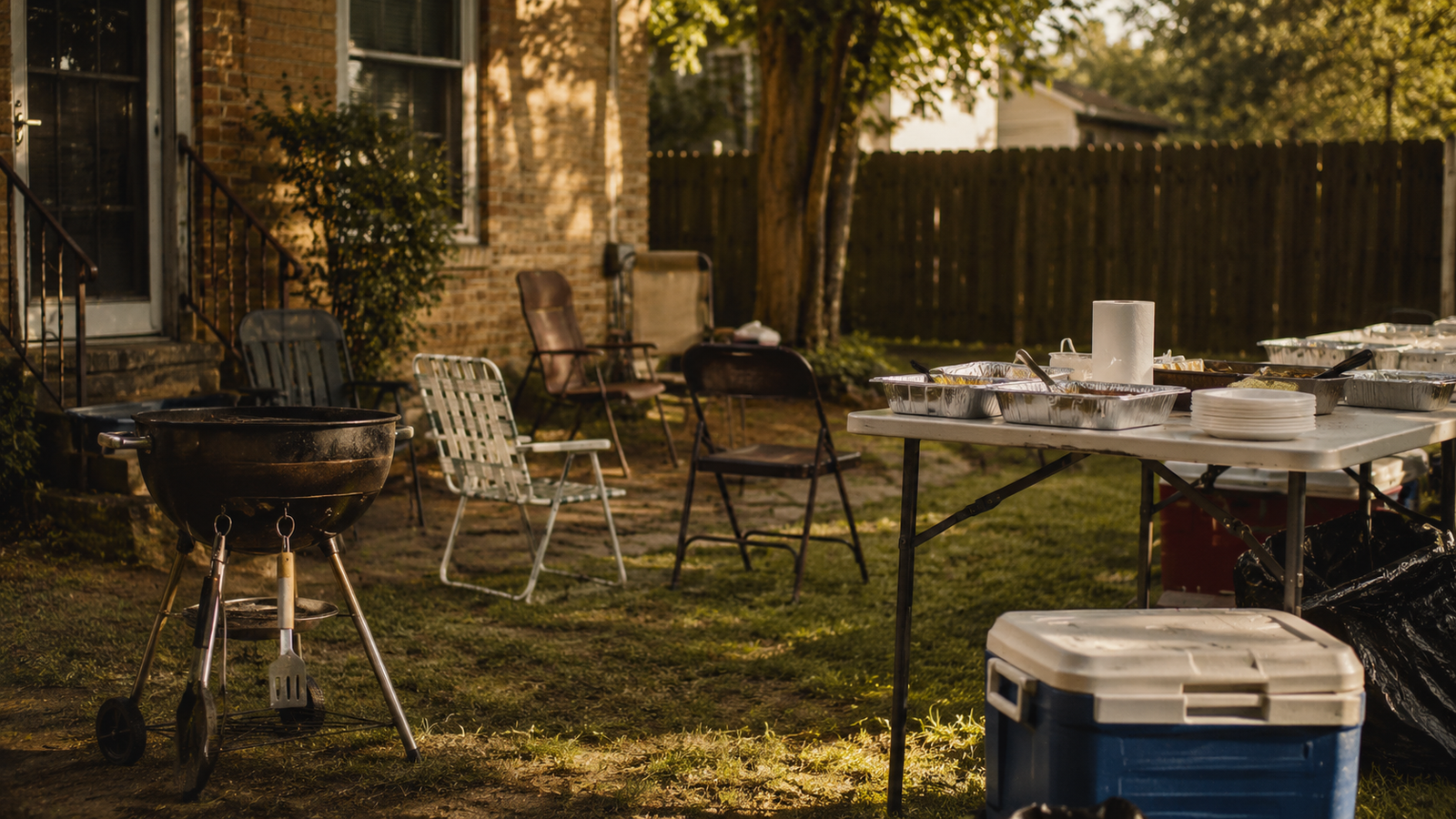
Informal rules in communities become very easy to understand when somebody walks toward the grill.
Some people at the cookout may approach it.
Others may stand nearby.
A few should probably avoid sustained eye contact with the grill altogether.
Nobody issued badges, and no certification exam was administered.
There was certainly no email from Human Resources titled “Updated Grill Access Policy.”
Still, everybody knows.
The person cooking may have spent forty-five minutes standing in smoke while everybody else was inside debating whether the potato salad looked right.
That person has authority now.
You do not simply walk over and begin moving meat.
Instead, you may ask a question, offer a beverage, or—depending on your standing—say something like, “You need anything?”
But grabbing the tongs?
That requires credentials.
The grill is only the beginning
The cookout has many rules like this.
There is an expectation about who brings ice and another about who brings folding chairs.
Someone will get sent to the store.
Another person controls the music.
Meanwhile, food distribution has its own governance structure.
Some people may begin fixing a plate.
Others have absolutely not earned that privilege yet.
Then there is usually somebody who arrived with nothing.
No ice, drinks, chips, or even the fragile confidence of a person carrying napkins.
Yet somehow, thirty minutes later, that person is holding a plate with structural integrity problems.
Again: there are rules.
The fascinating part is that most were never formally written down.
Instead, they were learned, observed, corrected, repeated, and passed along.
That is where the cookout starts looking less like a party and more like an institution.
Informal Rules in Communities Do Not Need a Handbook to Be Real
Everybody learns the room
Formal organizations love documentation.
Policies, procedures, flowcharts, and carefully maintained documentation all have their place.
However, groups also organize themselves through observation.
You arrive and watch.
Before long, you learn what people do.
More importantly, you begin noticing what people do not do.
At the cookout, nobody needs to explain every rule because the room is constantly teaching them.
The person tending the grill has a role.
Food-table management belongs to somebody else.
Meanwhile, the person keeping an eye on the children has a role whether they accepted that appointment or simply made the mistake of sitting where all the children could find them.
Older relatives often carry authority that needs no announcement.
And somebody controls the music.
That last position is not constitutional, but it is sensitive.
After all, a poorly timed song change can destabilize the entire afternoon.
Unwritten social rules become visible when somebody violates them
One of the easiest ways to discover a rule is to break it.
Try opening the foil before the food is ready and observe the response.
Alternatively, attempt to remove something from the grill without permission.
Collect the available data.
For maximum clarity, arrive late, empty-handed, and ask whether anybody made you a plate.
You will receive governance.
Possibly from several departments.
This is how unwritten social rules work.
People understand not only what others usually do, but also what the group expects people to do.
Those expectations matter because behavior is social.
We are constantly reading the room.
What do people like us do here?
What counts as helping?
Where does disrespect begin?
And, perhaps most importantly, what would make everybody look at me?
That last question has governed civilization more than we admit.
Informal Rules in Communities Work Better When Roles Are Clear
Roles create order without making everything formal
The rules matter, but roles may matter even more.
A functioning gathering has people who know what they are carrying.
Someone bought the food.
Another person started early.
Somebody knows where the extension cord is, while somebody else brought the extra table.
One person remembered ice.
Fortunately, another remembered that one bag of ice was an unserious amount of ice.
A relative is monitoring the food.
Nearby, a different relative is monitoring the people monitoring the food.
This sounds funny because it is.
It is also coordination.
Everybody does not need to do everything.
Instead, people need enough shared understanding for the parts to fit together.
Authority can be understood without being announced
Formal organizations often confuse title with authority.
The cookout is less sentimental about that distinction.
Usually, the person who knows what they are doing has authority over the thing they know how to do.
Grill authority belongs near the grill.
Food-table authority belongs near the food table.
If Aunt Denise has organized the family reunion for twenty-two years, nobody needs a workshop to determine whether Aunt Denise understands logistics.
She has evidence.
Of course, this is not a perfect system.
No human system is.
Expertise can become territorial.
Somebody may keep a role three administrations past usefulness.
And sometimes the person controlling the music has clearly abused executive privilege.
Still, something valuable remains underneath it.
The group usually knows where responsibility lives.
That clarity alone would improve a surprising number of organizations.
Community Norms Make Standards Easy to Recognize
A standard does not need a poster if everybody can see it
Organizations sometimes have standards nobody can explain.
Words like excellence, professionalism, ownership, and collaboration end up on beautiful lobby material.
Then a real situation arrives and nobody knows what any of them mean.
By contrast, informal systems often embed standards in recognizable behavior.
Bring what you said you would bring.
If you arrived early, help set up.
Do not create work for everybody else and then call your presence a contribution.
Also, do not touch what you were not assigned to touch.
And if somebody older asks you to carry something, this is probably not the moment to open negotiations.
Because people can see the standard, enforcement becomes easier.
Consequences do not have to be formal to be effective
Not every consequence is punishment.
Sometimes enforcement is a look.
Other times, it is a pause or a sentence beginning with your full first name.
An auntie saying, “Oh, so that’s what we’re doing now?” can also close a case efficiently.
No tribunal needed.
The norm has been restated.
Informal rules in communities create shared expectations
Research on social norms makes a similar distinction in more formal language.
Norms are not merely behaviors that happen often.
They also involve expectations about what people do and what others believe people ought to do.
As a result, those shared expectations can support cooperation because people are not forced to make every decision from scratch.
Research published through the National Library of Medicine has found that social norms can predict and influence cooperative behavior.
The cookout version is simpler.
You know what the room expects.
More importantly, the room knows that you know.
That is a powerful governance technology.
Informal Rules in Communities Can Make Cooperation Easier
Shared expectations reduce unnecessary negotiation
Imagine having to negotiate every part of a cookout from first principles.
Who should bring chairs?
Should children be supervised?
Is the grill available to the general public?
May one person take six ribs before everyone has eaten?
At what hour does music become appropriate?
And can someone arrive with three additional guests and no warning?
Society would collapse before the hot dogs were ready.
Shared expectations save time.
Because people do not have to reopen every question, coordination becomes easier.
That is one reason informal rules in communities can matter so much.
When people share enough understanding about behavior, contribution, and consequence, cooperation becomes less expensive.
You spend less energy wondering whether a rule exists.
Instead, more energy can go toward participating in the thing the rule is helping hold together.
Trust grows when people can predict one another
Trust is not only about affection.
It is also about predictability.
You expect somebody to bring what they said they would bring.
The person cooking is trusted to understand the food.
Meanwhile, somebody will probably notice if a child wanders too far.
And the elderly relative should get a chair before the cousin who has been sitting in air conditioning all afternoon.
These are small things.
Small things are where most systems live.
Research on cooperation similarly points to the role of shared norms in shaping cooperative behavior.
In practical terms, people coordinate more easily when they have usable cues about how others are likely to behave.
Over time, trust grows because the pattern keeps holding.
Not because everybody signed something.
Because people saw one another carry the standard.
Some Organizations Have More Policy and Less Governance
Documentation cannot rescue unclear ownership
This is where the cookout starts getting embarrassing for certain organizations.
A workplace may have an employee handbook, a strategic plan, a values statement, a project-management platform, and a leadership retreat.
Then six people sit in one meeting asking:
“So who actually owns this?”
Meanwhile, at the cookout:
“Who has the ice?”
“Derrick.”
Done.
This is not an argument against formal structure.
That would be ridiculous.
Large institutions need documentation, defined authority, legal clarity, succession planning, accountability, and systems that can survive beyond personal relationships.
However, paperwork is not the same thing as governance.
Governance answers the questions the binder cannot
Governance is whether people understand how decisions get made.
It clarifies who carries responsibility, which standard applies, and what happens when something fails.
The cookout often has answers to those questions.
Some committees do not.
That distinction matters because written systems still depend on lived behavior.
If nobody knows who owns a decision, another page in the handbook will not necessarily fix it.
Good systems make important behavior easier to recognize
The lesson is not “run your company like a barbecue.”
Please do not put that in a consulting deck.
The lesson is more useful.
Formal systems work better when the lived rules are as clear as the written ones.
People should know what responsibility looks like.
Likewise, they should know where authority lives.
When trade-offs appear, the standards that matter should already be legible.
And when somebody violates one, the result should be clearer than another meeting about values.
This is where Build What Holds becomes more than a slogan.
A system has to survive actual use.
Informal Rules in Communities Become Culture When They Get Passed Forward
Children are watching more than adults think
At some point, the child who used to be sent to get napkins becomes the adult who remembered napkins without being asked.
That is how continuity sneaks up on us.
Sometimes culture is taught directly: “This is how we do it.”
But a great deal of it is learned by standing nearby.
A child watches who helps and who gets corrected.
They notice what older people protect.
They learn what people laugh about and what nobody laughs about.
Eventually, they also notice which roles get handed to whom.
As participation repeats, it becomes memory.
Memory becomes expectation.
Eventually, expectation becomes tradition.
Ritual is one way a community stores knowledge
Research on intergenerational cultural transmission has found that community rituals can serve as channels for passing values, traditions, beliefs, and historical knowledge across generations.
Research available through the National Library of Medicine documents this transmission role in community ritual.
That should not surprise anybody who has watched a family gathering closely.
The event is doing more than feeding people.
It is also rehearsing a way of being together.
Who serves?
Who leads?
Who gets protected?
What does contribution look like?
Where does disrespect begin?
Which responsibilities belong to everybody, and which ones must somebody carry personally?
Eventually, another question arrives: what gets passed to the next person when the current carrier is no longer there?
That is Continuity.
It preserves essential function, knowledge, standards, and purpose even when the person carrying them changes.
The system survives when the room keeps teaching
This is the part worth protecting.
The cookout does not matter because every rule is perfect.
Some rules should change.
Other customs outlive their usefulness.
Certain roles need to be shared.
And somebody should absolutely be allowed to update the playlist.
Eventually.
The asset is not frozen tradition.
Instead, the asset is a community that knows how to carry useful knowledge socially.
A culture does not survive because everybody remembers the rule. It survives because somebody keeps teaching the room how the rule works.
And Maybe That’s the Part
We laugh because everybody recognizes the grill politics.
There are the foil pans, folding chairs, and the relative who came empty-handed but somehow left with enough food to establish a small restaurant.
Underneath all of that, though, is something sturdier.
People are coordinating, teaching, correcting, remembering, and passing things forward.
Not perfectly.
But often without a handbook, training seminar, or annual compliance module anywhere in sight.
That may be the most interesting thing about informal rules in communities: when they work, they can make a system feel natural even though generations of people have been actively maintaining it.
Receipts
A little evidence underneath the observation.
Social norms can actively support cooperation
Experimental research has found that social norms can predict and causally influence cooperative behavior. Researchers describe norms as informal behavioral rules supported by shared expectations about what people do and what others believe people ought to do. National Library of Medicine
Ritual can help carry culture across generations
Qualitative research on intergenerational cultural transmission found that community rituals can serve as important conduits for passing values, traditions, beliefs, and historical knowledge from one generation to another. National Library of Medicine
The chairs will get folded.
Eventually, the foil pans will disappear.
Somebody will ask who took the good serving spoon.
After everybody else has eaten, the person at the grill will finally sit down.
Then next time, most of the same rules will somehow still be there.
Nobody voted or circulated minutes.
The system simply kept teaching itself.
Funny as that may be, some of what holds us together has always worked like that.

Continue the Thought
Further Groundwork
If this stayed with you, keep following the questions underneath informal rules, participation, responsibility, and the systems communities learn to carry together.
House Rules: How Black Folks Turned Uno Into a Cultural System
Another look at how unwritten rules, shared memory, and cultural enforcement can create a functioning system.
Everyone Wants Community Until It’s Their Turn to Bring the Chairs
What shared belonging requires once somebody actually has to carry part of the work.
Build What Holds
The governing principle behind building systems durable enough to survive pressure, handoffs, and change.
Explore This Is Us (But Funnier)
More ordinary behavior, cultural rules, and the systems hiding inside them.
Groundwork Framework
The structure underneath this observation.
This article applies one governing principle and one structural condition from the Groundwork Daily architecture.
Core Principle
Build What Holds
Strong communities preserve the informal structures that make cooperation, responsibility, and shared life durable enough to survive beyond any one gathering or person.
Primary Condition · Carries
Continuity
Community rituals carry knowledge, standards, expectations, and roles forward so the system can retain its essential function even as the people carrying it change.
See the full Core Principles and Conditions architecture .
Meet the Builder

Micah Green
Builder, This Is Us (But Funnier)
Micah Green is the Groundwork Daily Builder behind This Is Us (But Funnier), an observational series about the systems hiding inside ordinary behavior, relationships, culture, family life, work, money, and the little rules people somehow agreed to without holding a meeting.