

System Updates examines the gap between the stories institutions tell about themselves and the structures that actually determine outcomes.
Did Reagan end free college in California? Not by himself. Ronald Reagan did not sign a single law that suddenly abolished tuition-free higher education at the University of California. But he was not a passive observer either. As governor, Reagan explicitly pushed tuition, sought reductions in university spending, and challenged the political settlement that had kept instruction tuition-free for California residents.
The University of California Regents ultimately controlled university policy and imposed the new Educational Fee. The Legislature controlled appropriations. University leadership fought over budgets and governance. Reagan, meanwhile, used the governorship to apply political and fiscal pressure.
That makes the popular argument too simple in both directions. Saying Ronald Reagan ended free college assigns one politician power he did not possess alone. Saying Reagan had nothing to do with it ignores the pressure he deliberately brought to the system.
This article focuses on California and Reagan’s role. For the broader national history, including CUNY, federal student aid, public subsidy, tuition, and student borrowing, see History of Free College in America: What Changed?
Did Reagan End Free College?
Ronald Reagan did not single-handedly end tuition-free higher education in California. The University of California Regents, not the governor acting alone, ultimately imposed the Educational Fee that marked a major departure from the state’s tuition-free tradition.
However, Reagan was a major political force behind the change. He proposed tuition, called for substantial reductions in university spending, defended greater student contribution, and used the governor’s office to challenge California’s existing higher-education financing model.
Was College in California Actually Free Before Reagan?
Before deciding whether Reagan ended free college, the word free needs definition. The University of California historically maintained a distinction between tuition for instruction and other student fees.
California residents were not generally charged tuition for instruction at UC. That did not mean attending the university cost nothing. Students had been paying an incidental fee since 1921, and those charges increased over time.
The distinction was nevertheless important. California’s 1960 Master Plan for Higher Education preserved the principle that instruction at the University of California should remain tuition-free for state residents. At the same time, the system allowed fees to support services and activities outside the direct cost of instruction.
So the accurate starting point is not that UC was literally free. It is that California had made a major policy choice to place a substantial share of instructional costs on the public side of the ledger rather than billing those costs directly to resident students.
California was not the only place where public institutions operated under a tuition-free or heavily subsidized model. New York City’s municipal colleges also maintained a long tuition-free tradition. The larger national pattern is examined in the history of free college in America.
Tuition-Free Is Not the Same as Cost-Free
A public institution can charge no tuition and still impose fees. Students can also face housing, transportation, books, food, and lost work time.
The historical question is therefore narrower and more useful: Who was expected to finance the instructional mission of the university?
What Did Ronald Reagan Actually Propose for California Colleges?
Reagan’s role becomes much clearer when his own policy argument is placed at the center of the history.
On January 17, 1967, only weeks after taking office, Governor Reagan issued a formal statement defending tuition as one possible response to California’s budget problems. He argued that state government faced a serious deficit and that higher education could not be exempt from efforts to reduce public spending.
Reagan did not present tuition as an isolated charge. He paired the proposal with a different model of student financing. Students who could not afford tuition, he argued, should have access to loans repaid after graduation, while scholarships should protect students without adequate financial means.
That financing philosophy matters. The proposal did not eliminate government involvement in higher education. Instead, it changed where part of the obligation would sit.
Under the existing model, taxpayers absorbed more of the university’s instructional cost before students arrived. Under Reagan’s proposal, students could be asked to contribute directly, while financial aid and borrowing would help some households manage the new obligation.
This was not merely a debate over whether California valued universities. It was a debate over who should pay for public higher education.
Did Reagan Cut Funding for the University of California?
Tuition did not appear in a vacuum. Reagan also proposed significant reductions in university funding. The University of California Academic Senate’s institutional history records that he proposed a 10 percent cut in university funding while also advocating tuition.
UC President Clark Kerr opposed both ideas. Kerr had been central to the development of California’s 1960 Master Plan and to the enormous expansion of the state’s higher-education system during the postwar era.
The disagreement therefore represented more than a technical budget dispute. Two different ideas about the relationship between the state, the university, and the student were colliding.
One model treated broad public investment in higher education as part of California’s development strategy. The other placed greater emphasis on budget restraint and on requiring students who benefited from university education to carry more of its direct cost.
What Did UC Berkeley Protests Have to Do With Reagan’s College Policy?
The fiscal argument cannot be separated completely from the politics surrounding the University of California in the 1960s. Reagan rose politically during a period of intense public conflict over student protest, campus governance, free speech, and the role of universities in American political life.
His campaign for governor included criticism of UC Berkeley and its leadership. According to the UC Academic Senate’s institutional history, Reagan’s election was based in part on a promise to clean up Berkeley. Shortly after taking office, Reagan joined other Regents in a 14-to-8 vote dismissing UC President Clark Kerr.
Those events make it tempting to tell the tuition story entirely as punishment for campus activism. That would also be too simple.
California faced genuine fiscal questions. The university was expensive. Enrollment had expanded. State government had competing obligations. Reagan had a broader philosophy about taxes, public spending, and the proper share of educational costs students should carry.
Still, campus conflict shaped the political environment in which those financial arguments were made. Fiscal policy and political legitimacy were interacting with each other.
Who Had the Power to Charge University of California Students?
This is where the question of whether Reagan ended free college becomes an institutional-literacy problem.
The governor of California is powerful, but the governor does not personally administer the University of California. UC operates under a distinctive constitutional governance structure in which the Board of Regents holds substantial authority over the university.
Several institutions therefore mattered at the same time.
The Governor: proposed budgets, shaped the political agenda, advocated policy changes, exercised executive and veto power, and participated in the Regents as an ex officio member.
The Legislature: controlled appropriations and made statewide fiscal choices that affected how much public funding UC received.
The UC Regents: governed the university and held authority over major university policies, including student charges.
University leadership: developed budgets, administered campuses, defended institutional priorities, and negotiated with political authorities.
This division of authority is why the statement the Regents did it, not Reagan is technically relevant but analytically incomplete.
Formal authority and political causation are not the same thing.
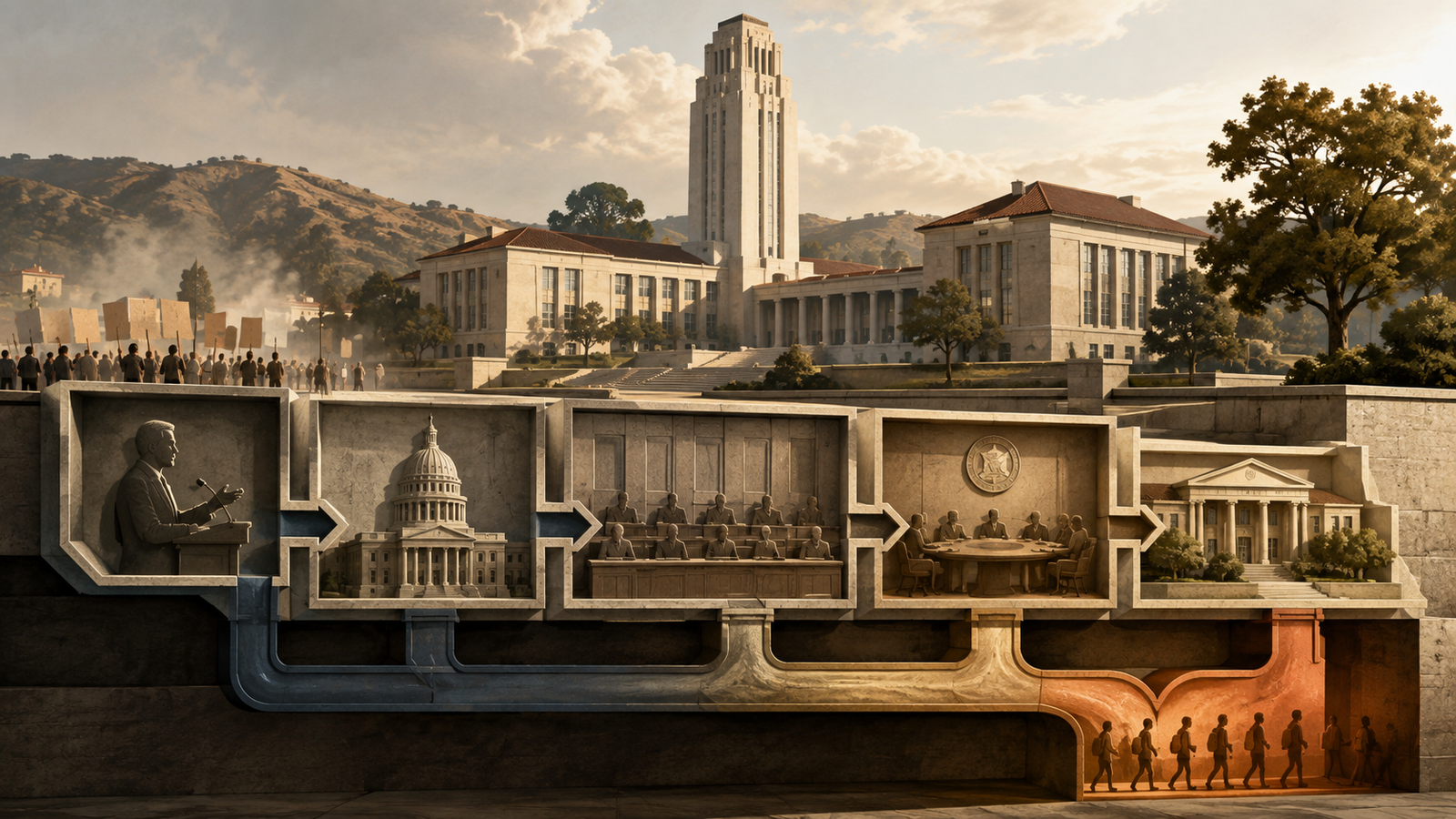
How Institutional Change Actually Moves
Authority → Pressure → Decision → Implementation → Persistence
A political leader may not possess the formal authority to make the final institutional decision. That leader can still alter budgets, appoint or influence decision-makers, change public expectations, raise the political cost of resistance, and create pressure that changes what governing institutions consider possible.
Another institution can then make the formal decision.
That distinction appears throughout public life. Presidents influence agencies they cannot personally command in every detail. Governors shape universities they do not directly administer. Legislatures change incentives that alter local decisions. Courts change the boundaries within which executives operate.
Looking only for the person whose signature appears on the final action misses much of how power works.
When Did the University of California Start Charging Tuition?
The answer depends partly on terminology.
In 1970, UC students began paying an additional charge known as the Educational Fee. UCLA’s historical account describes this as a symbolic move away from free tuition for California residents.
The name mattered because UC continued to distinguish the Educational Fee from formal tuition. The economic direction mattered too. Students were now contributing more directly toward university educational operations.
This creates one of the most persistent semantic disputes in the history of California higher education. Someone can correctly say that California did not suddenly introduce a charge formally called tuition in 1970. Someone else can correctly observe that the new Educational Fee represented a substantial departure from the state’s older tuition-free financing principle.
Both facts can be true.
The terminology became even more revealing decades later. In November 2010, the Regents approved changing the name of the Educational Fee to Tuition, effective July 1, 2011. UC now describes Tuition as the former Educational Fee and explains that it supports the university’s operating budget, including instruction and academic support.
That later rename does not make the terms historically interchangeable. It does show why arguments that depend entirely on the word fee can obscure the financing change that had already occurred.
So, Did Ronald Reagan End Free College in California?
The evidence supports a more precise verdict than the popular internet argument.
Claim: “Ronald Reagan single-handedly ended free college in California.”
Verdict: False. The transition involved the Regents, state finances, university governance, legislative appropriations, and multiple institutional decisions.
Claim: “Reagan had nothing to do with the change because the Regents imposed the fee.”
Verdict: False. Reagan explicitly proposed tuition, sought reductions in university funding, and publicly advocated greater student contribution.
Claim: “The University of California was completely free before Reagan.”
Verdict: Misleading. California residents generally did not pay tuition for instruction, but students already paid required fees and other attendance costs.
Claim: “The UC Regents, not Reagan acting alone, formally imposed the Educational Fee.”
Verdict: Correct.
Claim: “Reagan was a major political force pushing California toward greater student payment for public higher education.”
Verdict: Supported by the historical record.
Why the Reagan Free-College Argument Still Matters
The Reagan debate persists because people often want institutional change to have a single author. That makes history easier to narrate. It also makes political argument easier to weaponize.
But systems rarely change that cleanly.
A governor can create pressure without possessing unilateral authority. A governing board can formalize a change without originating the political demand for it. A legislature can reduce or increase resources without administering the institutions that eventually absorb those decisions.
When those roles are collapsed into a single story, readers lose the machinery.
The better question is not simply Who did it? The better sequence is:
Who had authority? Who applied pressure? Who made the formal decision? Who implemented it? Who kept the new arrangement in place after the original political fight ended?
That framework gives us a better way to understand what happened in California and a better way to read modern fights over public college tuition.
Higher Education Access & Finance
The Reagan Story Is One Part of a Larger College-Finance Shift
California’s transition did not happen in isolation. Across the United States, public higher education moved through different combinations of direct public subsidy, tuition, grants, federal aid, student lending, and household payment.
New York City’s tuition-free CUNY tradition followed a different path. Federal student aid changed the payment architecture again. State appropriations and student borrowing shifted the balance further.
Start with the broader pillar: History of Free College in America: What Changed?
Frequently Asked Questions About Reagan and Free College
Did Ronald Reagan make California colleges charge tuition?
Reagan strongly advocated tuition and reductions in university spending, but he did not possess unilateral authority to impose University of California student charges. The UC Regents governed the university and ultimately established the Educational Fee.
Did Ronald Reagan end free college in California?
Not by himself. Reagan was a major political force behind the shift, but the change required action across California’s higher-education governance and financing system. The Regents formally imposed the Educational Fee, while state appropriations, university leadership, and political pressure all shaped the transition.
Was college free in California before Reagan?
California residents generally did not pay tuition for instruction at the University of California, but students still paid required fees and living expenses. The system was better described as tuition-free for resident instruction than completely cost-free.
When did the University of California start charging students?
UC students paid required fees well before Reagan became governor. California residents began paying an incidental fee in 1921. The major structural change came in 1970, when UC added the Educational Fee.
Was UC tuition-free under California’s 1960 Master Plan?
Yes, in the specific sense that the Master Plan supported tuition-free instruction for California residents. It also permitted fees for services and other purposes, so tuition-free did not mean that students paid nothing.
What was the University of California Educational Fee?
The Educational Fee was an additional systemwide student charge introduced in 1970. It marked a significant movement toward greater student financing of university operations. UC later renamed the Educational Fee “Tuition,” effective in 2011.
Did Reagan cut funding for the University of California?
Reagan entered office advocating substantial spending reductions and proposed a 10 percent reduction in university funding. The final budget process involved negotiations and decisions among the governor, Legislature, Regents, and university administration.
Why did Ronald Reagan oppose UC Berkeley?
Campus protest, the Free Speech Movement, university governance disputes, and broader political unrest had made Berkeley a major political issue by the time Reagan ran for governor. His campaign criticized university leadership and promised a tougher response to campus disorder.
Who actually ended California’s tuition-free university model?
No single actor did. Reagan challenged the existing financing settlement and pushed tuition. The Legislature controlled appropriations. The UC Regents governed the university and imposed the Educational Fee. The durable shift emerged from the interaction among those institutions.
Was free college common elsewhere in America?
Tuition-free or heavily subsidized public higher education existed in several forms, but America never had a universal national free-college system. New York City’s municipal colleges and California’s public system are two important examples. For the national history, see History of Free College in America: What Changed?
The Groundwork
Ronald Reagan did not walk into Sacramento, flip a switch, and end free college. Public systems do not usually work that way. Authority was divided, financing moved through several institutions, and the Regents controlled the university’s formal decisions.
But Reagan’s lack of unilateral authority does not erase his role. He challenged the existing settlement, proposed tuition, pressed for lower university spending, and argued for a model in which students should directly carry more of the cost of higher education.
Understanding both facts at the same time is the point. Institutional literacy begins when we stop confusing the person who signs the final decision with the entire system that made the decision possible.
The System: Updated.
Old model: Ronald Reagan ended free college in California.
Updated model: Reagan did not abolish tuition-free higher education through a single executive act. He challenged California’s existing financing settlement, proposed tuition and lower university spending, and used the governorship to push a different philosophy of who should pay. The UC Regents ultimately imposed the Educational Fee. Reagan mattered, but the system changed through institutions.

Groundwork Architecture
Principle + Condition
Core Principle
Structure Is Mercy
When responsibility is divided among institutions, clarity matters. Ask who possesses formal authority, who controls resources, who applies pressure, who makes the decision, and who absorbs the consequences.
Primary Condition
Structure
Structure determines where authority sits, how pressure moves, which institution can act, and where responsibility ultimately lands. Without that map, political causation is easily confused with formal authority.
Join the Groundwork List
Groundwork Daily examines institutions, incentives, governance, civic power, and the structures underneath public life.
Continue Building
Search Hub
Foundation
Related System
Series

The Builder
Langston Reed
Langston Reed builds frameworks for understanding civic power, public policy, institutional behavior, and the systems that shape everyday outcomes.
Explore Langston Reed’s work | Civic Power & Policy | System Updates
Receipts
The central claims in this analysis rely primarily on Ronald Reagan’s gubernatorial archive and institutional records from the University of California.
- Ronald Reagan Presidential Library, January 17, 1967: Reagan’s formal statement defending tuition as a possible response to California’s fiscal problems and advocating loans and scholarships alongside student charges. Read the statement
- Ronald Reagan Presidential Library, April 1, 1967: Reagan again publicly defended the administration’s proposal for tuition in California’s university and college systems. Read the address
- University of California Academic Senate: institutional history documenting Reagan’s campaign conflict with Berkeley, his proposed 10 percent university funding reduction and tuition, Clark Kerr’s opposition, and the Regents’ 14-to-8 vote dismissing Kerr. Read the UC history
- UCLA Student Fee Advisory Committee: historical timeline documenting the 1921 incidental fee, the Master Plan’s tuition-free principle, and the 1970 Educational Fee. Review the fee history
- University of California Office of the President: current explanation of UC charges confirming that the Regents renamed the Educational Fee “Tuition,” effective July 1, 2011. Review UC’s description of charges