
Contents
Emotional presence in relationships rarely hinges on the controller itself. Instead, it shows up in what happens around it. Arguments about gaming usually surface something older and heavier: missed bids for attention, uneven emotional labor, unclear priority, and the creeping feeling that one person is carrying more of the relationship than the other.
In short, play is not the issue. Absence is.
That distinction matters because couples can spend years fighting the visible object while leaving the invisible problem untouched. Take away the gaming console and the same conflict may migrate to a phone, work, television, sports, the gym, social media, or something else.
If the relationship lacks reliable presence, another object will eventually become the symbol.
The Controller Was Never the Issue
Gaming is unusually easy to blame because everyone can see it.
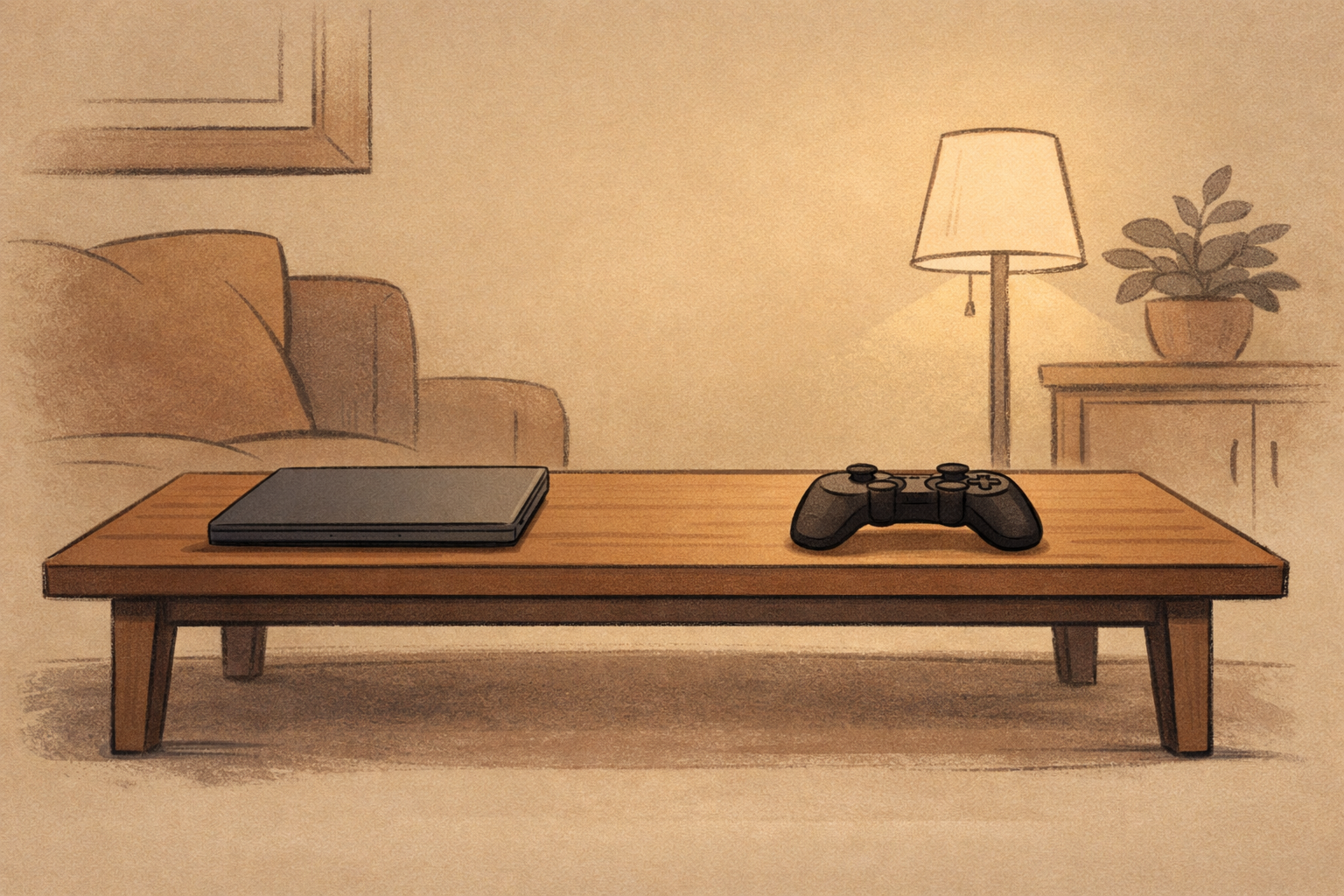
The controller is on the table. The headset is on. The screen is glowing. Time is passing. Meanwhile, emotional neglect has no blinking light that announces itself.
You cannot photograph unequal emotional labor as easily as you can photograph someone sitting in front of a television.
That visibility creates a convenient story: the game is the problem.
Sometimes it is. Often it is not.
The stronger question is whether the person playing still returns to the relationship with attention, reliability, contribution, and emotional availability intact.
That is why Groundwork Daily has consistently separated the hobby from the structure around it. In Are Video Games Bad for Adult Men?, the question was never simply whether a grown man should play. The question was whether play has an appropriate place inside a functioning adult life.
The same principle applies here.
Emotional Presence in Relationships Is a Practice, Not a Mood
Presence does not come from proximity alone.
A partner can sit six feet away and still feel emotionally absent. Another partner can be away for the afternoon and remain deeply connected through communication, reliability, and follow-through.
Therefore, emotional presence in relationships should not be confused with constant access.
Presence is a practice.
It looks like remembering what your partner told you yesterday. It sounds like asking how something important went without needing to be reminded. It appears when promises are kept, responsibilities are shared, and repair happens after conflict instead of being postponed indefinitely.
Most importantly, presence becomes visible when attention is inconvenient.
Anyone can be attentive when nothing else is competing for focus. The real test arrives when the game is good, the workday was hard, the phone is buzzing, and someone you love still needs you.
That is where priorities stop being theoretical.
Why Couples Blame the Visible Instead of the Invisible
Relationships naturally gravitate toward visible explanations.
The phone gets blamed because it is in the hand. Work gets blamed because the emails keep arriving. Gaming gets blamed because the controller sits in plain sight.
However, the deeper breakdown often happened before the object entered the argument.
Maybe one person has been initiating every difficult conversation. Perhaps one partner has become the default keeper of birthdays, appointments, household needs, emotional check-ins, and family logistics. Maybe affection has slowly become reactive rather than intentional.
None of those things has a convenient physical object attached to it.
Then one night, someone starts another gaming session and the resentment finally has somewhere to land.
Suddenly, the argument sounds like it is about video games.
It is not.
It is about everything the controller came to represent.
This is also why labeling gaming a relationship red flag without context misses the point. As explored in Is Gaming a Red Flag in Relationships?, gaming becomes concerning when structure disappears, responsibilities erode, or one partner repeatedly retreats from the relationship.
The controller becomes evidence. It is rarely the entire case.
Emotional Presence Depends on Shared Emotional Labor
Emotional labor is often misunderstood because people hear the phrase and assume it means talking about feelings all day.
It does not.
Emotional labor includes much of the invisible maintenance that keeps a relationship functional: noticing tension, initiating difficult conversations, remembering what matters to the other person, anticipating friction, repairing ruptures, and keeping shared life from drifting into neglect.
When one partner carries most of that maintenance, visible leisure can start to look like abandonment.
The gamer may think, “I am just relaxing.”
The other partner may be thinking, “I am still working.”
Those two realities can coexist.
That is where couples get into trouble. One person evaluates the gaming session as an isolated activity. The other evaluates it against the entire backlog of unfinished relational labor.
As a result, the fight becomes less about how long someone played and more about who gets to rest while someone else keeps carrying.
The answer is not to eliminate leisure. The answer is to share the load.
Priority Is What People Actually Feel
People rarely feel neglected because their partner has interests.
They feel neglected when the hierarchy becomes obvious.
If gaming repeatedly comes before conversation, repair, intimacy, parenting, household contribution, or plans the couple already made, the message lands whether anyone intended to send it or not.
That is why emotional presence in relationships requires more than saying, “Of course you matter.”
Priority must become visible through behavior.
Protected time matters. Follow-through matters. Ending a session when you said you would matters. Returning to the room without resentment matters.
This is where healthy gaming boundaries become useful. The purpose of boundaries is not to make one partner the parent and the other the child. The purpose is to make expectations predictable enough that neither person has to fight for basic attention.
That framework is developed more fully in How Couples Can Set Healthy Gaming Boundaries Without Power Struggles.
Presence Is Measured by the Return, Not the Activity
This may be the simplest test in the entire gaming cluster:
What happens when the leisure ends?
A man can play video games for an evening and return warm, attentive, and engaged.
Someone else can spend that same evening reading a book and use the book to avoid every difficult conversation in the house.
A partner can go fishing, exercise, watch football, attend a concert, take a long walk, work in the garage, or spend time with friends.
None of those activities tells you enough by itself.
The return tells you more.
Do they come back restored or irritated?
More available or more withdrawn?
Ready to participate or looking for another place to disappear?
This is the same distinction explored in Escape vs Rest: When Gaming Is Healthy and When It Becomes Avoidance. Rest returns capacity. Avoidance postpones responsibility.
The activity is not the measure.
The return is.
A Healthy Relationship Does Not Fear Leisure
A mature partnership should have room for individuality.
Partners should be able to enjoy hobbies without requesting permission like children. They should also be able to expect that leisure will not consume the structure that protects the relationship.
Those two ideas are not contradictory.
In fact, healthy relationships need both.
People need time together, and they need time that belongs to themselves.
This matters especially for men because male leisure often carries its own cultural baggage. Why Men Need Play and Why Society Only Sanctions Their Labor examines the tendency to treat male productivity as virtue while treating nonproductive play as suspicious.
That suspicion should not be imported uncritically into relationships.
A man sitting at home playing a game is not automatically failing his partner. Likewise, being home is not the same thing as being present.
Both truths need to survive the conversation.
When Gaming Really Does Become a Problem
None of this requires pretending that gaming cannot become unhealthy.
Concern is warranted when gaming consistently replaces important parts of life.
- Sleep repeatedly gets sacrificed.
- Work, school, or long-term goals begin to suffer.
- Household responsibilities consistently shift onto someone else.
- Gaming replaces intimacy, conversation, or shared time.
- The player becomes defensive whenever limits are discussed.
- Stopping feels unusually difficult even when consequences are obvious.
- Gaming becomes the primary way to avoid stress, conflict, sadness, or uncertainty.
At that point, couples should stop debating whether gaming is a respectable hobby.
That is no longer the relevant question.
The relevant question is whether avoidance, compulsive behavior, or emotional withdrawal has entered the relationship.
The Emotional Presence Framework
Instead of policing hobbies, couples can evaluate emotional presence using four simple measures.
1. Reliability
Do you do what you said you would do?
If gaming ends at 10:00, does it actually end around 10:00? If you agreed to dinner, bedtime, childcare, or a conversation, can your partner trust the agreement?
2. Responsiveness
Can your partner reach you emotionally?
Responsiveness does not mean dropping everything instantly. It means important needs do not disappear because another activity has your attention.
3. Shared Contribution
Does leisure happen after one person finishes carrying everyone else?
If one partner regularly gets recreation while the other manages the household, children, scheduling, or emotional maintenance, resentment is not a gaming problem. It is a fairness problem.
4. Return
What version of you comes back?
Rest should restore enough capacity to make participation easier. If leisure consistently leaves you less patient, less available, or less engaged, the system needs adjustment.
Together, these four measures move the conversation away from moral judgment and toward observable behavior.
That is more useful than arguing about whether adults are “supposed” to play video games.
- Are Video Games Bad for Adult Men? A Grounded Look at Play, Purpose, and Partnership
- Is Gaming a Red Flag in Relationships? Only When Structure Is Missing
- Escape vs Rest: When Gaming Is Healthy and When It Becomes Avoidance
- The Single Man’s Question: Is Gaming Holding Me Back or Helping Me Reset?
- Why Men Need Play and Why Society Only Sanctions Their Labor
- Not at the Club: Why Some Women Prefer a Man Who Plays Video Games
- How Couples Can Set Healthy Gaming Boundaries Without Power Struggles
- Stability Is a Deposit: What Men Need After They Come Home
- Peace Requires Maintenance: A Partnership Checklist
The Bottom Line
Relationships almost never deteriorate because someone enjoys a hobby.
They deteriorate when priorities quietly change, emotional labor becomes uneven, expectations stay unspoken, and presence slowly disappears.
The controller simply becomes the object everyone can see.
Remove it without fixing the underlying structure and another object will eventually take its place.
That is why emotional presence in relationships matters more than whether someone games, golfs, reads, exercises, watches sports, or disappears into work.
The real question is not whether your partner has somewhere to go.
It is whether they reliably come back.
The controller was never the problem.
Presence was always the point.
Frequently Asked Questions About Gaming and Emotional Presence
Is gaming bad for relationships?
No. Gaming itself is not inherently bad for relationships. Problems emerge when gaming repeatedly replaces communication, responsibility, intimacy, sleep, or emotional presence. Structure matters more than the hobby.
Can couples set healthy gaming boundaries?
Yes. Healthy gaming boundaries work best when couples agree on protected time together, household responsibilities, reasonable gaming windows, and what happens when an agreement is missed. The goal is coordination, not control.
What is emotional presence in a relationship?
Emotional presence is the consistent practice of attention, responsiveness, reliability, and follow-through. A present partner notices what matters, participates in shared life, and reconnects after work, stress, hobbies, or individual downtime.
Why does gaming sometimes feel like emotional neglect?
Gaming can feel like emotional neglect when it occupies time or attention that a partner expected would belong to the relationship. The problem becomes more intense when one partner also carries most of the household or emotional labor.
Why do couples blame gaming instead of the underlying relationship problem?
Gaming is visible. Uneven emotional labor, resentment, unclear priorities, and declining intimacy are much harder to see. As a result, the controller can become a symbol for deeper issues that already existed.
How do I know if gaming is rest or avoidance?
Look at what happens after the gaming session. Healthy rest generally helps a person return to life with more capacity. Avoidance postpones responsibilities, conversations, sleep, goals, or emotional discomfort. The return often tells you more than the activity itself.
Can a serious adult relationship include video games?
Absolutely. Adult relationships can include gaming, sports, travel, reading, exercise, nightlife, or any number of hobbies. The standard is not whether leisure exists. The standard is whether responsibility, presence, and mutual respect remain intact.
What should I do if my partner plays video games too much?
Start with the impact rather than attacking the hobby. Name what is being displaced, such as sleep, household contribution, intimacy, communication, or shared time. Then build clear agreements around the actual problem. If compulsive gaming continues despite serious consequences, additional professional support may be appropriate.
