

Economy & Ownership · Structural Failure
System failure from cost transfer begins long before the visible break. It starts when a structure repeatedly moves burden into people, assets, budgets, or future obligations without rebuilding the capacity required to carry it.
At first, the system may look stable.
The work still gets done. Buildings remain open. Services continue. Deadlines are met.
Yet apparent stability can be misleading.
A system can keep functioning because someone else has absorbed the cost that formal capacity no longer carries.
Stability Can Be Borrowed
Workers stretch. Repairs wait. Customers tolerate friction. Future budgets inherit obligations.
Those transfers can preserve the surface.
However, they also weaken the base.
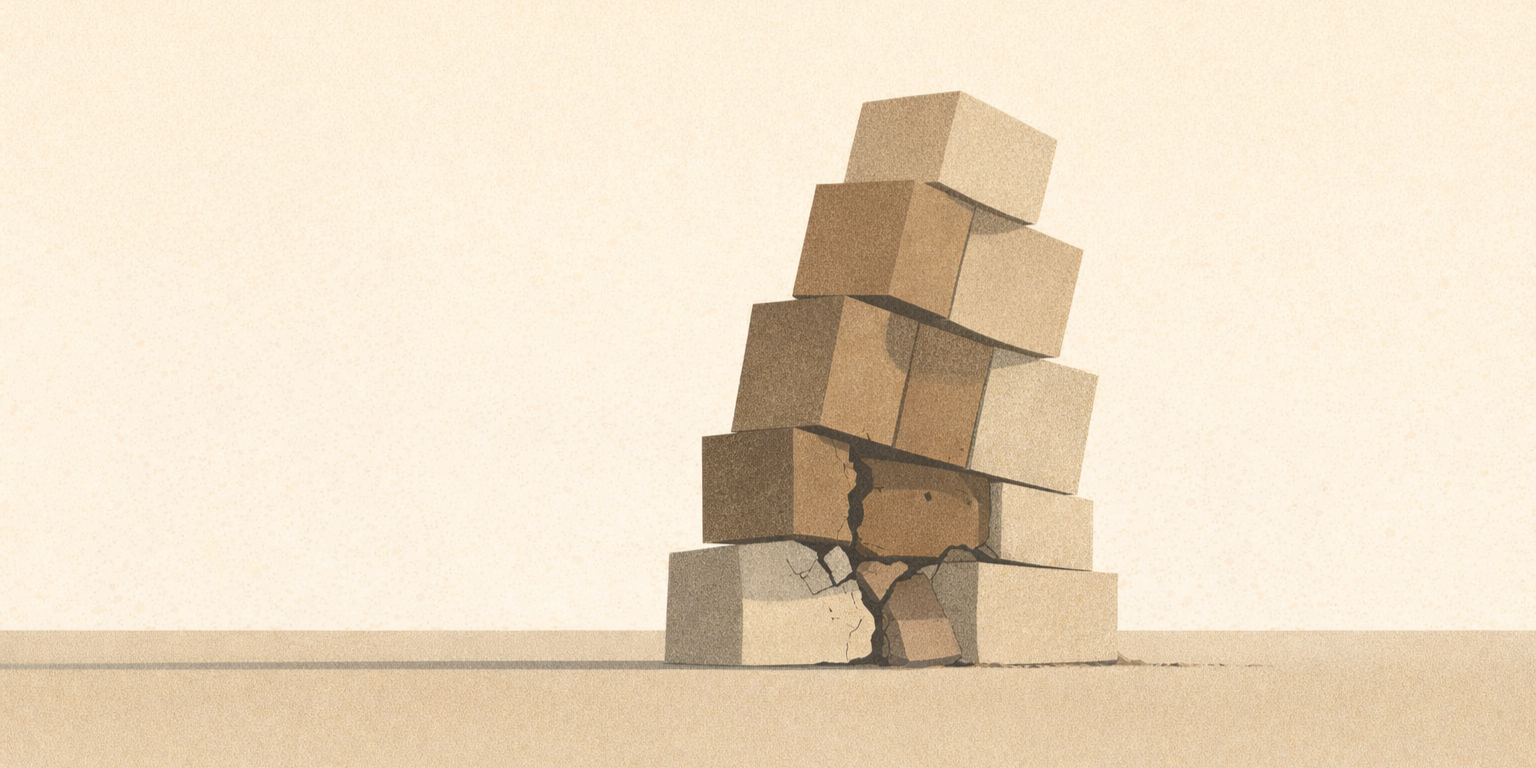
System Failure From Cost Transfer Begins With a Temporary Solution
Cost transfer is often rational in the short term.
A vacant position appears, so the remaining team divides the work.
A repair is expensive, so the institution waits another budget cycle.
Cash is tight, so maintenance, training, reserves, or staffing get pushed later.
A Transfer Can Solve the Immediate Problem
The system keeps moving.
That matters because not every burden transfer is reckless. Emergencies sometimes require temporary redistribution.
The danger begins when the temporary solution becomes permanent.
The Original Cost Has Not Disappeared
It has only changed form.
Payroll savings can become overtime. Deferred repair can become asset deterioration. Reduced staffing can become slower service and more management intervention.
Therefore, cost transfer should never be mistaken for cost elimination.
A System Can Look Stable While Its Capacity Is Falling
This is the most dangerous stage.
Output remains visible, while depletion stays hidden.
Leadership sees continuity and interprets it as proof that the structure can carry the load.
Survival Can Produce the Wrong Signal
If workers keep covering vacancies, the staffing gap can appear manageable.
If maintenance teams keep repairing symptoms, the capital problem can appear contained.
If customers continue tolerating delays, service weakness may look acceptable.
The system learns from continued operation.
Unfortunately, it may learn the wrong lesson.
Artificial Stability Depends on an Invisible Subsidy
Someone is giving the system more than the formal design provides.
That subsidy might be employee effort, customer patience, borrowed money, deferred maintenance, family labor, or future spending.
Once that subsidy becomes necessary for ordinary operation, the system is already weaker than it looks.
Institutional Capacity Determines How Much Cost Can Be Absorbed
Every system has a carrying limit.
People have limited time and attention. Equipment has operating tolerances. Budgets have finite reserves. Organizations have limited management depth.
Capacity is what determines whether pressure can be absorbed without degrading the underlying structure.
Pressure Is Not the Same as Overload
Healthy systems experience pressure.
Pressure can reveal capability, force prioritization, and encourage adaptation.
Overload begins when required output repeatedly exceeds the resources available to produce it safely or sustainably.
Capacity Can Erode Before Output Falls
That distinction matters.
A team may still hit deadlines while losing experienced employees. A building may remain open while maintenance backlog grows.
Likewise, a household may continue paying bills while reserves disappear.
Visible output can therefore remain stable even while resilience declines.
System Failure Usually Sends Warnings Before the Break
Failure rarely arrives without evidence.
More often, the evidence becomes ordinary.
Deferred Repair
Maintenance moves from preventive work toward recurring emergency intervention.
Workarounds
Temporary exceptions become the normal way the system gets through the day.
Churn
Experienced people leave faster than the institution can replace knowledge and capacity.
Quality Drift
Standards quietly decline because maintaining the original standard requires resources the system no longer has.
Escalation Dependence
Routine issues increasingly require managers, executives, or emergency intervention.
Reserve Depletion
Time, money, goodwill, maintenance capacity, or human energy is repeatedly spent without being rebuilt.
Warning Signs Become Dangerous When They Stop Feeling Unusual
The first workaround feels temporary.
The tenth workaround can start feeling like the job.
That shift is critical because the institution stops treating the workaround as evidence.
System Failure From Cost Transfer Accelerates When Damage Becomes Normal
Normalization is the moment when the system stops distinguishing between healthy operation and compensated failure.
Everyone knows the equipment is unreliable, so schedules include time for breakdowns.
Everyone knows staffing is thin, so managers assume people will stay late.
Everyone knows the process is confusing, so experienced workers maintain unofficial instructions.
The Workaround Becomes Part of the Design
That is the trap.
Once compensation becomes predictable, the institution can begin depending on it.
What started as resilience becomes hidden infrastructure.
Normalization Suppresses the Signal
Problems stop generating urgency because people have learned how to live around them.
As a result, leaders may see fewer complaints even while the structural weakness deepens.
Silence can therefore be misread as stability.
The System Breaks When the Receiving Layer Has Nothing Left to Give
Eventually, the transfer reaches a limit.
A worker leaves. A critical asset fails. A reserve runs out. Customers stop tolerating the friction. A budget can no longer postpone the obligation.
At that point, the system appears to fail suddenly.
The Visible Break Is Usually the Last Event
The real failure began earlier.
It began when capacity stopped being restored.
The final fracture only makes the accumulated deficit impossible to hide.
The Base Fails First Because the Base Was Carrying the Transfer
This is why structural failure often looks unfair from the bottom.
The people or assets closest to the operating work can fail first even though they did not create the decisions that produced the burden.
They were simply the place where the bill kept landing.
The Structural Failure Cycle
System failure from cost transfer becomes easier to diagnose when the sequence is made visible.
Cost Transfer
A burden is moved away from the place where it first appears.
Artificial Stability
The receiving layer compensates, allowing normal output to continue.
Capacity Erosion
Time, reserves, maintenance margin, labor capacity, trust, or operating flexibility begins to decline.
Normalized Degradation
Workarounds become ordinary, and weak performance becomes incorporated into expectations.
Failure Point
The receiving layer can no longer compensate.
Forced Repair
The system finally confronts costs that earlier transfers allowed it to postpone.
Markets Can Hide Structural Weakness Too
Businesses can appear healthy while relying on conditions that cannot last.
Low prices may depend on labor practices that create high turnover. Fast delivery may depend on excess workload. Cheap property can reflect deferred maintenance.
In each case, the market sees a price before it sees the full cost.
Price Can Conceal the Subsidy
If someone else is absorbing part of the cost, the visible price can look more efficient than the underlying system really is.
Eventually, the hidden subsidy may disappear.
When that happens, prices rise, service changes, labor leaves, assets fail, or the business model must be redesigned.
Discipline Requires the System to Price Its Own Weakness
This is where Discipline Before Dollars enters the analysis.
Discipline forces the institution to count what convenience prefers to ignore.
Temporary Savings Need a Future-Cost Test
What does delaying the repair create later?
What does leaving the position vacant require from everyone else?
What happens to quality, reliability, turnover, or future capital needs?
Those questions make the hidden bill visible earlier.
Stability Should Include Restoration
A healthy system does more than survive a difficult period.
It restores the reserves consumed during that period.
Otherwise, every recovery begins from a weaker base.
Repair Must Restore Capacity, Not Just Resume Output
After a breakdown, organizations naturally focus on restarting.
That is necessary.
However, restarting the same system can reproduce the same failure.
Identify the Hidden Subsidy
What kept the system functioning before the break?
Was it overtime, deferred maintenance, customer patience, emergency spending, manager intervention, or informal workarounds?
The answer identifies what the system was consuming.
Restore the Missing Layer
Add staffing where staffing was insufficient.
Repair assets where maintenance was deferred. Rebuild reserves where liquidity disappeared.
If decision rights were unclear, clarify governance.
Remove Dependence on Exceptional Effort
Extraordinary effort can save a system during crisis.
It should not be required for normal operation.
If ordinary performance depends on extraordinary people constantly rescuing the structure, the structure is still weak.
The Break Is Only One Stage in the Cost Sequence
This article explains how accumulated burden can turn hidden weakness into visible failure.
The next stage is accountability.
When Blame Moves, the Cost Moves With It examines what happens when responsibility begins traveling away from the point of control after failure.
Who Benefits When Blame Moves follows the protection created when authority and consequence separate.
Finally, Who Keeps Paying After System Failure traces the remaining burden to the workers, households, communities, and budgets that continue holding the structure together.
System Failure Is Usually a Capacity Story Before It Is a Collapse Story
The visible break gets attention because it is dramatic.
The real story begins earlier.
Costs move. Reserves decline. Workarounds become normal. Capacity stops being restored.
The Fracture Is the Final Signal
By the time the system visibly breaks, the underlying structure may have been weakening for years.
That is why the break should not be treated as the beginning of the investigation.
It is the end of the warning sequence.
Follow What the System Was Consuming
If stability depended on people working beyond capacity, assets operating beyond maintenance limits, or budgets pushing costs into the future, the system was borrowing stability.
Eventually, borrowed stability comes due.

Reinforce the Base Before the Break
Start by identifying the burden that keeps moving.
Then identify the person, asset, budget, or future obligation currently absorbing it.
Measure the Hidden Subsidy
Count overtime, deferred maintenance, workarounds, emergency intervention, reserve depletion, repeated exceptions, and the operational cost of keeping weak systems alive.
Restore Capacity Before Output Fails
The best repair happens before visible collapse.
Strengthen staffing, maintenance, reserves, governance, and operating systems while the organization still has room to act deliberately.
If the system can survive only by consuming the capacity of its foundation, the system is already breaking.
Where This Article Sits
This article examines what happens when cost keeps moving through a system faster than capacity is restored.
Its governing Core Principle is Build What Holds. Its primary Condition is Capacity, supported by Pressure.
Build What Holds
Durable systems must be able to carry their real obligations without depending indefinitely on hidden subsidies, exceptional effort, or deferred repair.
Building what holds means designing enough structural strength that ordinary pressure does not continuously consume the foundation.
Capacity
Capacity determines how much demand a person, asset, budget, or institution can carry before performance begins consuming the resources required for future operation.
When capacity is repeatedly exceeded without restoration, pressure becomes structural weakness.
Explore the Full Groundwork Architecture
Core Principles:Structure Builds Freedom · Stillness Is Strategy · Discipline Is Emotional Governance · Structure Is Mercy · Discipline Before Dollars · Accountability Is a Form of Strength · Build What Holds
Conditions:Capacity · Discernment · Alignment · Pressure · Overload · Recovery · Clear
Browse the complete Groundwork Daily Core Principles and The Conditions architecture.
Meet the Builder
Samual Drayton
Samual Drayton examines the structure beneath economic activity: who controls the asset, who sets the terms, who absorbs risk, and where cost finally settles after money or pressure moves.
His work follows ownership, pricing, leverage, institutions, markets, financial systems, incentives, and capital retention to reveal the difference between apparent stability and durable economic position.
Signature philosophy: Follow the money past the transaction. The structure tells you who controls the terms, who carries the cost, and where the value settles.
Sources & Supporting Evidence
- U.S. Government Accountability Office. Federal Real Property: Disposing of Unneeded Facilities Could Help Reduce Maintenance Backlog. GAO reported substantial federal building repair backlogs and warned that continued deterioration can create larger future costs and premature asset replacement. Review the GAO report .
- National Institute for Occupational Safety and Health. Stress and Work. NIOSH examines how job demands, available resources, work design, and organizational conditions can contribute to harmful workplace stress. Review NIOSH guidance .
- National Institute for Occupational Safety and Health. Psychosocial Hazards. NIOSH identifies potential hazards including excessive workload, inadequate staffing, unclear roles, long hours, low control, and inadequate organizational resources. Review the NIOSH material .
- Groundwork Daily. When Blame Moves, the Cost Moves With It. Companion analysis examining how responsibility and economic burden can move after system failure. Read the article .
- Groundwork Daily. Who Keeps Paying After System Failure. Companion analysis examining the people, budgets, and operating layers that continue carrying burden after formal capacity has failed. Read the article .
- Groundwork Daily. Build What Holds. The governing Core Principle for this article’s argument that durable systems must carry real obligations without relying indefinitely on hidden subsidies. Explore Build What Holds .
- Groundwork Daily. Capacity. The governing Condition for evaluating whether a person, asset, budget, or institution has enough usable strength to absorb demand without degrading future performance. Explore Capacity .