
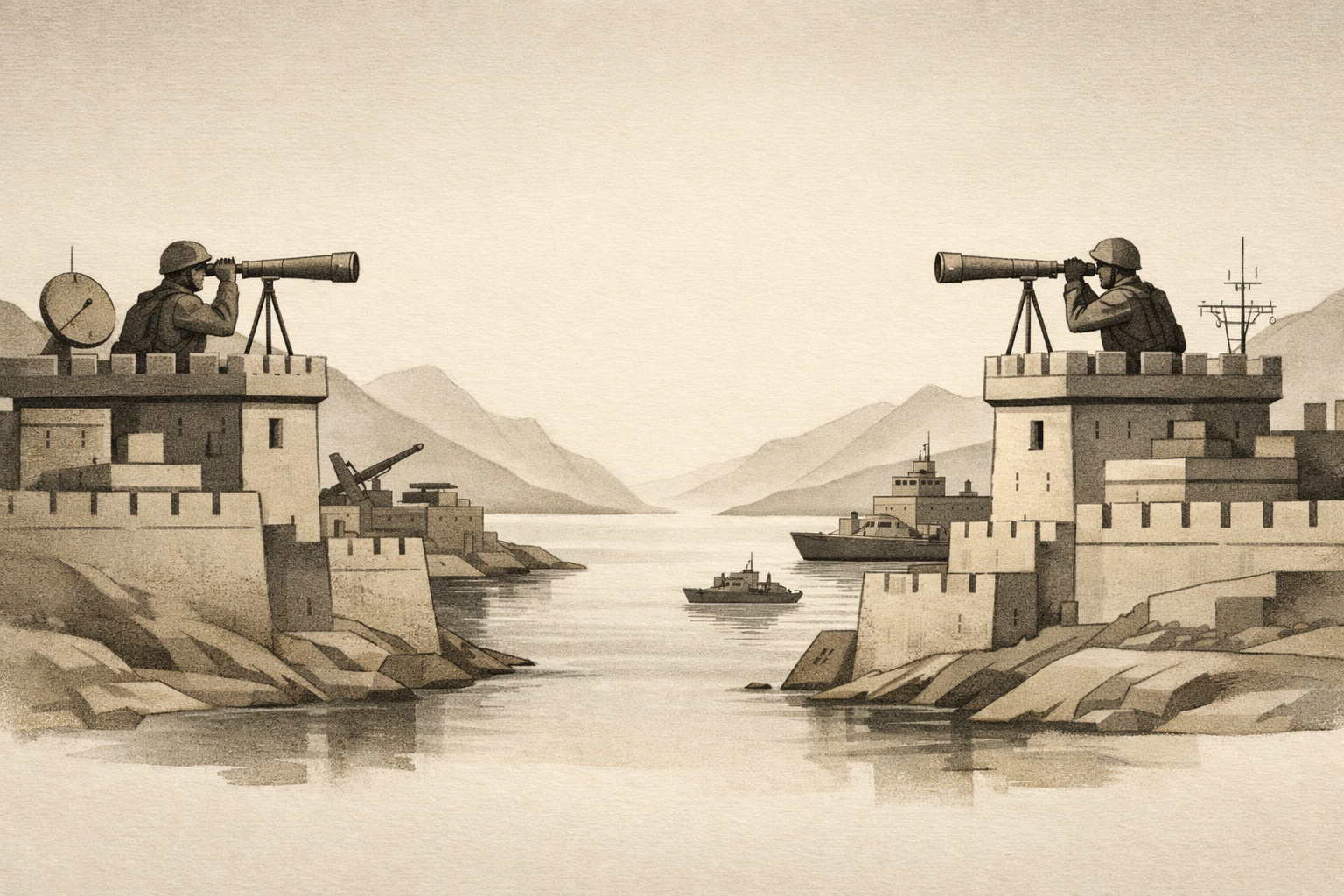
The security dilemma in geopolitics explains how countries can make one another less secure while each believes it is acting defensively.
A government expands its military, strengthens an alliance, deploys new technology, or moves forces because its leaders believe the country needs greater protection. A rival sees the same capability and faces a harder question: is this preparation defensive today but potentially offensive tomorrow?
The rival responds. It increases readiness, acquires new weapons, strengthens partnerships, or changes its military posture. The first government then reads that response as evidence that its original concern was justified.
What began as an attempt to create security becomes a feedback loop: uncertainty produces preparation; preparation produces interpretation; interpretation produces a countermove; the countermove produces more uncertainty.
System Updates
The System: Updated.
What looked like the problem: Rival countries arm because they expect conflict.
What the system reveals: Some rivalries intensify because each government’s attempt to become safer changes the threat perceived by the other.
Updated model: Security depends not only on how much power a state possesses, but on how capability is interpreted, communicated, constrained, and governed under uncertainty.

What the Security Dilemma in Geopolitics Means
The security dilemma describes a condition in which measures taken by one state to increase its security reduce the perceived security of another. The second state responds to protect itself, and those measures then appear threatening to the first.
Neither government has to begin with a plan for conquest for the relationship to deteriorate. The mechanism can emerge because governments operate under uncertainty and because military capability is often easier to observe than future political intent.
International politics makes that uncertainty difficult to remove. Treaties, alliances, diplomacy, economic relationships, international organizations, and international law can constrain behavior and facilitate cooperation. But no single authority can guarantee every state’s security against every possible future threat.
Governments therefore judge both intent and capability. Intentions can change after elections, leadership transitions, coups, economic crises, territorial disputes, technological breakthroughs, or changes in strategic doctrine. Weapons, bases, alliances, industrial capacity, logistics, and geography can outlast the political intentions surrounding them.
The Operating Loop
Uncertainty → Defensive Preparation → Rival Interpretation → Countermove → Greater Uncertainty
The danger grows when capabilities are difficult to classify as defensive or offensive, communication is weak, leaders expect the worst, and the perceived cost of being unprepared exceeds the perceived cost of escalation.
Why States Fall Into the Security Dilemma
Three pressures sit near the center of the problem: uncertainty, survival, and the dual use of power.
Uncertainty makes intention difficult to price
Governments rarely receive perfect information about another state’s plans. Intelligence agencies work with incomplete signals, deliberate deception, bureaucratic mistakes, conflicting assessments, changing political conditions, and leaders whose preferences may themselves change.
That creates an asymmetry. A government may know why it is building a capability. Its rival sees the capability without having equal access to the reasoning behind it.
Survival makes mistakes expensive
Underestimating a military threat can carry consequences far beyond an ordinary policy error: territorial loss, destruction of infrastructure, political collapse, military defeat, or large-scale loss of life.
That possibility encourages governments to prepare for threats they hope never materialize. The preparation may be rational from one capital and alarming from another.
Power rarely has only one use
Aircraft can defend airspace or strike targets. Naval forces can protect shipping or blockade it. Cyber capabilities can defend networks, collect intelligence, or disrupt an opponent’s systems. Satellites, drones, missiles, industrial capacity, logistics networks, and infrastructure can acquire different strategic meanings depending on how they are configured and used.
The result is a system in which preparation becomes information. One state says, “We are becoming harder to attack.” Its rival may hear, “You are becoming more capable of acting against us.”
Capability Is Visible. Future Intention Is Not.
Governments can count ships, monitor exercises, observe missile deployments, estimate industrial production, track alliance activity, and study military doctrine. Future intention cannot be measured with the same precision.
That gap gives interpretation enormous power.
A military exercise near a border might be routine training, political signaling, coercion, preparation for conflict, or several of those things at once. A defensive system can reassure one domestic audience while convincing a rival that the country deploying it will gain greater freedom to act.
Public rhetoric can deepen the problem. Political leaders communicate simultaneously with domestic constituencies, allies, military institutions, markets, and adversaries. Language intended to demonstrate resolve at home may sound like preparation for escalation abroad.
Strategic communication is therefore not cosmetic. It is part of the security architecture. When signals become inconsistent, ambiguous, or deliberately provocative, governments have fewer reasons to interpret uncertainty generously.
When Defense and Offense Look Too Similar
One of the central questions in security-dilemma theory is whether defensive and offensive capabilities can be distinguished.
Political scientist Robert Jervis’s influential formulation emphasized two variables: whether offense or defense has the advantage, and whether offensive and defensive postures can be distinguished from one another. When defense is relatively advantageous and defensive preparations are recognizable as defensive, the dilemma can become easier to manage. When offensive advantage appears strong and capabilities are difficult to distinguish, uncertainty becomes more dangerous.
Geography and technology help shape those conditions. Some environments make attack expensive, visible, slow, or difficult to sustain. Others may reward mobility, surprise, long-range strike capability, or the belief that acting first provides an advantage.
Those beliefs matter even when they are wrong. If leaders think waiting improves their position, a crisis can leave room for communication. If they believe waiting makes them increasingly vulnerable, delay itself begins to look dangerous.
That is why the security dilemma is not equally intense in every rivalry. The hardware matters. So do geography, doctrine, warning time, political relationships, and what leaders believe the hardware makes possible.
Not Every Conflict Is a Security Dilemma
This distinction is essential. The concept becomes analytically weak if every international confrontation is described as a security dilemma.
Governments sometimes seek territory, political domination, regime change, strategic leverage, resources, or other advantages that another state cannot concede without surrendering something it values. Leaders can also deliberately use coercion or military force because they believe aggression will produce gains.
Those cases should not be reduced to mutual misunderstanding.
If two states primarily want to avoid attack and preserve their existing position, yet each repeatedly makes the other more fearful while trying to become safer, security-dilemma dynamics may explain an important part of the escalation.
If one state cannot achieve its objective without taking something another is determined to keep, the underlying problem may instead be a direct conflict of interests.
The distinction changes the policy problem. Transparency, verification, and reassurance can reduce escalation driven by uncertainty. They cannot, by themselves, reconcile genuinely incompatible objectives.
How the Security Dilemma Appears in History
History is useful here as a diagnostic laboratory, not as a collection of perfect analogies.
Europe before World War I
The years before World War I are frequently examined through security-dilemma and offense-defense frameworks. European powers expanded armies and naval forces, relied on alliances, and developed mobilization plans while watching the capabilities and intentions of potential rivals.
Those dynamics did not by themselves cause the war. Nationalism, imperial competition, alliance politics, domestic pressures, the Balkan crises, the assassination of Archduke Franz Ferdinand, political decisions, and other forces belong to the larger causal history.
But the military system mattered because mobilization schedules, beliefs about offensive advantage, alliance commitments, and fear of strategic delay could reduce the amount of time available for political decision-making during a crisis.
The Cold War
The Cold War offers a different version of the problem. The United States and Soviet Union built enormous nuclear capabilities while deterrence remained central to each side’s strategic reasoning.
Nuclear weapons could make direct attack catastrophically costly. Yet each side still had to interpret changes in the other’s arsenal, delivery systems, missile defenses, warning systems, alliances, doctrine, and technology.
A capability designed to strengthen deterrence could raise a different question across the divide: did the change preserve mutual vulnerability, or could it eventually give one side a strategic advantage?
Arms-control agreements, inspections, notifications, hotlines, data exchanges, and other risk-reduction mechanisms became important partly because deterrence alone could not solve every information and interpretation problem. These structures did not require complete trust. They reduced how much each side had to infer in the dark.
System Distinction
Deterrence and the Security Dilemma Can Exist at the Same Time
Deterrence asks whether enough credible capability exists to make an opponent decide that aggression is too costly.
The security dilemma asks what happens when building that capability changes the opponent’s own perception of danger.
The two mechanisms are not opposites. A military posture can deter one action while simultaneously creating pressure elsewhere in the relationship. Strategic analysis has to examine both effects rather than assuming that a capability is either stabilizing or destabilizing in every respect.
Why the Security Dilemma Extends Beyond Armies
Modern strategic competition increasingly runs through systems that do not look military at first glance.
Cyber capabilities, satellites, artificial intelligence, semiconductor production, undersea cables, cloud infrastructure, energy networks, ports, shipping routes, supply chains, critical minerals, industrial capacity, and telecommunications infrastructure can all affect national power.
That makes the boundary between economic resilience and strategic capability harder to draw.
A semiconductor policy can be described domestically as industrial resilience while another government interprets it as technological containment. Investment restrictions can be presented as national-security safeguards while targeted governments view them as attempts to limit future power. Infrastructure investment can improve economic reliability while also creating logistical routes, dependencies, redundancy, or strategic leverage.
Groundwork Daily examines the material side of this problem in Are Wars Really About Resources? The Long Debate From W.E.B. Du Bois to Modern Geopolitics . Material interests and security fears do not have to compete as explanations. They can operate simultaneously.
The companion Groundwork analysis of how the internet physically works reveals the same structural reality. Digital power still depends on cables, data centers, electricity, equipment, routes, and physical territory. A system can look commercial or technological until a crisis exposes its security function.
Why This Matters Outside Foreign-Policy Circles
Geopolitical competition does not stay inside defense ministries.
Governments respond to security concerns through defense budgets, trade policy, sanctions, export controls, industrial subsidies, alliance commitments, infrastructure investment, research restrictions, energy policy, technology controls, and procurement.
Those choices can affect consumer prices, employment, public spending, universities, transportation systems, technology access, energy costs, manufacturing, and the industries communities depend on.
That does not mean every economic policy should be reduced to military rivalry. The more useful question is whether policymakers have begun treating an economic system as a security system.
Once that shift occurs, governments may accept costs that would look inefficient under ordinary market logic because resilience, autonomy, deterrence, redundancy, or strategic capacity has become the priority.
Institutional literacy therefore requires looking beneath the visible policy. Ask what capability is being built, what vulnerability it is supposed to address, what alternative uses the capability has, how rivals are likely to interpret it, and what mechanisms exist to keep interpretation from becoming uncontrolled escalation.
Can the Security Dilemma Be Managed?
It cannot be solved simply by asking countries to trust one another.
Trust without verification can create vulnerability when the consequences of miscalculation are severe. The more realistic objective is to build structures that make behavior easier to interpret and give governments more options before they assume the worst.
Communication
Direct diplomatic and military communication can help governments clarify unusual activity during crises. Hotlines and military-to-military channels matter most when normal interpretation is breaking down and decision time is shrinking.
Notification
Advance notice of major exercises or certain military activities can help distinguish routine preparation from unexpected mobilization.
Verification
Inspections, monitoring, data exchanges, and other verification mechanisms can reduce the amount of strategic behavior that must be interpreted through assumption alone.
Arms control and restraint
Agreements can constrain particular weapons, deployments, activities, or locations when governments conclude that mutual limits produce more security than unconstrained competition.
Decision time
Perhaps the least visible resource is time. Systems become more dangerous when leaders believe they must act before information can be checked, communication can occur, or political alternatives can be tested.
These mechanisms do not eliminate rivalry. Their function is narrower and more practical: prevent every ambiguous action from automatically producing the most dangerous available interpretation.
The Institutional Objective
Controlled Uncertainty
Perfect trust is not the operating requirement.
Competitors can remain competitors while building rules that reduce the probability that routine behavior is mistaken for preparation for war.
The institutional test is whether a relationship contains enough communication, verification, restraint, and decision time to keep fear from automatically setting the tempo.
The Hard Trade-Off: Deterrence Without Unnecessary Escalation
Governments cannot resolve the security dilemma simply by becoming incapable of defending themselves. If another state has aggressive objectives, weakness can increase vulnerability to coercion or attack.
Credible defense can therefore contribute to stability by increasing the expected cost of aggression and reassuring allies that commitments can be honored.
But additional security measures can produce secondary effects.
More weapons may strengthen deterrence while increasing uncertainty. Stronger alliances may discourage attack while being interpreted by outsiders as strategic encirclement. Faster military systems may improve responsiveness while reducing the time available to determine whether a warning is real.
There is no universal formula for balancing these pressures. Outcomes depend on technology, geography, doctrine, political relationships, credibility, domestic politics, institutions, and whether the underlying objectives of the states are compatible.
The central analytical task is therefore not to label every buildup “defensive” or every response “aggressive.” It is to trace the feedback effects each action creates inside the wider system.
What to Watch in a Developing Security Dilemma
Weapons inventories matter, but the system is larger than the inventory.
Watch how governments explain new deployments and whether rivals accept those explanations. Track changes in doctrine, force posture, alliance commitments, exercise patterns, warning times, industrial capacity, and technologies that change how quickly a government can move from readiness to action.
Watch the institutional infrastructure too. A strategic relationship becomes more fragile when diplomatic channels close, military contacts weaken, verification arrangements disappear, arms-control structures collapse, or leaders increasingly communicate through public threats rather than reliable private channels.
Domestic political language can reveal another layer. If compromise is routinely described as weakness and every rival action is treated as proof of hostile intent, governments can lose the political space required for de-escalation.
The most useful question is not simply whether countries are becoming more powerful. It is whether growing power is accompanied by institutions capable of explaining, constraining, verifying, and slowing how that power is interpreted.
The Groundwork
Security Is Not Only What You Build. It Is What Others Believe You Built It to Do.
The security dilemma exposes a limit in raw measures of power. A country can become militarily stronger while the relationship around it becomes strategically more dangerous if every move generates a larger countermove.
That does not mean governments should assume peaceful intentions or abandon deterrence. Some threats are real. Some objectives are incompatible. Some states deliberately use coercion or force.
The discipline is learning to distinguish those conditions from situations where uncertainty itself is amplifying the danger. Power matters. But power also produces signals, interpretations, incentives, timelines, and reactions. The system is the interaction among them.
Groundwork Principle
Stillness Is Strategy
The security dilemma becomes most dangerous when pressure begins deciding the timetable. A rival acts. Fear compresses the decision window. Leaders feel compelled to respond before they fully understand what the action means.
Strategic judgment requires preserving enough space between signal and response to test assumptions without pretending the risk is not real.
Put the principle to work with one question whenever escalation begins to look automatic: Who is setting the tempo?
If fear, public pressure, incomplete information, or an opponent’s timetable is determining when a decision must be made, restoring decision space can itself become a form of strategic capacity.
Continue Building
Follow the Architecture of Power
The security dilemma explains one mechanism behind strategic competition. These paths extend the analysis into resources, infrastructure, institutional literacy, and the wider System Updates framework.
Go Deeper — Material Power
Are Wars Really About Resources? The Long Debate From W.E.B. Du Bois to Modern Geopolitics
Examine how resources, economic structures, dependence, and material incentives can operate alongside security fears.
Related System — Infrastructure
Digital Infrastructure Isn’t Virtual: How the Internet Physically Works
Trace the cables, data centers, electricity, routes, and physical systems underneath digital power.
Foundation — Institutional Literacy
Building Institutional Literacy
Build the habit of tracing authority, incentives, constraints, capacity, and institutional responsibility beneath visible events.
Continue — System Updates
Explore System Updates
Continue beneath public events into the institutions, incentives, infrastructure, and feedback loops producing recurring outcomes.
Groundwork Architecture
Where This Analysis Fits
Groundwork Daily treats public events as outputs of deeper systems. This article sits at the intersection of three layers:
What governments can actually deploy, produce, protect, deny, or destroy.
How states infer intention from observable capability under incomplete information.
The rules, channels, verification systems, and decision structures that keep feedback from becoming automatic escalation.

Meet the Builder
Langston Reed
Builder, Civic Power & Policy
Langston Reed helps readers understand how institutions, governance, and public policy shape everyday life. His work develops institutional literacy by translating complex civic systems into practical frameworks that remain useful after the news cycle moves on.
Research Trail
Receipts
These sources support the article’s treatment of the security dilemma, offense-defense dynamics, deterrence, strategic stability, escalation risk, and the institutions governments use to reduce uncertainty.
Robert Jervis — “Cooperation under the Security Dilemma,” World Politics
The foundational 1978 analysis used here for the security-dilemma mechanism and the importance of the offense-defense balance and the ability to distinguish defensive from offensive postures.
Glenn H. Snyder — “The Security Dilemma in Alliance Politics,” World Politics
Extends security-dilemma analysis into alliance behavior and helps establish an important limit of the concept: uncertainty among security-seeking states should not be treated as equivalent to a situation in which a state has revealed expansionist objectives.
Stockholm International Peace Research Institute — Risk Reduction in Northern Europe
Contemporary analysis of military-to-military communication, dangerous encounters, dialogue, deployment limits, and other mechanisms intended to reduce escalation risk under conditions of strategic competition.
SIPRI — Calibrating Deterrence: Disruptors of Strategic Stability on NATO’s New Northern Flank
A 2026 examination of deterrence, strategic stability, military activity, arms-control erosion, and the problem of managing security-dilemma effects while maintaining credible defense.