
Article Map
The Digital Conflict Architecture · Part 3 of 5
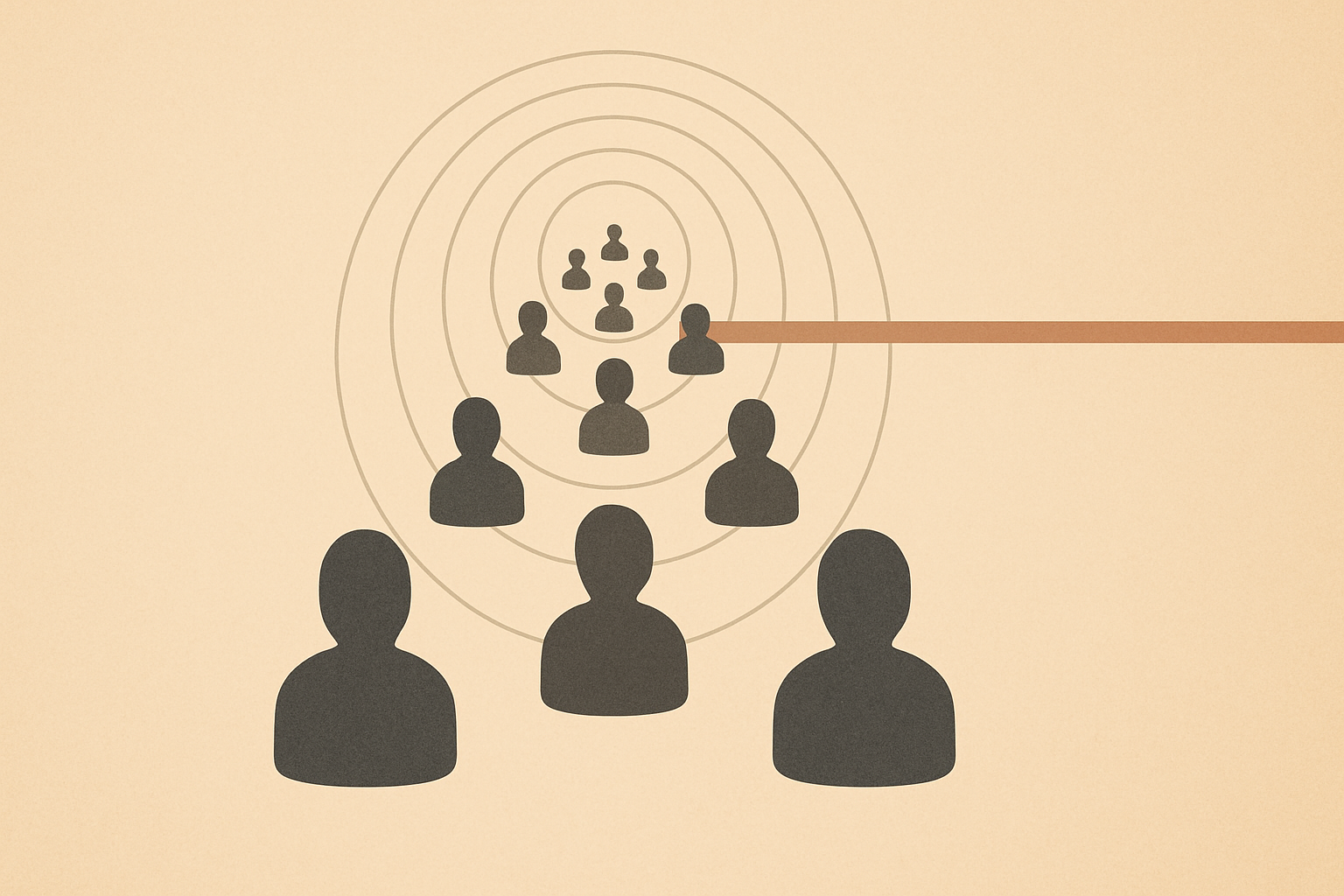
The illusion of consensus appears when a viewpoint becomes so visible that people begin treating visibility as evidence of widespread agreement. A claim shows up repeatedly, reactions multiply, screenshots circulate, and similar arguments begin appearing across a feed. Before long, people start asking why “everyone” believes something that may never have been measured in the first place.
Online gender debates are especially vulnerable to this mistake. A small number of highly active accounts can generate enormous amounts of content. One provocative post can produce replies, reaction videos, quote posts, commentary, reposts, and arguments about the arguments.
None of that tells us how common the underlying belief actually is. Visibility tells us what is receiving attention. Consensus tells us what a population broadly believes. Those are different measurements, and confusing them can badly distort how people understand one another.
The Core Distinction
What the Feed Can—and Cannot—Tell You
Visibility tells you what you are seeing.
Engagement tells you what people are reacting to.
Repetition tells you what is circulating.
Prevalence tells you how common something actually is.
Consensus tells you whether a broad group actually agrees.
The Illusion of Consensus Starts by Confusing Visibility With Agreement
Most people experience social platforms through feeds rather than representative samples of a population. That distinction should change how online claims are interpreted. A feed is a selection environment, not a census.
What appears there can be influenced by accounts someone follows, prior behavior, social connections, searches, engagement, platform design, recommendation systems, and the activity of other users. The exact mix changes by platform and by person.
This means two users can receive very different impressions of the same public conversation. One feed may make a position look dominant while another barely shows it at all.
The fact that a claim surrounds you online is evidence about your information environment. It is not yet evidence about the population outside that environment.
How Repetition Creates the Illusion of Consensus
Repetition is powerful because people often use frequency as a shortcut. If something appears again and again, it starts to feel important. If many accounts repeat the same conclusion, the conclusion can begin to feel broadly shared.
Online, one underlying event can create dozens or hundreds of repetitions. The original post appears first. Reaction accounts respond to it. Other users respond to those reactions. Screenshots circulate, podcasts discuss the screenshots, and commentary accounts summarize the controversy.
A user may now encounter the subject ten different times while still looking at one underlying incident. Ten pieces of content are not necessarily ten independent pieces of evidence.
That distinction matters. Repetition can increase perceived scale without increasing actual scale.
Provocative Claim
↓
Strong Reaction
↓
Additional Distribution
↓
Repeated Exposure
↓
Perceived Prevalence
↓
Illusion of Consensus
Perceived Belief Can Change Behavior
What people think others believe matters even when their estimate is wrong. Social behavior is partly shaped by expectations about what a group accepts, rejects, rewards, or punishes. If a viewpoint appears overwhelmingly popular, people may adjust before they know whether the appearance is accurate.
Some become quieter because they assume their position is socially isolated. Others become more confident because the surrounding environment appears to validate them. People who were undecided may interpret apparent consensus as useful social information.
This is why distorted perception can matter even when nobody changes a deeply held belief. A mistaken estimate of what everyone else thinks can still change what people say, what they avoid saying, and which positions appear safe to express.
The illusion of consensus is therefore not just a perception problem. It can become a behavioral feedback loop.
Silence Is Hard to Interpret Online
Silent users are one of the biggest blind spots in online discourse. People choose not to comment for many reasons. They may dislike confrontation, fear being misunderstood, lack enough information, feel exhausted by the discussion, or simply have no interest in performing an opinion in public.
That absence creates a measurement problem. Visible participants are easier to count than invisible nonparticipants, yet the visible group may differ from everyone who chose not to enter the conversation.
Silence also cannot automatically be read as disagreement. Some quiet users may agree. Others may strongly object. Many may hold mixed views that do not fit the binary framing of the debate.
The disciplined conclusion is modest: silence leaves information missing. It should not be converted into whatever interpretation best supports the loudest side.
Why Online Gender Debates Produce Consensus Illusions So Easily
Gender debates combine subjects that already carry emotional weight: attraction, rejection, safety, sex, money, marriage, family, masculinity, femininity, respect, status, and power. A personal experience can therefore become a group-level argument with very little distance between the two.
One bad date becomes evidence about modern men. One financial dispute becomes evidence about modern women. A painful divorce becomes a general theory of marriage. An extreme clip becomes proof that an entire generation has lost its mind.
The leap feels persuasive because other users often supply matching anecdotes. Yet anecdotes do not solve the denominator problem. A thousand stories can establish that a behavior exists while still telling us very little about how common it is among millions of people.
Online gender debates become distorted when the question shifts from “Does this happen?” to “Is this what most people are like?” without gathering evidence capable of answering the second question.
Personalized Feeds Can Create Different Social Realities
Personalized distribution makes consensus illusions harder to detect because people do not encounter one common internet. A user who repeatedly watches relationship grievance content may receive more opportunities to see it. Another person may receive almost none.
Both can look at their own environment and believe they are observing society directly. In reality, they are observing a filtered sample shaped by their behavior, networks, platform systems, and the content available to recommend.
The effect can be particularly strong when the feed repeatedly supplies examples that confirm an existing expectation. Someone who already believes men are unreliable can easily interpret each new example as another data point. Someone who believes women are exploitative can construct the opposite archive.
Neither archive is automatically fictional. The problem is that a personalized collection of examples does not provide a reliable denominator.
Platform Incentives Can Magnify the Illusion of Consensus
Platforms organize attention, but that does not mean every platform deliberately prefers conflict or every ranking system behaves the same way. The stronger claim is that emotionally charged group conflict can produce substantial engagement, giving platforms and creators more behavioral signals around the dispute.
Those signals matter because online distribution systems have to make choices about what appears next. Material that repeatedly triggers viewing, commenting, sharing, following, or return visits can gain additional opportunities for exposure depending on the platform and ranking system.
Audience behavior compounds the process. People who oppose a claim can still help circulate it by quote-posting, reacting, criticizing, or sharing it with others. The content receives attention from supporters and opponents at the same time.
The system does not need to establish that the viewpoint is popular. It can make the viewpoint highly visible because the argument around it is active.
How to Tell Whether an Online View Is Actually Widespread
Population-level claims require population-level evidence. Reliable surveys, administrative data, representative polling, large datasets, longitudinal research, and other appropriately designed methods can tell us far more about prevalence than a feed can.
Even those sources need scrutiny. Who was sampled? How was the question worded? What population does the research represent? Was the result measured nationally, locally, among platform users, or inside one demographic group?
Online engagement data answer different questions. They can reveal that a topic is attracting attention or that a particular community is active. They usually cannot establish what the entire public believes without additional evidence.
The analytical discipline is matching the evidence to the claim. A viral post can tell you what went viral. It cannot automatically tell you what America thinks.
How to Resist the Illusion of Consensus
Start by separating the claim from its apparent popularity. Ask whether you are evaluating the evidence for the idea or reacting to the number of times the idea has appeared. Those are different judgments.
Look for unique sources rather than repetitions of the same incident. Ten reaction videos built around one clip do not create ten independent examples. A large comment section also tells you more about the people who chose to comment than about everyone who encountered the post.
Seek evidence outside the feed when the claim concerns a broad population. Public datasets, representative surveys, research, and direct experience across varied environments provide a better reality check than a personalized recommendation stream.
Most of all, resist the phrase “everyone thinks.” It usually hides a measurement question that has not been answered.
Recognition Skill
Six Questions That Test Apparent Consensus
- How many independent people or sources am I actually seeing?
- Am I looking at one incident reproduced many times?
- What population is the claim supposed to describe?
- Where is the denominator?
- Who is missing because they did not participate publicly?
- What evidence exists outside the feed?
What Comes After Perceived Consensus
Once a viewpoint looks widespread, the source of the viewpoint becomes more important. Who is actually speaking? Are the accounts identifiable? Is the same person operating several profiles? Is the statement attached to a reputation, community, location, or history that helps readers interpret it?
Those questions lead to Part 4 of the Digital Conflict Architecture. Anonymity can protect legitimate privacy and vulnerable speech, but it can also remove information people normally use to evaluate credibility, social cost, and representativeness.
Continue to Part 4: When Anonymity Shapes Gender Narratives →
Research Trail
Receipts
“The illusion of consensus” is used here as a Groundwork explanatory frame for several documented social and digital mechanisms. The sources below support the analysis of network visibility, social-norm perception, platform behavior, and online information environments.
Nature — Redesigning Algorithms to Intervene on Social Norm Misperceptions During a National Election
Experimental research examining how feed design affected exposure to particular forms of content and users’ perceptions of social norms.
PLOS ONE — The Majority Illusion in Social Networks
Research showing how network structure can make an attribute appear far more common in a person’s local social environment than it is across the population.
Pew Research Center — Internet & Technology
Research on social-media use, digital behavior, online participation, platforms, and information environments.
Data & Society Research Institute
Research on digital platforms, information systems, online culture, automated systems, and public interpretation.
The Groundwork
A Feed Can Show You a Crowd Without Showing You the Public
Digital visibility can be informative. It can reveal emerging issues, mobilized communities, real anger, neglected experiences, and changing cultural language. It becomes misleading when visibility is asked to answer a question it was never designed to measure.
The number of times a viewpoint appears does not automatically tell us how many people hold it. The silence surrounding an argument does not tell us what nonparticipants believe. A personalized feed cannot establish population consensus simply by feeling overwhelming.
The discipline is straightforward: when a digital argument looks universally accepted, look for the denominator before accepting the consensus.
System Updates
The System: Updated.
What looks like the problem: extreme views are becoming universal and everyone is choosing a side.
What the system reveals: repetition, active minorities, personalized feeds, reaction content, nonparticipation, and platform distribution can make some viewpoints look larger than the available evidence supports.
Updated model: treat visibility as evidence of attention. Require better evidence before calling it consensus.
Groundwork Principle
Stillness Is Strategy
Apparent consensus creates pressure to react quickly. People rush to defend a side, retreat from one, or adopt an interpretation because the social environment looks settled. That is exactly when slower judgment becomes valuable.
Before treating a digital majority as a real majority, ask what was actually measured. The pause creates enough room to separate what the feed is showing from what the evidence can support.
See the System Behind the Signal
Join the Groundwork List for selected essays, frameworks, research, series releases, and systems analysis from across Groundwork Daily. No noise. Just the work worth bringing to your attention.
Continue Building
Continue Through the Digital Conflict Architecture
Framework — Full System
The Digital Conflict Architecture
See how fracture, emotional velocity, perceived consensus, anonymity, and identity operate as one connected system.
Previous — Part 2
Emotional Velocity in Digital Conflict
Examine how reaction can spread faster than verification, context, and careful interpretation.
Next — Part 4
When Anonymity Shapes Gender Narratives
Follow the next layer: what changes when the identity, reputation, and context of the speaker become harder to evaluate.
Related System — Public Discourse
System Updates: Public Conversation Collapse
Extend the analysis into the larger conditions that make productive public disagreement harder to sustain.

System Updates · Civic Power & Policy · Groundwork Daily

Meet the Builder
Langston Reed
Builder, Civic Power & Policy
Langston Reed helps readers understand how institutions, governance, public systems, and digital incentives shape everyday life. His work develops institutional literacy by tracing the rules, resources, authority, constraints, and feedback operating beneath visible outcomes.