
What is Black media? The answer used to feel cleaner than it does now. Black ownership, Black audiences, Black editorial priorities, and a commitment to serving Black communities once gave the Black press a fairly recognizable institutional role. Today, Black content can travel globally while ownership, distribution, and economic control sit somewhere entirely different.
Let’s get one thing straight before we go any further: Black people showing up on a screen does not automatically make it Black media.
We’ve reached a point where anybody with a ring light, a podcast mic, and a playlist in the background can look like a media company.
You built a vibe. That’s not a media company.
Who Actually Controls Black Media?
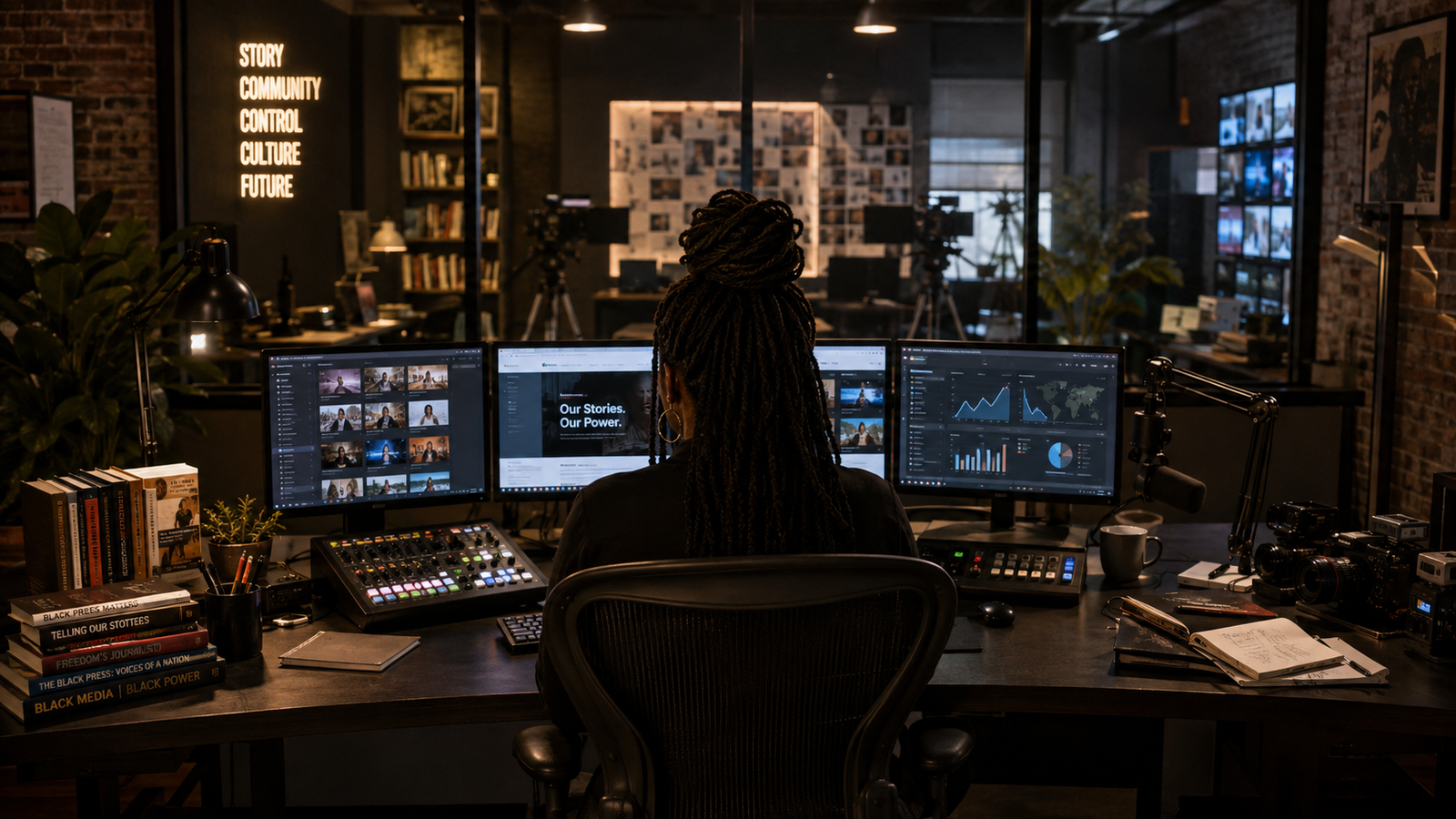
Black media was never only about who’s in the frame. It’s about who owns the frame.
Who has the keys to the building? Who decides what runs and what gets spiked? Who can say, “No, we’re not covering that,” and actually make it stick?
Beyond editorial authority, who controls the money, keeps the archive, and can reach the audience without begging an algorithm for permission?
Then comes the question everybody suddenly gets quiet around: when the whole thing becomes valuable, who owns the thing that became valuable?
Black culture has never had much trouble getting attention. For generations, Black communities have shaped American music, language, fashion, comedy, politics, food, sports, media, and popular culture.
Influence was never the whole problem. The real issue is what happens after the influence shows up.
Jump to
- Who Actually Controls Black Media?
- What Black Media Inherited From the Black Press
- Black Media Visibility Is Not the Same as Power
- What Actually Makes It Black Media?
- The Black Media Control Stack
- Black Media Ownership and Final Authority
- Editorial Authority in Black Media
- Mission and the Purpose of Black Media
- Black Media Audiences Are Broader Than They Look
- Black Media Distribution Is a Power Question
- Economic Control in the Black Media Industry
- Representation Is Not Institutional Control
- How Digital Media Changed Black Media
- When Black Attention Builds Somebody Else’s Asset
- Black Media Does Not Need a Purity Test
- What Black Media Needs to Own Next
- The Groundwork
What Black Media Inherited From the Black Press
Nobody started a Black newspaper because Black folks needed better photo albums. Black newspapers developed because somebody had to tell stories that much of the mainstream press ignored, distorted, or treated as somebody else’s problem.
The historical record is deep enough that the Library of Congress describes African American newspapers as a cornerstone of the Black press and an important record of Black social and cultural history.
These publications documented churches, businesses, elections, schools, organizing, migration, celebrations, violence, family life, and ordinary community activity that might otherwise have gone unrecorded.
In other words, that was not just representation. It was infrastructure.
Representation says: we’re here. Infrastructure says: we can tell our own story, preserve it, distribute it, and keep doing that whether everybody else thinks it matters or not.
Black Media History Was About Function, Not Just Visibility
The distinction appears throughout Black press history. The Library of Congress identifies Freedom’s Journal, founded in 1827, as the first African American-owned and operated newspaper .
Later publications became major institutions in Black civic and cultural life. The Chicago Defender, for example, did more than report on the Great Migration. Smithsonian’s National Museum of African American History and Culture notes that Black newspapers such as the Defender helped spread information that encouraged migration and supported the development of Black urban communities.
That is institutional power in practice. The outlet was not simply describing history. It was participating in it.
The Definition of Black Media Got More Complicated
For a long time, one influential way of understanding the Black press centered on three characteristics: Black ownership and management, an intended Black audience, and advocacy for racial equality.
Digital media made those borders less tidy.
Media scholar Miya Williams Fayne examines that transition directly in the 2026 Oxford University Press book The Blackish Press: Content, Ownership, and Audience of Digital Black News Outlets .
Her research complicates the old checklist. Contemporary digital Black outlets can include entertainment-heavy publications, organizations that are not Black-owned, and outlets whose actual audiences contain substantial numbers of non-Black readers.
Williams Fayne does not treat those differences as proof that such publications are somehow “less Black.” Instead, the research shows that the boundaries of the Black press changed as ownership, content, audience, and distribution changed.
Good. Grown folks can handle a complicated question.
Still, complexity does not mean structure stops mattering. If audience targeting becomes the only requirement, a corporation can build a Black-focused vertical, hire Black talent, attract Black attention, sell advertising against that attention, and leave the underlying ownership somewhere else.
The content may be Black. The audience may be Black. The economic asset may not be. That difference is where this conversation gets useful.
Black Media Visibility Is Not the Same as Power
We’ve got to stop confusing being seen with having power. Those are cousins, not twins.
Black cultural visibility is enormous. Black music travels globally. At the same time, Black creators influence online language and aesthetics, political conversations become national conversations, and Black humor, style, commentary, and storytelling move across platforms at tremendous speed.
If visibility were the entire game, the argument would already be over. Yet visibility does not tell you who owns anything.
Nor does it reveal who controls distribution, collects audience data, sells the advertising, owns the archive, or keeps the upside when all that attention becomes valuable.
This same distinction runs through Groundwork Daily’s Ownership Equation . Access and participation can be useful, but neither is the same as control.
In media, the principle works the same way. A creator can reach millions of people and still not own the system that determines whether those people see the next post.
So the better question is not simply, Are Black people represented? Instead, ask: Who controls what happens after Black attention arrives?
What Actually Makes It Black Media?
I’m not interested in running a purity test. We have enough of those.
Black media does not need a committee deciding whether something is Black enough, serious enough, political enough, independent enough, or culturally acceptable enough to enter the room.
Black life is too wide for that. Somebody should investigate City Hall. Another outlet should cover the election. Elsewhere, somebody should report on business, review the album, document the neighborhood, or make us laugh.
Joy belongs in the archive too.
Williams Fayne’s research is useful because it resists reducing the modern Black press to one type of content. The digital ecosystem includes legacy publications and digital-native organizations, traditional advocacy and cultural coverage, serious news and entertainment.
Instead of grading outlets on vibes, we need a framework that examines the kind of power they actually possess.
The Black Media Control Stack
Groundwork Daily’s Black Media Control Stack evaluates a media institution across six dimensions. It is not a Blackness score. It is a control audit.
Who ultimately owns the institution and its assets?
Who decides what receives attention, resources, and protection?
What is the institution built to do, and whom is it built to serve?
Who is the intended audience, and who actually uses the institution?
Who controls the roads through which the audience finds the work?
Where do revenue, data, intellectual property, and long-term value accumulate?
Black Media Ownership and Final Authority
Start with ownership. Not who hosts the show, whose name appears on the byline, or who has the impressive executive title.
The question is simpler: Who owns the operation?
Ownership establishes a different kind of authority because owners can allocate capital, appoint leadership, change strategy, sell assets, restructure the organization, or close it.
That does not mean Black-owned automatically means good. Likewise, non-Black-owned does not automatically mean bad.
Ownership simply answers the question that becomes very important when everybody else leaves the meeting: Who has the final say?
This is why the conversation connects directly to The Economics of the Black Hair Industry . In both cases, cultural demand can originate inside a community while ownership determines where the economic upside accumulates.
Editorial Authority in Black Media
Ownership and editorial authority are connected, but they are not identical. Next, ask who decides what’s worth chasing.
Who gets six months to investigate a story? Which neighborhood receives regular coverage instead of appearing only when something goes wrong? Which issue is treated as structural, and which gets dismissed as an isolated incident?
A publication tells you what it values through what it covers. Just as importantly, it tells you through what it repeatedly decides is not worth covering.
That absence matters because media institutions do more than distribute information. They help decide what enters the public record.
Mission and the Purpose of Black Media
What is the outlet actually here to do?
Not every Black publication needs to save democracy before its first cup of coffee. Some should investigate. Others should entertain, celebrate, teach, preserve history, or make us laugh.
A media ecosystem serving Black people should be broad enough to record Black life without demanding that every piece perform struggle.
Williams Fayne’s work matters here because it identifies a shift in what advocacy can look like. Some modern outlets retain traditional sociopolitical advocacy. Others serve Black audiences through cultural affirmation, context, visibility, or positive representation.
The useful question is not whether every publication performs the same mission. It’s whether the institution actually knows its mission.
Because if you do not know what you’re built to do, the algorithm will happily hand you a job description.
Black Media Audiences Are Broader Than They Look
Who is Black media actually for? That question gets slippery fast.
Williams Fayne found that digital Black press organizations can attract substantial non-Black readership. That should not surprise anybody. Black institutions have produced ideas, reporting, culture, art, political thought, and analysis that travel well beyond Black communities for generations.
Black media does not need racial exclusivity to remain oriented toward Black communities.
Pew Research Center’s research on Black Americans’ news habits also shows how varied the information environment is. Black adults draw news from local and national outlets, social media, people they know, and Black news outlets rather than relying on one dominant source.
The important distinction, then, is between who happens to arrive and whom the institution understands itself to serve.
When Audience Growth Changes the Institution
The problem is not other people showing up. Trouble starts when success with everybody else makes an institution forget why it was distinctive enough for everybody else to show up in the first place.
A niche can become a market. From there, the market becomes a growth opportunity. Eventually, the growth opportunity becomes a strategy deck.
Somewhere in that process, the people who built the original relationship may start asking who the thing is for now.
That is not merely a branding problem. It is an institutional one.
Black Media Distribution Is a Power Question
Here is the sneaky one: you can own the story and still not own the front door.
Search engines mediate discovery. Social platforms mediate reach. Video platforms shape recommendation, while email providers mediate delivery. Increasingly, AI systems mediate information retrieval before somebody ever reaches the original publisher.
Pew reported in 2025 that 53% of U.S. adults at least sometimes get news from social media. That does not make publishers irrelevant. Instead, it means the road between publishers and audiences increasingly passes through infrastructure publishers do not own.
Ro has already broken down the incentive structure behind that environment in The Economics Behind Viral Content . Platforms do not distribute material according to cultural importance. They respond to behavior, engagement, attention, and the incentives built into the system.
Distribution, therefore, is power.
Followers Are Reach, Not Ownership
A platform can dramatically expand an outlet’s reach. However, a platform change can also reduce that reach just as quickly.
One million followers can be valuable, but one million followers are not one million direct relationships. The platform still owns the road.
Groundwork Daily’s Discernment framework makes a related point from the reader side. Modern media competence requires knowing what matters, what does not, and what deserves another look before attention becomes action.
Economic Control in the Black Media Industry
Finally, we get to the part people love to walk past: where does the money go?
Culture creates attention. That attention can create traffic. Traffic can produce data, advertising opportunity, subscriptions, memberships, intellectual property, brand value, and archives that become long-term assets.
So where does all of that settle?
A community can be culturally central and economically peripheral at the same time. We can make something cool, make it matter, and get everybody talking about it while somebody else still owns the building.
That is the difference between influence and infrastructure. One produces headlines. The other produces long-term equity. More importantly, it is an expensive lesson to keep relearning.
Representation in Black Media Is Not Institutional Control
Representation still matters. This is not an argument against it.
It matters who gets hired, who gets promoted, who appears on camera, who receives an editorial budget instead of a diversity panel, and whose stories get taken seriously.
However, representation cannot do a job it was never designed to do.
A Black executive does not automatically equal Black institutional control. Similarly, a large Black audience does not equal Black ownership of the underlying platform, and a viral Black creator does not own the recommendation system making the content viral.
A seat at the table is useful. It is still not the table.
Representation and ownership answer different questions. One measures presence. The other measures position.
For a deeper treatment of that distinction, read The Ownership Equation: Why Control Matters More Than Access .
How Digital Media Changed Black Media
To be fair, the internet did something real. It knocked down gatekeepers who used to sit at the front door with a clipboard.
A creator no longer needed a television contract to find an audience. Writers did not need a newspaper editor to hand over a column. Commentators no longer needed a radio station to provide the microphone.
People could publish, build, and find audiences directly. That changed who got to speak.
Williams Fayne describes this evolution as part of the Black press’s long adaptation from newspapers and magazines into websites and other digital forms. The tools changed, but the underlying need for Black-centered information institutions did not disappear.
Publishing Became Easier Than Owning Infrastructure
What digital media did not completely change was who owns the infrastructure underneath that speech.
You can build an audience on a platform you do not control. A business can depend on an algorithm it did not write. Meanwhile, search traffic can rely on rules somebody else can change.
As a result, years of reach can be reordered by one platform adjustment.
Digital media democratized publishing faster than it democratized ownership.
As Ro argues in When Everywhere Started Looking the Same , digital distribution also accelerated the speed at which culture moves.
Communities can create something locally and watch it become globally visible before they have much time to define, document, or protect it. Speed expanded opportunity, but it also shortened the distance between creation and extraction.
When Black Attention Builds Somebody Else’s Asset
Let’s be plain. Attention has economic value.
Maybe not immediately, and maybe not through a clean line item labeled “your attention.” Still, businesses compete aggressively for it because sustained attention can create advertising revenue, consumer data, subscription opportunity, brand value, and market leverage.
Every follow, view, click, share, stream, search, and comment can contribute to an economic system larger than the individual piece of content.
The creator may benefit. Publishers can benefit too. Of course, the platform can benefit right alongside them.
Direct Audience Relationships Build Durability
That is why Black media institutions need more than audiences. They need direct relationships with those audiences.
- Direct traffic.
- Email lists.
- Memberships.
- Subscriptions.
- Events.
- Community partnerships.
- Archives.
- Intellectual property.
- Recognizable institutional brands.
- Multiple paths back to the work.
The objective is not to abandon platforms. That would make no sense. Use every useful road available.
Just do not confuse somebody else’s road with your land.
This is where media strategy connects to Groundwork Daily’s Institutional Durability framework . Durable institutions are designed to continue functioning when leadership changes, money tightens, urgency fades, or external conditions shift.
A media institution built entirely on one platform has reach. By contrast, one with direct audience relationships, archives, revenue diversity, leadership depth, and controlled assets has durability.
Black Media Does Not Need a Purity Test
None of this means every Black media organization needs to fit one mold. Please spare us.
A Black-owned newspaper belongs. So does a Black-led digital newsroom. Independent creators belong too. Entertainment media, local journalism, investigative reporting, business media, podcasts, cultural criticism, and community archives all belong.
Mainstream publications with Black journalists doing excellent work are part of the broader information ecosystem too.
The point is not to rank everybody according to how Black they seem. Instead, the goal is to understand what kind of institutional power each model actually possesses.
A Black-owned local newspaper and a Black-focused vertical inside a multinational corporation can both produce valuable journalism for Black readers. They are still different structures.
That’s not an insult. That’s accounting.
The Black Media Control Stack gives us language for seeing those differences without turning the conversation into a cultural purity contest.
What Black Media Needs to Own Next
More content is not going to solve this. We already have content. The internet is drowning in it.
The assignment now is building what surrounds it.
That means ownership where possible, editorial independence, direct audience relationships, sustainable revenue, search visibility, distribution diversity, accessible archives, protected intellectual property, technical capacity, leadership pipelines, and business systems capable of surviving changes in advertising, platforms, search, and technology.
Black Media Institutions Must Outlive Individual Creators
We also have to think beyond individual creators.
Creators matter, but institutions can outlive creators. An account can go viral. An institution can hire people, train them, preserve records, maintain standards, own assets, develop new leadership, and transfer knowledge.
More importantly, an institution can still be standing when the platform that launched a thousand careers becomes a trivia question.
That’s a different level of ambition.
Black America has never lacked cultural production. The harder challenge has been building and retaining enough infrastructure to convert cultural production into durable institutional capacity.
That is where the next chapter gets interesting.
The Groundwork: What Is Black Media Really Built On?
So what actually makes Black media Black?
There is no single checkbox. Honestly, we should be past checkboxes anyway. Look at the structure instead.
Who owns it? Who runs the editorial room? Who was it built to serve? What is its mission? Who controls the relationship with the audience? Who controls the roads leading to the work? Finally, where does the economic value go?
Those questions tell you more than a logo, a host, a hashtag, or a February campaign ever could.
Black visibility matters. Black voices matter. Black representation matters. Still, visibility is not control, attention is not ownership, and influence is not infrastructure.
If Black media is going to remain durable in the next era, it cannot only be good at making people look.
It has to become better at controlling what people are looking at, how they reach it, what happens to the value afterward, and what remains when the trend moves on.
Because culture will always make us visible. Institutions are what let us stay.
Own the Relationship, Not Just the Reach
The Groundwork List sends one clear note on the systems beneath culture, money, institutions, discipline, and everyday decisions. No feed to chase. No algorithm required.
Join the Groundwork ListFramework Connections
This article sits at the intersection of culture, ownership, judgment, and institutional durability. Continue through the Groundwork architecture:
- The Ownership Equation , why control matters more than temporary access.
- Discernment , how judgment filters noise and protects direction.
- Institutional Durability , the systems that allow organizations to survive changing conditions.
- The Economics Behind Viral Content , how attention, engagement, and platform incentives shape what spreads.
- When Everywhere Started Looking the Same , how digital distribution accelerates cultural movement while weakening local incubation.
- The Economics of the Black Hair Industry , another case study in the difference between cultural demand and asset ownership.
Receipts
- Miya Williams Fayne, The Blackish Press: Content, Ownership, and Audience of Digital Black News Outlets , Oxford University Press, 2026.
- Library of Congress, African American Newspapers .
- Library of Congress, African Americans in Press & Publishing .
- Smithsonian National Museum of African American History and Culture, Millions Move North .
- Pew Research Center, Black Americans’ News Habits .
- Pew Research Center, Social Media and News Fact Sheet .
About the Builder
Rochelle “Ro” Hayes
Rochelle “Ro” Hayes is the Groundwork Daily builder behind Real Talk Blueprint, a series focused on culture, relationships, accountability, communication, and the behavior people often explain away before they examine it.
Ro works primarily inside Culture, Media & Leadership , with strong overlap into relationship systems, public behavior, gender expectations, attention incentives, and modern social performance.
Real talk creates structure where avoidance creates confusion.
Ro builds frameworks that make ordinary behavior harder to ignore. The work is direct, observational, and culturally grounded. Rather than performing outrage, it names the pattern, identifies the incentive, and asks what people are really protecting.
Real Talk Blueprint examines the gap between what people say they value and what their behavior actually reinforces.
Meet Rochelle “Ro” Hayes · Explore Real Talk Blueprint · Explore Culture, Media & Leadership