
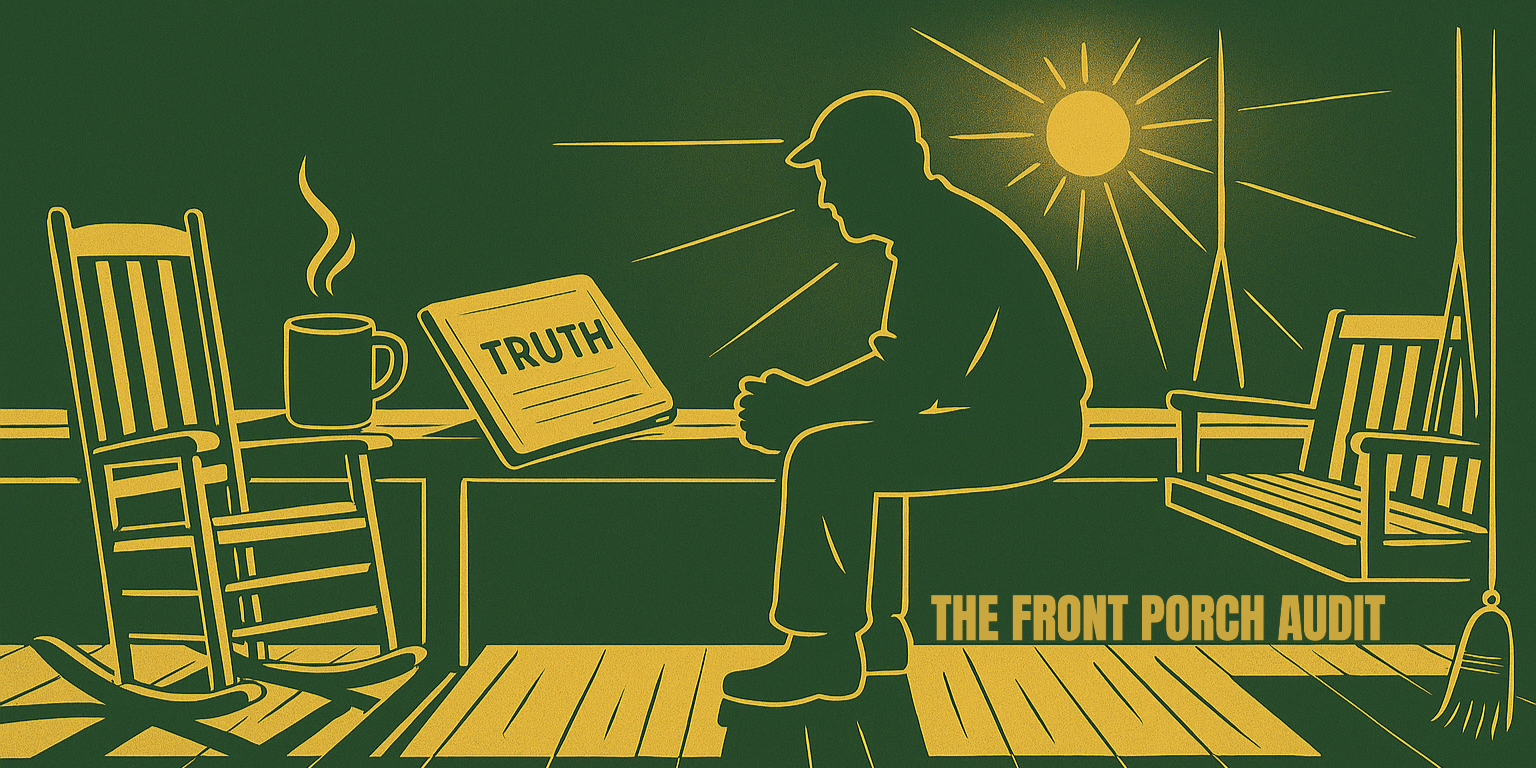
When folks talk work but do not work, the porch does not need an argument. It just shows the dust they did not sweep.
There is a kind of person who can talk a job clean to death before they ever lift a tool.
They can describe the plan.
They can name the problem.
They can explain why the last person failed.
They can stand there with one hand on their hip and the other pointing at everything that needs doing.
Then somehow, after all that talking, the broom is still leaning in the same corner.
The porch is still dusty.
The hinge is still squeaking.
The trash still needs taking out.
And everybody is a little more tired from listening.
Talk is easy because it costs nothing but air.
Work costs time, sweat, focus, and the humility to stop performing long enough to be useful.
When Folks Talk Work But Do Not Work
When folks talk work but do not work, they usually want the credit without the weight.
They want to sound responsible.
They want to look busy.
They want to be seen near the work without being held accountable for the result.
But looking busy never fixed a leak.
Looking busy never balanced a ledger.
Looking busy never fed a family.
Looking busy never swept a porch.
The old-timers used to say, “If you have time to talk about it, you have time to do it.”
That was not just country wisdom.
That was moral math.
Every excuse adds interest to a debt you owe your own potential.
Sooner or later, the bill comes due.
Work Ethic Does Not Need a Press Conference
Real workers do not announce every move.
They show up.
You know them by the rhythm of their hands, not the rhythm of their mouths.
They do not need applause before they begin.
They do not need three meetings to decide whether the floor needs sweeping.
They see the work.
They do the work.
Then they move to the next thing.
That is why work ethic is not built on excitement. It is built through responsibility carried without needing the room to admire the carrying.
Some folks confuse talking about standards with having standards.
That is a dangerous mistake.
A person can describe a clean porch all day.
The dust still knows who swept.
Folks who talk too long about the work often prove they do not want the truth that comes with finishing it.
Talking Feels Safer Than Finishing
There is a reason some people keep talking.
Talking keeps the work in the future.
Finishing brings the work into evidence.
Once the job is done, everybody can see whether it holds.
That scares people who would rather be known for potential than proof.
Potential is comfortable.
Proof has splinters.
Proof asks whether the gate closes.
Proof asks whether the bill got paid.
Proof asks whether the promise was kept.
Proof asks whether the floor got swept after the speech ended.
That is why some folks stretch planning into a hiding place.
They are not preparing.
They are avoiding the audit.
And the porch has always been good at audits.
Consistency Separates Workers From Talkers
Anybody can have one productive day.
Anybody can get inspired on Monday.
Anybody can buy a new notebook, underline three things, and start talking about a new season.
Good.
Now show up next Tuesday.
Then the Tuesday after that.
Then again when nobody is impressed anymore.
That is where consistency matters more than motivation. Motivation likes the announcement. Consistency likes the assignment.
Talkers love beginnings.
Workers understand repetition.
The porch does not stay clean because somebody swept it once.
It stays clean because somebody keeps coming back.
Small Habits Tell on Big Talk
A person who talks work but does not work usually leaves clues.
They do not return what they borrow.
They leave tools where others cannot find them.
They promise too quickly.
They arrive almost on time and call that close enough.
They explain every delay with the confidence of a courtroom lawyer.
They make the work sound complicated so nobody notices it is still undone.
Those little things matter.
That is where small habits reveal character. The smallest patterns usually tell the truth before the big moment arrives.
If someone cannot handle the broom, be careful handing them the blueprint.
Leadership Does Not Just Point at the Work
Leadership is not standing on the porch naming everything wrong with the yard.
Anybody can point.
Leadership bends down and picks up what needs moving.
Leadership grabs the other end of the table.
Leadership makes the call nobody wants to make.
Leadership handles the small problem before it becomes a meeting with twelve people and no solution.
That is why leadership is weight before it is status. A title may give someone the right to speak, but responsibility proves whether their words can carry anything.
Some folks want to supervise work they have never respected.
That never ends well.
The Work You Avoid Becomes Your Reputation
Work does not disappear because someone talks around it.
It waits.
The dust waits.
The bill waits.
The apology waits.
The unfinished repair waits.
The promise waits.
And while it waits, it gathers evidence.
Eventually, people stop listening to the explanation and start watching the pattern.
That is when reputation begins to settle.
Not from one missed task.
From repeated avoidance.
Not from one excuse.
From a habit of making words do work they were never built to do.
Stewardship Means Doing What Needs Doing
Stewardship is not glamorous.
It does not always arrive with a speech.
Sometimes stewardship is washing the dish you used.
Sometimes it is returning the call.
Sometimes it is fixing the loose board before somebody steps through it.
Sometimes it is admitting the work is yours and doing it without making everybody else carry your delay.
Eventually, you can tell who someone is by what they take care of.
You can also tell who someone is by what they keep discussing but never touch.
That second list is usually more honest than people want it to be.

The Front Porch Rule
Front Porch Rule: If the broom keeps hearing your plans but never feels your hands, you are not working. You are performing.
That rule may sting.
Good.
Some medicine is supposed to let you know where the infection was.
Talk has its place.
Planning has its place.
Strategy has its place.
But eventually, somebody has to pick up the tool.
Otherwise, all that talk is just dust with better vocabulary.
The Front Porch Test
Here is the test.
What have you been talking about more than doing?
What task keeps showing up in your mouth but not in your hands?
What promise has become a slogan?
What responsibility have you explained longer than you have carried?
What would get better this week if you stopped narrating and started moving?
Those answers will tell the truth.
So when you catch yourself saying, “I’m fixing to,” stop.
You may already be late.
Pick up the broom.
Pick up the wrench.
Pick up the phone.
Whatever the tool is, get to it.
Every porch tells a story.
The clean ones do not come from talkers.
That’s the truth, from the front porch. Now go build.
Further Groundwork
Keep building the structure beneath the habit:
Receipts
Build Stronger Foundations Every Morning
Groundwork Daily publishes practical frameworks on discipline, systems, leadership, and rational thinking designed to strengthen everyday decision-making.
This article is part of the Front Porch Audit series by Darius “Dee” Colson, examining the everyday habits, assumptions, humor, responsibilities, and patterns that quietly reveal character long before anyone notices the results.