

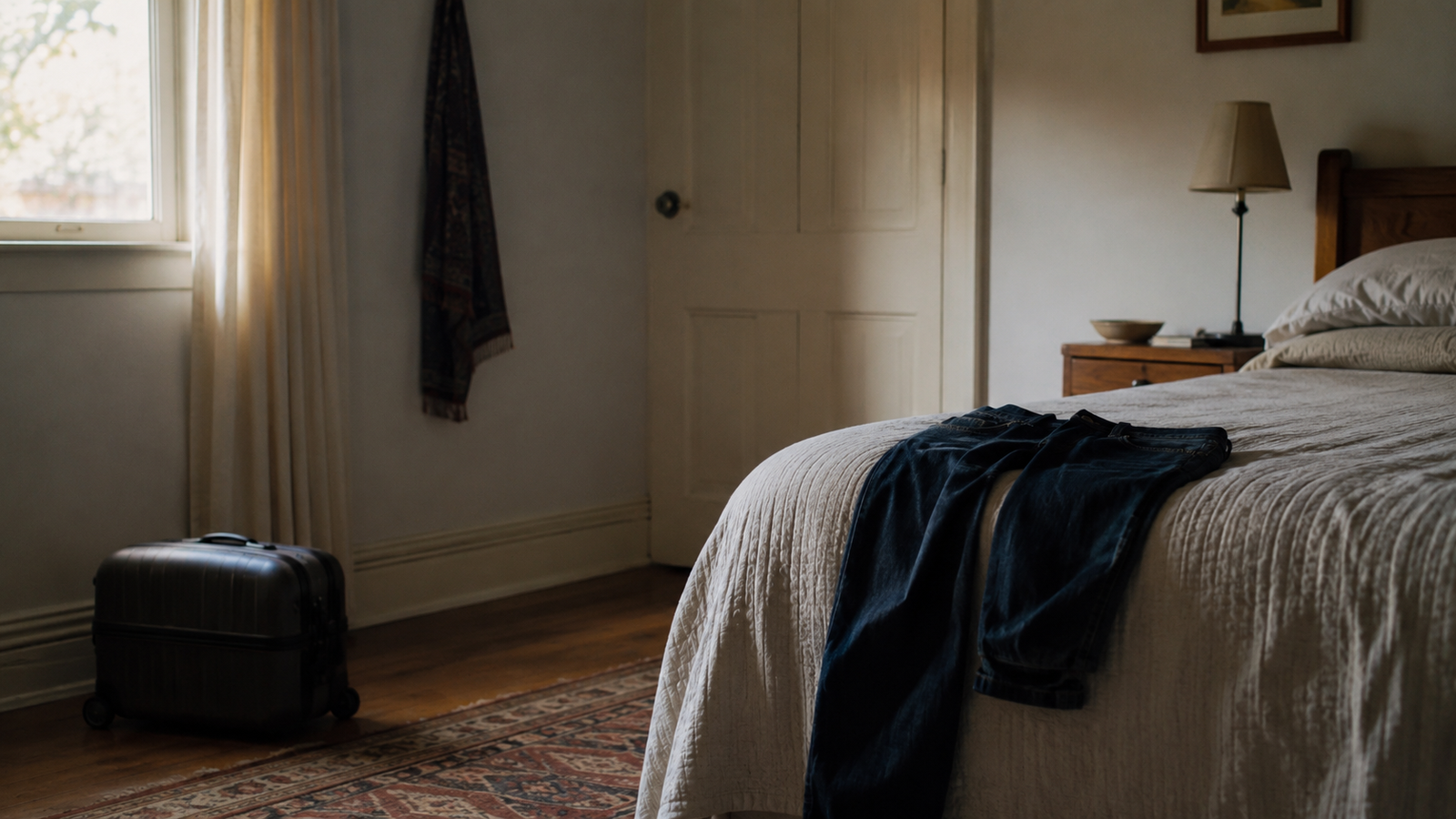
You can learn a lot about somebody’s childhood by sitting on their bed wearing jeans. A surprising number of hygiene habits learned in childhood are hiding in what happens next.
Some people will continue the conversation like nothing happened.
Others will look at you as if you just placed a New York City subway pole directly on their pillow.
Maybe you do not even know what you did.
That is the interesting part.
A lot of what we call cleanliness does not begin with a health class, a dermatologist, or a carefully considered personal philosophy.
Instead, it begins with somebody in the house saying:
Take those shoes off.
Wash your hands.
Do not sit on the bed in those clothes.
Go take a shower.
Put some lotion on.
Use a washcloth.
Change that towel.
And do not put that suitcase up there.
Depending on the house, some of those instructions were suggestions.
Others were apparently constitutional law.
Most of us never received a copy of the constitution. We simply learned the rules.
Eventually, we grew up and met other people.
That is where things got interesting.
The House Had Rules
How hygiene habits learned in childhood become normal
Online arguments over bathing and hygiene become funny almost immediately because people are rarely comparing only routines.
Usually, they are comparing childhoods.
One person describes what happened after playing outside. Someone else explains which clothes could touch the furniture. Another person mentions how towels, washcloths, lotion, shoes, sheets, luggage, hair, scent, or bath time worked in their house.
Before long, everybody is asking some version of the same question:
Wait.
Your house did what?
The question gets bigger the longer you sit with it because most children do not evaluate household standards.
They inherit them.
When everybody in your house does something, it does not feel cultural. It feels normal.
Likewise, when nobody in your house does something, its absence does not feel unusual either.
It is just Tuesday.
Those hygiene habits learned in childhood can become so automatic that adulthood is often the first time anybody realizes another rulebook exists.
Then two people arrive with completely different standards, and both are shocked to discover that the other person apparently grew up without civilization.
House rules have a long memory
Half of adulthood is discovering that your house rules were not laws of nature.
That applies to hygiene, but it also applies to money, food, guests, noise, laundry, privacy, punctuality, leftovers, shoes, cleaning, dishes, bedrooms, bathrooms and whether the good towels are ever actually supposed to be used.
We have already seen how house rules can become a cultural system without anybody formally writing them down.
At home, something similar happens at a smaller and more intimate scale.
Rules get repeated. Reactions reinforce them. Eventually, nobody needs to explain much.
Somewhere right now, a grown adult is still afraid to touch a decorative towel.
The system worked.
What Counts as Clean?
Everybody draws the line somewhere
“Clean” sounds obvious until people start describing it.
Then the word starts doing a remarkable amount of work.
Does clean mean you showered? Maybe it means the bathroom was wiped down. Perhaps it means the clothes smell fresh, the kitchen was reset before bed, or the shoes stayed near the door.
For somebody else, clean includes fresh sheets, washed hands after coming inside, lotion after bathing, or a suitcase that never touches the comforter.
Every household draws lines, but the lines are not always in the same place.
That does not mean every standard is equally useful. Some practices clearly produce cleaner spaces and better personal care than others.
Still, hygiene habits learned in childhood are often established long before a child understands why the standard exists.
That distinction matters.
A child may hear, “Do not get in that bed without taking a shower,” hundreds of times before anybody explains what the rule is protecting.
The explanation can disappear before the rule does
Eventually, the explanation becomes unnecessary.
The rule turns into instinct.
You come home and change clothes. After that, you wash up. By the time you settle in, you are simply handling the house the way the house taught you to handle it.
That is culture at its smallest scale.
Not a parade.
Not a flag.
Not a speech.
A towel.
A pair of shoes.
And a mother looking at you from across the room because apparently you have forgotten everything she ever taught you.
The standard survives because everybody knows where the line is supposed to be, even when nobody remembers the original meeting where the line was drawn.
Then You Meet Other People
Different household systems eventually collide
College probably ends a lot of illusions.
Roommates help.
Marriage helps more.
Dating is extremely efficient.
Nothing introduces competing household systems quite like loving somebody who thinks your normal behavior is deeply suspicious.
At first, the differences can seem personal.
Why do you do that?
Why don’t you do that?
Who leaves a wet towel there?
Why are those clothes on the bed?
How did the suitcase make it onto the comforter?
And why are there three partially used bars of soap in this bathroom?
Hygiene habits learned in childhood become especially visible when another adult arrives carrying a different definition of ordinary.
Eventually, another possibility appears: maybe nobody deliberately chose half of this.
Maybe people are reenacting what a household taught them.
Explanation is not exemption
The same thing happens with family roles in adulthood. Repetition can turn an arrangement into something everybody experiences as obvious.
However, understanding the origin does not remove personal responsibility.
Adulthood eventually has to enter the chat.
What changes is the question.
Instead of asking only, “How could somebody possibly do this?” you can also ask, “What did their normal look like?”
Because that is often where the behavior began.
Not with rebellion.
Not with laziness.
Certainly not with a manifesto against soap.
Mostly, it begins with repetition.
You watched adults do something, followed along, and discovered that nobody corrected it.
So the behavior survived.
That is usually how culture works.
Quietly.
Some Standards Get Enforced Harder
Sometimes the rule is carrying more than cleanliness
There is another layer to some household standards that deserves more care than the jokes usually allow.
For some Black families, rules around grooming and presentation can carry an additional awareness: the outside world may judge Black children through stereotypes the household did not create.
When a family believes its children may be inspected more closely, standards can start carrying more than one purpose.
Cleanliness is cleanliness.
Presentation, meanwhile, can become preparedness.
It can become protection.
Sometimes it becomes pride.
And, historically, it can also become respectability.
The idea may be simple: do not hand somebody an easy stereotype.
As a result, clothes, hair, skin, scent and general appearance can become serious household business.
You were not leaving the house looking any kind of way.
Apparently, “any kind of way” had a remarkably precise definition.
Understanding the pressure is not endorsing it
That pressure can help explain why some standards were enforced so hard.
However, explanation is not endorsement.
The stereotype is not made fair because a family learned to anticipate it.
Nor should outside approval become the measure of whether somebody is clean, respectable or worthy.
Children may never hear the history attached to the rule. They simply know somebody is standing at the door asking where they think they are going dressed like that.
Later, the instruction can remain after the original explanation fades.
That is worth noticing because cultural practices often survive precisely this way.
The instruction stays.
Meanwhile, the story behind it gets quieter.
In that sense, continuity can preserve a standard even when the next person carrying it knows less about where it came from.
Normal Is Local
The internet makes everybody’s house visible
For most of human history, you could remain blissfully unaware of how strangers handled bath time.
That was probably a gift.
Now somebody can document a personal hygiene routine on Tuesday, and by Wednesday thousands of people are conducting a public referendum on their upbringing.
Social media changes the scale of the encounter.
What used to happen when you got a roommate now happens while scrolling from the couch.
One person shows a routine. Another person is horrified. Soon somebody else announces that their entire family did the same thing.
Then a third person arrives to explain that everybody in the comments has apparently been bathing incorrectly since birth.
By the end, nobody is discussing one bathroom anymore.
Now the argument is about class, race, parenting, water use, beauty standards, childhood, body care and respectability.
Meanwhile, at least one person is quietly reconsidering every sleepover they attended between 1994 and 2007.
The useful part is not deciding which stranger deserves the most ridicule.
Instead, notice how quickly an invisible rule becomes visible once somebody breaks it in public.
“Normal” usually has an address
Hygiene habits learned in childhood can look universal when everybody around us shares them.
That is why we use the word “normal” much too confidently.
Often, normal simply means the people who raised me did this, the people around me reinforced it, and nobody I trusted questioned it.
So I stopped noticing it.
Of course, inherited does not mean correct.
Some practices deserve to survive.
Others deserve an update.
A few probably should have been retired two generations ago.
But you cannot really evaluate an inherited standard until you recognize that it was inherited.
That is the adult part.
You get to keep useful rules and understand why they exist.
Then you get to improve the weak ones.
Occasionally, you may even have to admit that another household was onto something.
Adulthood gets revision authority
This can be difficult, especially when the alternative is accepting that you have spent thirty years aggressively defending something your grandmother made up because she got tired of cleaning behind everybody.
Very efficient governance.
Still governance.
Yet adulthood gives us something childhood could not: the ability to inspect the standard instead of merely inheriting it.
We can ask what the rule protects, whether the reason still holds, and what happens to other people when the rule disappears.
In other words, inherited normal can become deliberate practice.
And There We Are
Maybe the useful question is not whether somebody grew up exactly the way you did.
The better question is whether the standards they carry now actually work.
Do they protect the person and the household?
Do they account for other people?
More importantly, do they produce cleanliness, care and consideration?
When a standard is missing, can somebody learn it without turning embarrassment into identity?
That last part matters.
There is a difference between saying, “Nobody ever taught me this,” and saying, “Nobody ever taught me this, so I refuse to learn it now.”
Childhood explains plenty.
Adulthood still gets a vote.
The Groundwork
What the house taught us still deserves a grown-up review.
Inherited does not mean universal. A household can teach a standard so thoroughly that it feels like common sense instead of culture.
Useful standards can survive explanation. Adulthood lets us understand what a rule protects instead of following it only because somebody once gave us the look.
Different beginnings do not prevent better shared standards. What we were taught explains the starting point. What we keep, revise and learn becomes our responsibility.
Receipts
A little evidence underneath the observation.
The point here is cultural, but two parts of the argument have a research trail.
Childhood habits really do become routine.
The CDC notes that parents and caretakers play an important role in teaching children handwashing and that early practice can become a lifelong habit. That supports the practical premise underneath hygiene habits learned in childhood: repetition at home can become automatic behavior later. See the CDC guidance on hand hygiene as a family activity.
Presentation can also become a response to racialized scrutiny.
Research on Black respectability politics and racialized vigilance describes attention to appearance and language as strategies people may use while anticipating prejudice or unequal treatment. Read the peer-reviewed study in PubMed Central.
The strange thing about household rules is that we usually notice them only after somebody violates one.
First the shoes cross the threshold.
Then the suitcase lands on the bed.
Somebody uses the decorative towel.
Suddenly the whole system becomes visible.
The rule did not appear that day.
For the first time, somebody else simply did not already know it.
Funny how much childhood can fit on one comforter.

Continue the Thought
Further Groundwork
Keep following the invisible rules families and communities inherit, enforce, revise, and carry forward.
House Rules: How Black Folks Turned Uno Into a Cultural System
What happens when unwritten rules, shared memory, and cultural enforcement become a functioning system.
Every Family Has a Job Nobody Applied For
Another look at how repetition inside a family becomes structure, expectation, and eventually somebody’s permanent assignment.
The Cookout Has Better Governance Than Some Organizations
What ordinary community rituals reveal about standards, roles, authority, memory, and rules nobody needed to print.
Explore This Is Us (But Funnier)
More ordinary behavior, inherited expectations, cultural rules, and the systems hiding inside them.
Groundwork Framework
The structure underneath this observation.
This article applies one governing principle and one structural condition from the Groundwork Daily architecture.
Core Principle
Structure Is Mercy
Useful household standards absorb preventable disorder by making care routine before everybody has to renegotiate the same expectation every day.
Primary Condition · Defines
Standards
The article examines the thresholds households teach around cleanliness, care, grooming, and presentation—and what happens when adulthood finally makes those thresholds visible.
See the full Core Principles and Conditions architecture .
Meet the Builder

Micah Green
Builder, This Is Us (But Funnier)
Micah Green is the Groundwork Daily Builder behind This Is Us (But Funnier), an observational series about the systems hiding inside ordinary behavior, relationships, culture, family life, work, money, and the little rules people somehow agreed to without holding a meeting.