
Groundwork Guide

When your homeland does not feel like home, the surprise can begin with something embarrassingly ordinary. You do not know which door to use. You hesitate over the money. A relative explains a joke after everyone else has already laughed. Someone hears your accent and asks where you are visiting from.
The place is not entirely foreign. That is what makes the feeling difficult to name.
You recognize names from family stories. A street resembles one in an old photograph. Food arrives carrying smells you knew long before you knew the geography behind them. Certain gestures make immediate sense, and a face across the table resembles someone you grew up with thousands of miles away.
Then you step outside and realize that recognition is not the same thing as belonging.
For many people raised in diaspora, an ancestral country can exist in the imagination years before it exists underfoot. Parents and grandparents may call it home. Stories give its neighborhoods emotional weight. Food, language, music, photographs, celebrations, warnings, and memories build a geography someone can inherit without ever having lived there.
Eventually, some people go.
The familiar version of the story says they are returning to their roots. Real return can be more complicated, especially when the homeland does not feel like home once memory meets an actual street.
You can feel affection for a country that does not feel fully yours. A place may recognize your ancestry while still reading you as foreign. Connection and estrangement can exist on the same block without one canceling the other.
Before a Homeland Does Not Feel Like Home, It Often Exists as Story
Some places enter a person’s life as memory before they enter it as geography.
A parent tells you where the family house stood. A grandparent describes the street before it changed. You hear which town an uncle left, which neighborhood a mother misses, or which village appears whenever someone explains where the family is “really from.”
Those descriptions accumulate until they begin to form an inherited map.
The Map Is Emotional Before It Is Practical
The map is not imaginary in the sense of being false. The places exist, and family memories may preserve remarkably precise details.
Yet inherited geography is selective. Families tend to transmit the places that mattered to them: the market someone loved, the house someone lost, the school someone attended, or the street where relatives still live.
They transmit emotion too. One neighborhood becomes beautiful because a parent misses it. Another carries fear because a family story remembers danger there.
The child receiving those memories inherits meaning without necessarily inheriting daily experience.
That difference becomes visible upon arrival.
When the Homeland Does Not Feel Like Home, Is It Still a Homecoming?
Researchers studying diaspora travel have asked versions of this question directly.
A study of 26 second-generation Chinese Americans who had traveled to China examined whether their parents’ homeland functioned as “home” or as a travel destination. Researchers identified themes involving language and appearance, family history, the search for authenticity, and the meaning of home.
The usefulness of the study is not that every second-generation traveler will experience China, or any ancestral country, in the same way. They will not.
The more important finding is conceptual: ancestry does not settle the meaning of a journey before it begins.
A Place Can Be Personal and Unfamiliar at Once
This is what makes diaspora travel different from an ordinary vacation without automatically making it a return home.
A visitor may have relatives waiting at the destination and know family history attached to particular streets. Cultural practices that another traveler would need explained may already feel familiar.
At the same time, the visitor may need directions.
Local slang, bureaucracy, transit, politics, neighborhood distinctions, or unwritten social rules may be unfamiliar. The version of the country carried through family stories may also belong to an earlier period.
The place continued changing while the inherited version remained partly preserved.
Arrival brings those two geographies together.
Inherited Geography Is Not the Same as Lived Geography
A parent can remember a city as it existed before the child was born. Years later, both generations may arrive in a place that no longer matches the memory.
The storefront is gone. A family building has been renovated. The neighborhood is wealthier, poorer, denser, quieter, more commercial, or simply different. Relatives have moved, roads have changed, and younger family members have built their own relationship to the place.
This is not unique to migration. Anyone returning to a childhood neighborhood after decades away can discover that memory has been preserving a city the city itself had no obligation to preserve.
Diaspora adds another layer: the younger generation may have inherited nostalgia for a place they never personally lost.
You Can Miss a Place You Never Lived In
That sounds contradictory until we consider what families actually transmit.
A person may not miss the literal street. They may miss what the street represents inside family memory: grandparents before they aged, parents before migration changed them, relatives who once lived closer together, or a language that was used more easily.
The longing may therefore be partly geographic and partly temporal.
You are not only traveling toward a place. You may also be traveling toward an earlier version of the people who taught you to care about it.
Why a Homeland Can Still Read You as Foreign
Appearance can make the experience especially complicated.
A traveler may blend into a crowd until they speak. Someone else may be recognized immediately as part of a diaspora community through clothing, movement, accent, vocabulary, or other cues that local residents understand better than the traveler does.
The resulting interaction can feel disorienting because ancestry and local belonging are being measured by different standards.
The Question Changes, but the Borderline Remains
Abroad, a person may have spent years being asked where they are “really from.” In the ancestral country, another question may arrive: Where did you grow up? Why do you speak like that? How long are you staying?
The first question can imply that the place where you live is not fully yours. The second can reveal that ancestry alone does not make another place fully yours either.
This does not always mean rejection.
Often, people are simply locating one another socially. Yet the location may be more complicated than the identity category the traveler carried onto the plane.
For someone whose homeland does not feel like home, that complexity can be the most revealing part of the visit.
When Language Makes the Homeland Feel Less Like Home
Language often makes the boundary audible.
A person may speak a heritage language well enough to communicate but not well enough to disappear into local life. Vocabulary can sound dated because it came from parents or grandparents who emigrated years earlier. An accent can reveal another country, while regional slang may expose distance almost instantly.
For others, the gap is larger.
The Borderlines essay The Language You Understand but Cannot Speak examines what happens when comprehension survives more strongly than speech. An ancestral visit can make that asymmetry suddenly public.
At home, relatives may understand why you answer in English. In the ancestral country, the surrounding world does not necessarily reorganize itself around the family accommodation.
Language Shapes Access Without Deciding Legitimacy
Fluency cannot become a moral test.
Language transmission is shaped by family choices, schools, migration histories, social pressure, community access, discrimination, work, and ordinary convenience. A person can inherit the consequences of those conditions without having chosen them.
Not speaking perfectly does not invalidate ancestry.
It can, however, affect lived access.
Those are different claims. One concerns legitimacy; the other concerns what someone can comfortably do inside a place.
Family History Feels Different When It Has an Address
Then come the moments that complicate the foreignness.
A relative points toward a window and says your mother slept there. Someone takes you to a cemetery where family names suddenly repeat across stone. You stand outside a school you have heard about for years or pass the corner where your grandparents supposedly met.
The abstract becomes physical.
This can create a powerful form of recognition even when the country as a whole does not feel like home.
Belonging Can Be Smaller Than a Nation
Research comparing attachment across migrant generations has distinguished between attachment to an ancestral country and attachment to a specific hometown. Those forms of attachment do not always move together or decline in a simple generational line.
That helps break a common assumption. Each generation does not necessarily become steadily less connected until the connection disappears.
Attachments can weaken, change scale, return, or become more symbolic.
Someone may not experience an entire nation as home but feel something intense toward a family building, neighborhood, region, landscape, or the people who still live there.
Sometimes home contracts.
The smaller definition may be the more accurate one.
Why “Return to Your Roots” Is Too Simple
There is a reason the language of roots is so attractive. Roots promise origin and imply that beneath the complexity of contemporary identity, one place exists where everything will finally make sense.
The metaphor is emotionally powerful. Structurally, it is weak.
People are not trees.
Families can come from several places. Borders move. Countries contain regional, racial, religious, linguistic, class, political, and urban-rural differences. Even parents from the same nation can remember dramatically different versions of it.
The Homeland Is Not a Museum of Family Memory
The ancestral country also does not remain frozen at the moment a family emigrates.
This matters because diaspora nostalgia can unintentionally turn a living country into a heritage object. A visitor arrives looking for authenticity and becomes disappointed by contemporary life.
The neighborhood feels too modern. Younger relatives do not practice a tradition the visitor expected. English appears on storefronts. Family rituals have shifted. Local residents are busy with careers, rent, relationships, politics, technology, entertainment, and tomorrow.
Nothing has gone wrong.
The place continued living.
If the homeland does not feel like home because reality fails to match an inherited image, the inherited image deserves examination too.
Ancestral Does Not Automatically Mean More Authentic
The ancestral country is not automatically more authentic than diaspora life. America is not automatically artificial. Tradition is not automatically virtuous, and change does not automatically equal cultural failure.
That does not weaken the ancestral relationship.
It makes the relationship mature enough to survive contact with the present.
What Diaspora Return Can Change When the Homeland Does Not Feel Like Home
Research on young second-generation Eritreans traveling to Eritrea offers another useful complication.
Geographer Samuel Graf examined how those journeys affected participants’ sense of belonging. The visits could become important identity-establishing experiences that influenced how travelers positioned themselves toward both Eritrea and the Eritrean diaspora.
That does not mean the trip simply confirmed that Eritrea was home.
The more interesting point is that travel created experiences through which belonging had to be negotiated.
Negotiation Is More Useful Than “Rediscovery”
Negotiation allows attachment and distance to coexist.
A person can become more connected to an ancestral country while becoming clearer that their everyday home is elsewhere. Another traveler may discover a stronger sense of belonging than expected but still remain aware of the social differences that mark them as part of a diaspora.
Sometimes the trip expands identity. Sometimes it corrects assumptions. Often it does both.
That is a more useful outcome than demanding a single answer to the question of home.
Sometimes Home Becomes Clearer After You Leave the Homeland
The journey back can produce its own surprise.
You land in the city where you grew up and understand the airport without thinking. Your phone works. You know how people queue, how the subway operates, what the cashier means, where to buy what you need, which neighborhood comes next, and how strangers expect you to move through public space.
Ordinary competence can feel unexpectedly intimate after spending years questioning whether this place counted as home.
That realization does not mean the ancestral journey failed.
It may mean the journey clarified something.
Part of the Homeland May Have Traveled With the Family
The earlier Borderlines essay Where Home Begins When It Isn’t a Place examines how home can be built through memory, relationships, and cultural identity rather than geography alone.
An ancestral visit adds another layer.
Sometimes you need to stand in the inherited place before realizing that home was never waiting there intact.
Some of it traveled through language, food, household rituals, expectations, stories, and memory.
Other parts remained behind.
The life built afterward became something else again.
Second-Generation Identity Does Not Need One Geographic Answer
The pressure to choose can come from both directions.
Where you grew up, someone asks where you are really from. Where your family came from, someone points to the place where you grew up as the obvious explanation for your differences.
It is tempting to read this only as evidence of permanent exclusion.
Sometimes exclusion is exactly what is happening. Yet another possibility also exists: the category of belonging may be too narrow for the life being described.
Several Geographies Can Be True at Once
A person can be meaningfully connected to more than one place without experiencing those connections in identical ways.
Citizenship, ancestry, childhood, family memory, language, neighborhood life, culture, and daily belonging do not always point toward the same country.
The result is not necessarily confusion.
It may be an accurate description of a transnational life.
When a homeland does not feel like home, the answer does not have to be choosing one geography and declaring the other false.
Belonging Is Not the Same as Ownership
Ancestry can give someone history in a place without granting authority over people who live there now.
A diaspora visitor may carry family knowledge that matters. Local relatives carry knowledge the visitor does not possess. Neither automatically outranks the other.
This distinction becomes especially important when people arrive searching for a country that will certify an identity formed elsewhere.
The Place Does Not Have to Approve Your Identity
An ancestral country cannot be required to function as a validation machine.
People who live there have their own conflicts, identities, histories, generational changes, and definitions of belonging. Their relationship to the country may bear little resemblance to the one preserved in diaspora.
The visit becomes more useful when the traveler does not need every interaction to prove that they belong.
That shift makes room for curiosity.
It also makes room for disappointment without turning disappointment into betrayal.
When the Homeland Does Not Feel Like Home, Discernment Matters
This is where Discernment becomes the relevant Groundwork Condition.
Discernment helps separate experiences that are easy to collapse into one another.
Recognition is not automatically belonging. Discomfort is not necessarily rejection. Tradition is not the same thing as authenticity, and familiarity is not automatically home.
Likewise, feeling foreign does not make the ancestral relationship meaningless.
The Trip Does Not Owe You a Revelation
This is also where Stillness Is Strategy sits beneath the work.
An ancestral visit can arrive burdened with expectations. The traveler is supposed to reconnect. A relative may expect gratitude. Friends may anticipate a transformative story. The traveler may have spent years imagining the emotional scene of finally arriving.
Stillness creates enough room not to manufacture that revelation.
Perhaps the place feels immediately familiar. Maybe it does not. Affection may develop after several visits, or the strongest connection may turn out to be with relatives rather than land.
A trip can deepen interest in family history while also making someone more certain that another country is home.
The honest answer is more valuable than the expected one.
You Can Feel Gratitude Without Pretending the Homeland Feels Like Home
One of the hardest parts of diaspora return can be admitting disappointment.
Some people feel guilty because parents sacrificed to leave. Others carry guilt because parents never wanted to leave. A traveler may worry that failing to love the ancestral country deeply enough represents ingratitude toward family.
That burden confuses several different relationships.
Your Parents’ Attachment Does Not Have to Become Yours
You can love your family without loving every place your family came from.
You can respect a country’s importance to your parents without reproducing their attachment exactly. It is also possible to dislike aspects of a place without imagining that country is inferior to the place where you grew up.
Family stories may turn out to be incomplete, too.
Parents remember through their own circumstances. Their attachment can contain class position, childhood, politics, religion, neighborhood, opportunity, trauma, privilege, nostalgia, or simply the fact that the people they loved were once there.
Your encounter happens under different conditions.
It is allowed to produce a different judgment.
What Do You Carry Back When the Homeland Does Not Feel Like Home?
A more useful question may begin after the trip.
What became more specific?
A family story now has a street attached to it. A photograph has scale. You understand how far your grandmother walked to school. You know why your father describes one neighborhood differently from another. A recipe that once seemed simply “traditional” becomes regional.
Family history can acquire political, economic, or geographic context that nobody had explained before.
The Homeland Becomes Smaller—and More Real
Before the visit, “the homeland” may function as one enormous symbolic place.
Afterward, it can break into actual places: a city, a district, a building, a kitchen, a cemetery, a cousin’s apartment, a street where you got lost, or a café your mother remembers under another name.
The country becomes harder to romanticize because it has become more real.
That is not necessarily a loss of inheritance.
It may be the beginning of a more durable one.
Maybe Home Was Never the Question the Trip Could Answer
There is a photograph families sometimes imagine before an ancestral journey happens.
The descendant arrives, the family street appears, and something inside them immediately recognizes the place. Everything lines up.
Sometimes life gives people that moment.
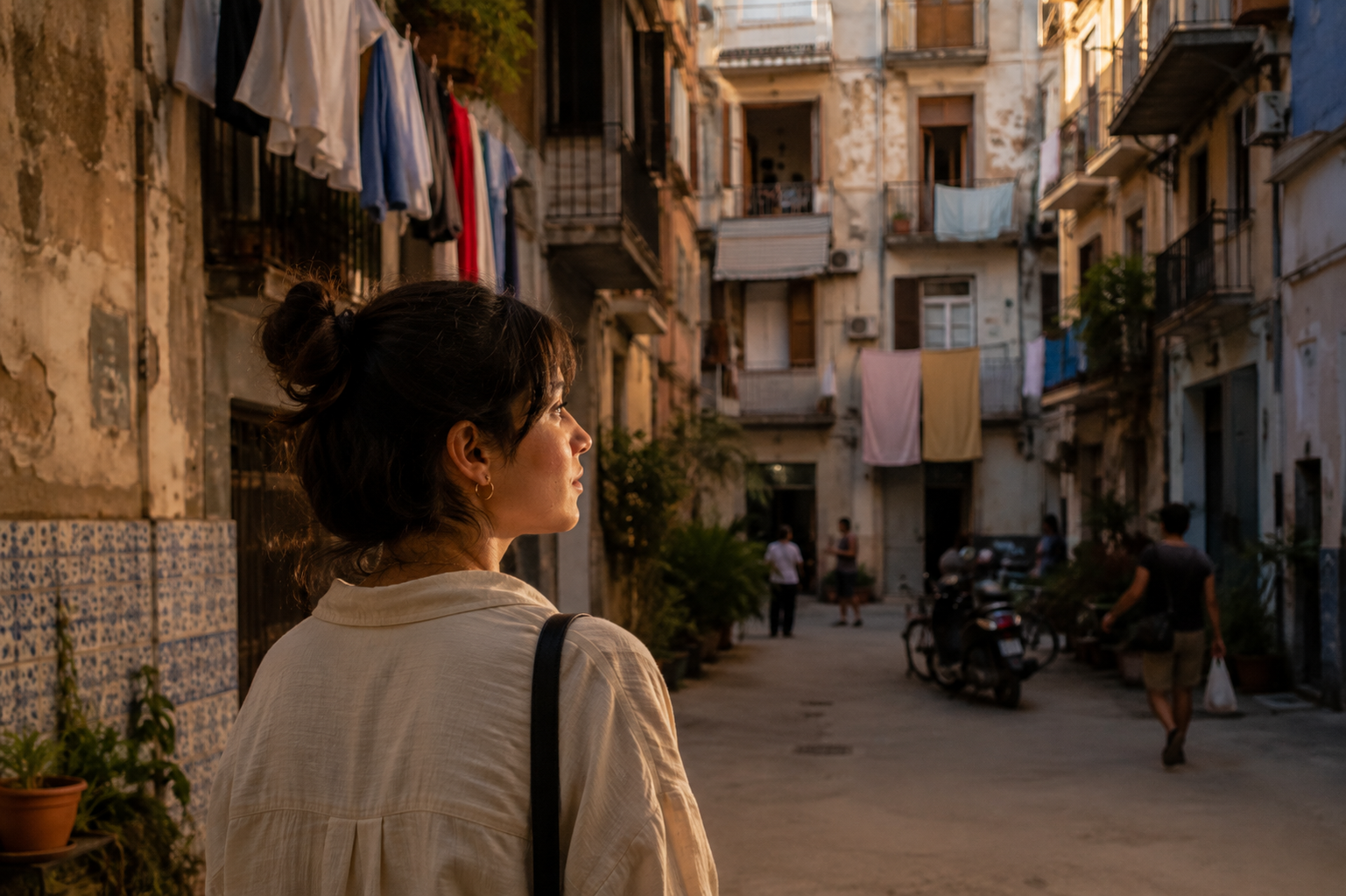
Other times, it gives someone standing on an ordinary street at the end of the day, listening to neighbors whose rhythms they do not quite know and looking at buildings that resemble family photographs while realizing they would still need directions to return tomorrow.
That moment is not less meaningful because it fails to resolve the question.
It may be more accurate.
Ancestry Explains Where Something Began, Not Where You Must Belong
Ancestry tells us that people before us were shaped somewhere. It does not require us to pretend that we were shaped there in exactly the same way.
A homeland can remain part of your history without becoming the place where you feel most at home. It can contain relatives, memory, language, affection, grief, and cultural knowledge without functioning as the center of your daily belonging.
You can leave with more connection than you arrived with and less certainty than you expected.
Both can be progress.
When the homeland does not feel like home, perhaps the work of returning is not to prove that the place was secretly yours all along.
Perhaps it is to finally meet the place your family carried—and decide, with clearer eyes, what you will carry from it now.
Further Groundwork
Continue through the Borderlines territory of home, language, inheritance, and belonging.
→ Borderlines: Diaspora, Migration, Identity & Belonging
→ Where Home Begins When It Isn’t a Place
→ The Language You Understand but Cannot Speak
→ Who Are You in the Language You Learned Later?
Receipts
Research informing this essay’s discussion of diaspora travel, ancestral place, second-generation identity, place attachment, and negotiated belonging.
Place Attachment Across Generations
Huang, Wei-Jue; Hung, Kuo; Chen, Ching-Chi. “Attachment to the home country or hometown? Examining diaspora tourism across migrant generations.” Tourism Management, Volume 68, 2018, pp. 52–65. The study examines how attachment to an ancestral country and hometown can vary across migrant generations rather than following one simple pattern of decline. Review the study .
Homecoming, Tourism, and Second-Generation Identity
Li, Tingting & McKercher, Bob. “Homecoming or tourism? Diaspora tourism experience of second-generation immigrants.” Tourism Geographies, Volume 18, Issue 1, 2016. Based on interviews with 26 second-generation Chinese Americans who traveled to China, the research identifies themes including language, appearance, family history, authenticity, and sense of home. Review the study .
Diaspora Travel and Negotiated Belonging
Graf, Samuel. “Diaspora tourism and the negotiation of belonging: journeys of young second-generation Eritreans to Eritrea.” Ethnic and Racial Studies, Volume 40, Issue 15, 2017. The study examines how travel to a parents’ country of origin can shape how second-generation participants position themselves toward both the ancestral country and the diaspora. Review the study .
Inherited Memory and Lived Place
King, Russell; Christou, Anastasia; Teerling, Janine. “Imagining ‘home’: Diasporic landscapes of the Greek-German second generation.” The research explores inherited diasporic memory, visits, return, places of upbringing, and ancestral home. Review the study .

Build better. Every day.
Get Groundwork Daily reflections on culture, identity, discipline, family, systems, and the structures that shape how we live.

Meet the Builder
Isabella Jean Ramírez
Isabella Jean Ramírez builds at the intersection of diaspora, migration, belonging, cultural identity, and language. Through Borderlines, she follows what people preserve, translate, adapt, and rebuild after geography changes and inherited culture enters contemporary life.