
Parking looks ordinary because it is everywhere.
That is the trap.
Most people treat parking as a convenience issue. Is there enough parking? Is it free? Is it close? Is it easy to find? Those questions matter, but they are too small. Parking is not only about where cars stop. Parking is one of the largest land-use decisions cities make.
As part of Urban Logic, this article studies parking as public infrastructure, land policy, transportation design, and civic tradeoff. Parking may look passive, but it quietly shapes housing, commerce, heat, walkability, transit access, wayfinding, and public life.
Every parking space occupies land. That land could hold housing, trees, shops, a bus lane, a wider sidewalk, a public bench, a bike lane, a library expansion, a plaza, or nothing at all. Once the space becomes parking, other possibilities are pushed aside.
That is where the serious conversation begins.
Parking is not neutral. It shapes how neighborhoods spread, how far people travel, how much housing costs, how businesses are built, how hot streets become, and how much public life a city can support.
A parking lot is not empty space.
It is a decision made visible in asphalt.
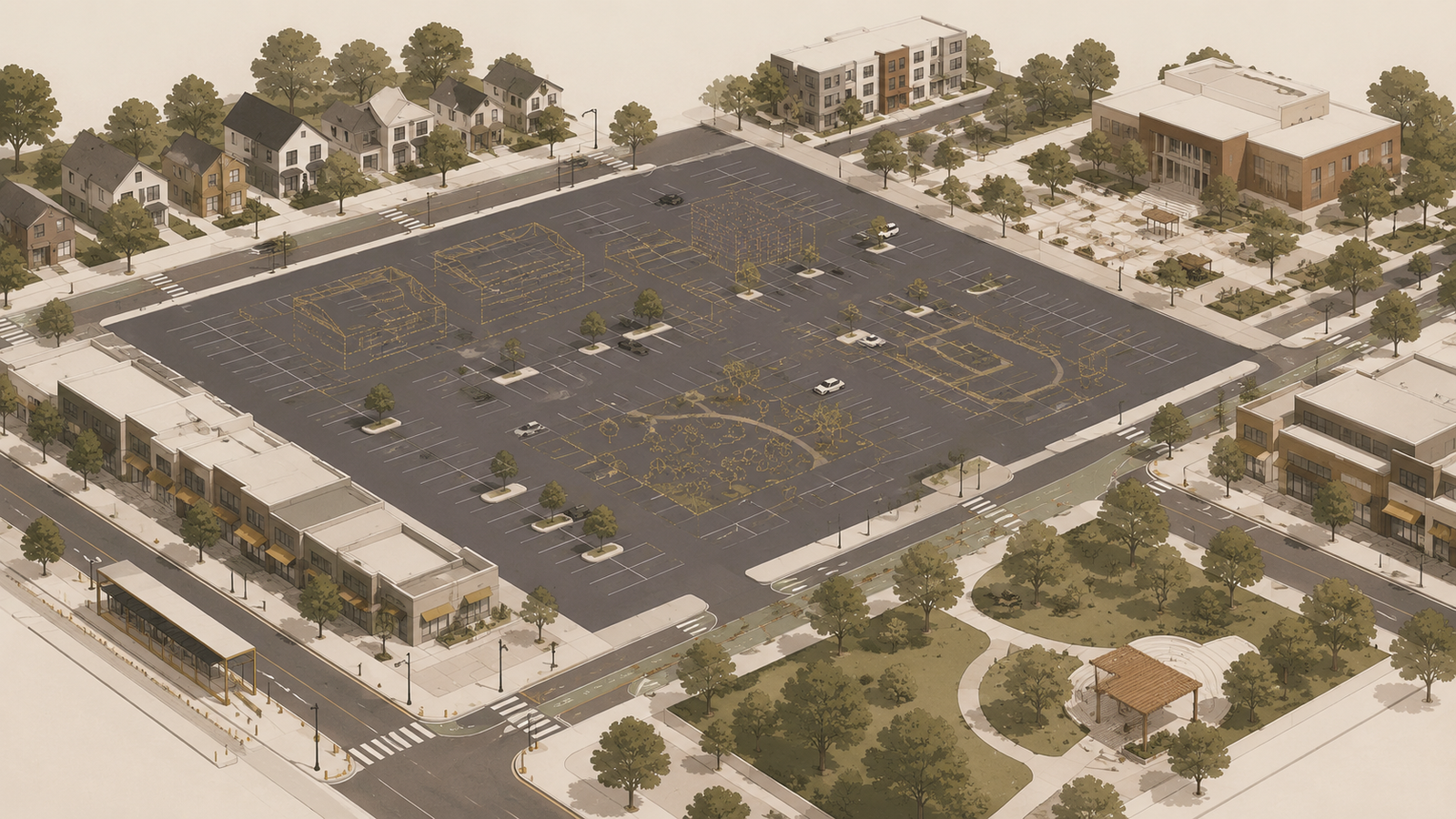
Parking Is Land Use
Parking is land use before it is transportation.
That statement matters because land is finite. A city cannot use the same parcel for everything. If a corner becomes a surface parking lot, it cannot also become apartments, a grocery store, a childcare center, a pocket park, or a public square.
This is the part of the conversation people avoid.
Parking feels practical because cars need storage. However, every storage decision competes with other civic needs. In dense neighborhoods, that competition becomes sharper. Land near transit, schools, libraries, hospitals, parks, and commercial corridors is especially valuable.
Using that land for vehicle storage may still be necessary in some cases. Even so, it should never be treated as automatic.
For example, a surface lot beside a train station can make driving to transit easier. Yet the same land could also hold housing for people who would not need to drive to the station at all. A parking lot beside a small business corridor may help some customers arrive. But if the lot pushes stores away from the sidewalk, it may weaken the walkable street life that helps those businesses survive.
That is the real tradeoff.
Parking does not only store cars.
It decides what a place cannot become.
Stand at the edge of a surface parking lot and look around. Ask what else the land could hold: housing, shade, shops, benches, transit access, public space, or stormwater infrastructure. That answer is the hidden cost.
Parking Is Transportation Infrastructure
Parking also shapes transportation behavior.
If parking is abundant, free, and close to every destination, driving becomes the easiest default. If parking is limited, priced, shared, or located behind buildings, other travel choices become more realistic.
This does not mean cities should punish drivers.
That is lazy framing.
People drive for real reasons. They carry children, groceries, tools, medical equipment, and work supplies. They travel across distances that transit does not serve well. They live in neighborhoods where walking or biking is not safe enough. Some people need cars because the rest of the system failed them first.
However, parking policy still matters.
When cities require every building to provide large amounts of parking, they make driving easier and often make everything else harder. Buildings spread farther apart. Sidewalk trips become longer. Transit stops become less convenient. Bike lanes get squeezed. Crosswalks must cover wider vehicle entrances. Public benches and street trees become afterthoughts.
In that way, parking becomes part of the transportation system.
It influences whether people walk, bike, ride transit, drive, or combine modes. It shapes the distance between destinations. It shapes how much land is available for bus stops, sidewalks, and protected bike lanes. It also shapes whether short trips feel possible without a car.
Transportation is not only movement.
It is also the storage that movement requires.
However, movement depends on more than pavement and parking. People also need to understand how the transportation network fits together. As explored in Wayfinding Is Public Infrastructure, clear signs, maps, transit information, and navigation systems reduce uncertainty by helping people move confidently between parking, sidewalks, bus stops, bike lanes, and public destinations. Parking works best when people can easily continue the rest of their journey.
Parking Changes Housing
Parking affects housing more than most people realize.
For decades, many cities required developers to build a minimum number of parking spaces for each apartment, condo, office, store, or restaurant. These rules are usually called parking minimums.
The logic was simple. New buildings should not create parking shortages nearby.
The problem is that simple logic can produce expensive outcomes.
Parking spaces cost money to build. Structured parking can be especially expensive. Underground parking costs even more. Those costs do not disappear. They get folded into rents, sale prices, commercial leases, or public subsidy needs.
As a result, parking requirements can raise the cost of housing, even for residents who do not own cars.
A small apartment building may need fewer units because the site must reserve room for parking. A mixed-use building may become financially harder to build because required parking adds cost. A vacant lot near transit may remain vacant longer because the required parking makes the project less feasible.
That is not theory.
That is land math.
Consider a modest infill site near a bus route. Without heavy parking requirements, it might support affordable apartments above small ground-floor retail. With strict parking rules, the same site may need a larger footprint, fewer homes, or a more expensive design. If the numbers do not work, nothing gets built.
Then people ask why housing is scarce.
The answer is often hidden inside rules that looked practical on paper.
Parking Changes Local Business
Businesses need access.
That does not always mean they need more parking.
This is where many debates get sloppy. Some business owners understandably fear losing nearby parking. If customers cannot arrive, sales can fall. That concern should be taken seriously.
Still, access can come from many directions. Customers can arrive by car, bus, bike, train, walking, rideshare, or a combination of modes. Employees also need access. Delivery vehicles need loading space. Older adults and disabled customers may need closer drop-off points. A strong commercial corridor plans for all of that.
More parking is not always the best answer.
Too much parking can weaken a business district. Large front lots push buildings away from the sidewalk. Gaps between storefronts reduce foot traffic. Wide curb cuts interrupt walking. Heat from asphalt makes the area less comfortable. A corridor built around parking may become easier to drive through but less pleasant to visit.
That hurts local commerce.
Walkable business districts often depend on short distances, visible storefronts, street trees, benches, lighting, crosswalks, and transit access. Parking can support that system when it is managed well. It can also damage the system when it dominates the street.
Wayfinding also matters here. Customers should not have to guess where to park, where to cross, where the entrance sits, or how to continue from a parking area into the business district. Clear navigation helps drivers become pedestrians without confusion, which is exactly what healthy commercial corridors need.
For example, one shared lot behind a row of shops may support access without breaking the sidewalk experience. By contrast, each shop having its own front parking lot can turn a commercial street into a scattered strip. The same amount of commerce becomes harder to walk, harder to browse, and harder to experience as a place.
Parking should support business.
It should not swallow the street that business depends on.
Surface Lots Cost More Than They Appear
Surface parking looks cheap because asphalt looks simple.
That is another weak assumption.
Surface lots carry hidden costs. They reduce taxable building value. They increase stormwater runoff. They absorb and radiate heat. They create dead zones between destinations. They require lighting, drainage, maintenance, striping, snow removal in cold regions, and enforcement.
They also create opportunity cost.
A downtown surface lot may produce far less public value than a building on the same land. A neighborhood lot may sit mostly empty during parts of the day while housing demand remains high nearby. A school, clinic, or civic building may use land for peak parking demand even though that land could serve the community in other ways most of the week.
That does not mean every surface lot is bad.
Some lots are necessary. Some support institutions. Some serve accessibility needs. Some help businesses in places where other transportation options are weak.
The problem is not parking itself.
The problem is pretending surface parking has no cost because the land looks quiet.
Asphalt has a balance sheet. It may not send a bill directly, but the city pays through heat, runoff, lower density, weaker street life, lost housing, and reduced public space.
Better Parking Is Smarter Parking
The answer is not “no parking.”
That would be unserious.
The answer is smarter parking. Cities need to manage parking as a system instead of treating every parcel as if it must solve its own parking problem alone.
Shared parking is one tool. A church, office, restaurant, and theater may need peak parking at different times. Instead of requiring separate lots for each building, shared facilities can reduce total land consumption.
Pricing is another tool. Free parking sounds generous, but it often hides costs and encourages overuse. Priced parking can help manage demand, especially in busy districts. If curb spaces are always full, the price may be too low. If garages are empty while curb parking is crowded, management is failing.
Better design also matters. Parking behind buildings can preserve walkable streets. Structured parking can reduce land consumption where density supports it. Clear loading zones can protect businesses without turning every curb into long-term vehicle storage. Accessible spaces must remain close and practical.
Good parking management also depends on good wayfinding. Drivers should be able to locate available parking without circling blocks unnecessarily. Meanwhile, pedestrians should be able to find sidewalks, transit stops, public buildings, and commercial destinations once they leave their vehicles. Clear navigation reduces congestion because people spend less time searching and more time moving through the city efficiently.
Technology can help, but technology is not the strategy. Apps and sensors do not fix bad land use by themselves. They only help if the city has a clear policy.
The goal is simple.
Put parking where it supports the city without letting it dominate the city.
Parking Connects Every Urban System
Parking connects every part of Urban Logic.
It affects sidewalks because curb cuts, front lots, and long block distances change how walking feels. It affects crosswalks because more vehicle entrances create more conflict points. It affects bus stops because transit works better when destinations sit close together. It affects bike lanes because street space is finite.
Parking also affects public benches because places designed mainly for cars rarely invite people to remain. It affects street lighting because large lots require lighting across spaces that may still feel empty. It affects wayfinding because drivers, cyclists, pedestrians, and transit riders all need clear information to move between parking areas and their destinations. It affects third places because social infrastructure depends on proximity, comfort, and repeat visits.
This is why parking cannot be treated as a side issue.
Parking shapes the distance between things. Distance shapes behavior. Behavior shapes economics. Economics shapes what survives.
A city with too much parking may still function, but it often functions at a lower civic intensity. People drive from one destination to another without experiencing the space between them. Streets become channels. Lots become buffers. Buildings become isolated objects. Public life thins out.
A city with too little parking can also fail if access breaks down. Deliveries become harder. Customers circle blocks. Residents fight over curb space. Disabled users lose practical access. Spillover harms nearby streets.
So the real work is balance.
Parking must be enough to support access, but not so much that it consumes the land that makes access valuable.
Examples Make the Tradeoff Clear
Look at a library.
A library surrounded by a huge surface lot may be easy to drive to. However, it may be harder to walk to, harder to approach from nearby homes, and less connected to other civic spaces. A library placed near sidewalks, transit, benches, street trees, clear wayfinding, and shared parking becomes part of a neighborhood network.
Look at a grocery store.
A store with parking can serve families making larger trips. That matters. Yet when the parking lot sits between the store and the sidewalk, it can make the store less useful for nearby residents arriving on foot. The design tells everyone that the driver is the default customer.
Look at a downtown block.
A surface lot may help office workers during the day. But after work hours, it may become a dead zone. If that same land held housing, shops, or a plaza, the block might stay active longer. Street lighting, benches, wayfinding, and local businesses would have more reason to work together.
Look at a school.
Drop-off and parking matter. But when school design is dominated by vehicle circulation, children walking or biking may face longer crossings, wider driveways, and weaker public space. The system protects one kind of access while making another kind harder.
These examples prove the point.
Parking is never only parking. It changes the whole operating environment around it.
Read Your City
Choose one parking lot you pass often. Count how many people use it at different times of day. Then imagine what the same land could do if it served housing, shade, commerce, public seating, wayfinding, or transit access. That is the land-use audit.
Reading parking means looking past convenience.
Ask where the parking sits. Does it support a building, or does it separate the building from the street? Does it help people reach local businesses, or does it weaken the pedestrian environment? Does it solve a real access problem, or does it consume land because old rules required it?
Then ask whether the parking system explains itself. Can drivers find it without circling? Can pedestrians leave it and reach the sidewalk clearly? Can visitors understand where the entrance, crosswalk, transit stop, or public destination sits? If not, the parking is not just using land. It is creating confusion.
Then ask who benefits most.
Drivers may gain convenience. But walkers may lose comfort. Transit riders may face longer distances. Local businesses may lose street life. Housing may become harder to build. Public space may disappear before anyone realizes it was possible.
Parking is not automatically good or bad.
It is powerful.
That power deserves better questions.
The Groundwork Principle
Parking is often treated as leftover space.
It is not.
Every parking space represents a choice about how land will be used, who a city is designed for, and what kinds of neighborhoods can emerge over time.
Cities need parking. However, they also need housing, businesses, parks, transit, sidewalks, libraries, trees, benches, crosswalks, bike lanes, wayfinding, and public gathering places. Good planning is not about eliminating parking. It is about understanding its true cost and allocating land with intention.
The principle is simple.
Cities do not simply store cars. They decide what every piece of land is allowed to become.
Keep Seeing the Systems Around You
Most people move through cities without noticing the systems shaping their choices. Urban Logic helps you read the built environment differently, from parking and sidewalks to bus stops, bike lanes, public benches, street lighting, wayfinding, and third places.
Subscribe to the Groundwork Daily newsletter for weekly essays that reveal the hidden systems behind modern life and help you navigate them with greater clarity, capability, and intention.
→ Urban Logic: Understanding the Hidden Systems That Shape Cities
→ The Hidden Cost of Long Commutes
→ Sidewalks Are Economic Infrastructure
→ Bus Stops Are Public Infrastructure
→ Bike Lanes Are Transportation Infrastructure
→ Wayfinding Is Public Infrastructure
→ Public Benches Matter More Than You Think
→ Street Lighting Is Public Infrastructure
Receipts:
→ Parking Reform Network
→ Strong Towns
→ Institute of Transportation Engineers
→ Congress for the New Urbanism