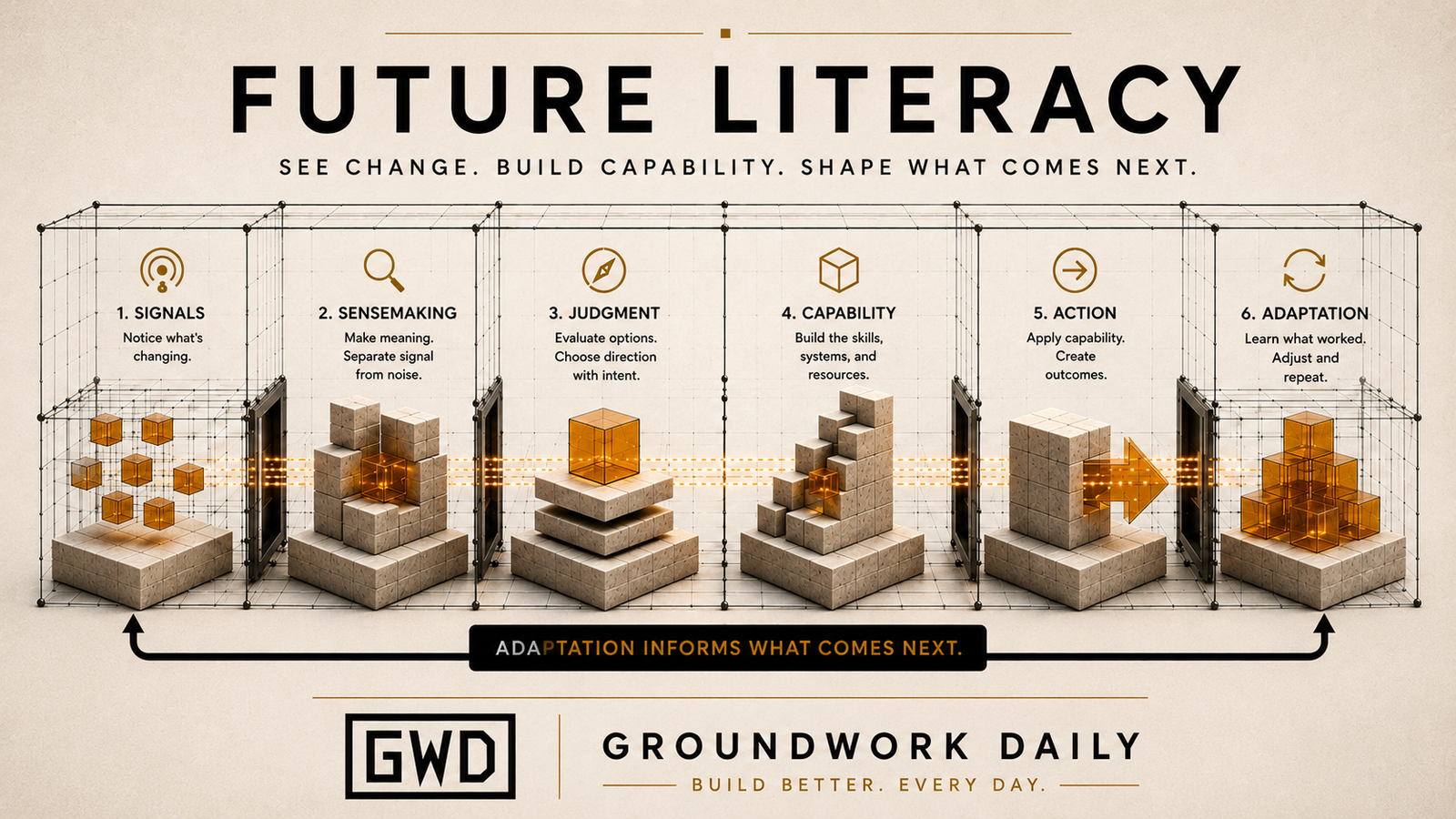
Future literacy skills are trainable capabilities that help you recognize change, interpret what matters, make better decisions, and remain capable as conditions evolve.
They are not a prediction system.
Perfect prediction is the wrong objective because the future remains partly uncertain. Instead, a stronger approach is building capabilities that still work when the forecast changes.
That means learning to notice patterns, understand systems, think across time, adapt plans, strengthen capability, examine consequences, and remain composed when several pressures move at once.
There is also an important terminology distinction.
Futures literacy is an established field concerned with how people use imagined futures to examine assumptions, expand perception, and improve present-day action. UNESCO’s Futures Literacy work is a major reference point for that concept.
Future Literacy, as Groundwork Daily uses the term, is a practical capability framework for translating related foresight principles into everyday judgment, systems thinking, skill building, decision-making, and adaptation.
This supporting framework belongs inside Groundwork Daily’s Future Literacy architecture. The foundational article, The Skill Stack You Actually Need in 2026, establishes the broader capability stack. This article goes narrower by developing seven future literacy skills that help you work with change rather than merely react to it.
The Seven Future Literacy Skills at a Glance
Pattern Recognition → notice meaningful repetition before the consequences become obvious.
Temporal Awareness → understand how present decisions create future conditions.
Systems Thinking → see the structures producing repeated outcomes.
Continuous Capability Building → keep useful skills current, practiced, and transferable.
Adaptive Planning → maintain direction while updating the route.
Ethical Foresight → examine consequences before treating progress as automatically beneficial.
Composure Under Complexity → preserve enough clarity to act when several pressures interact.
The seven skills are related, but they are not interchangeable.
Pattern recognition helps you notice change. Systems thinking helps explain it. Temporal awareness extends the decision across time. Adaptive planning turns interpretation into direction. Capability building strengthens execution. Ethical foresight tests consequences. Finally, composure keeps the whole system usable under pressure.
What Are Future Literacy Skills?
Future literacy skills are practical capabilities for working intelligently with change.
They help you prepare without turning uncertainty into panic, noise into obligation, or every new signal into a prediction.
In practice, these skills improve the quality of the questions you ask.
- What is actually changing?
- Is this an isolated event or part of a pattern?
- What system is producing the pressure?
- What becomes more likely if the current direction continues?
- Which capability would give me more options?
- What decision is likely to age well?
Those questions matter because significant change often begins quietly.
For example, a job description gains a new requirement. A household expense rises repeatedly. A workflow starts depending on a new tool. A relationship conflict returns around the same issue. Meanwhile, a formerly optional practice becomes expected.
None of those signals automatically tells you what the future will become.
Together, however, they may provide enough evidence to adjust before the consequences become expensive.
Future Literacy Skills Are Not Fortune-Telling
This distinction deserves protection.
Future literacy is not the ability to guess tomorrow correctly.
Instead, it improves your capacity to observe emerging conditions, test interpretations, prepare across several plausible outcomes, and update your behavior as evidence changes.
This overlaps with the broader discipline of futures literacy without claiming certainty about what comes next. UNESCO describes futures literacy as a capability that helps people use imagined futures to examine assumptions and perceive the present differently. Its explanation of futures literacy provides useful grounding for that distinction.
That is a more durable capability than prediction because it does not collapse every time reality violates the forecast.
Why Future Literacy Skills Matter Now
Modern pressure moves through connected systems.
Work affects money. Money affects options. Technology affects workflows. Workflows affect attention. Attention affects judgment. Judgment then affects relationships, learning, and long-term direction.
As a result, one weak system can create consequences elsewhere.
For example, poor digital boundaries can fragment attention. Fragmented attention can weaken decisions. Weak decisions can then produce avoidable financial or professional costs. Those costs may increase stress and further degrade judgment.
That is not a collection of isolated events.
It is a system.
Changing Work Raises the Value of Adaptable Capability
Workforce change makes this capability especially relevant.
Tools, occupations, workflows, and skill expectations continue to evolve. The OECD’s Future of Education and Skills work examines the knowledge, skills, attitudes, agency, and competencies people may need as economic and social conditions change.
The implication is not that every worker must continuously reinvent themselves.
That would create another form of instability.
Instead, the stronger strategy is maintaining enough transferable capability to learn when the environment genuinely requires an update.
Why Future Literacy Skills Build Capability
The goal is not to know everything that might happen.
Instead, the goal is to remain capable enough to respond when something meaningful does happen.
A capable person can notice a signal without immediately obeying it. They can investigate what changed, compare the evidence, decide what deserves attention, and make an adjustment proportional to the risk.
That rhythm is more useful than permanent vigilance.
Observe → Interpret → Judge → Act → Review → Adapt
The cycle also connects directly to the larger Future Literacy framework. Signals become useful only when sensemaking and judgment convert them into proportionate action.
Seven Future Literacy Skills You Can Train
The following seven future literacy skills turn the broader framework from an abstract idea into trainable practice.
1. Pattern Recognition Skills
Pattern recognition is the ability to notice meaningful repetition before the consequences become obvious.
A single event may be noise. Repeated events under similar conditions deserve closer examination.
A missed deadline can happen once. However, repeated delays at the same workflow stage may reveal a process problem. Likewise, one unexpected expense can be ordinary. Several months of rising costs in the same categories may show financial drift.
Pattern recognition therefore gives you lead time.
Why Pattern Recognition Matters
Many expensive problems become visible only after they have been developing for some time.
Earlier recognition creates more options. For instance, you may be able to adjust a process, build a skill, clarify an agreement, save additional cash, or test an assumption before the pressure forces a decision.
How to Practice Pattern Recognition
Choose one repeated frustration and ask:
- When does this tend to happen?
- What usually happens immediately before it?
- Under what conditions does it not happen?
- What does the repetition keep costing?
Keep the observation specific before interpreting it.
Continue building: How to Read the Patterns That Shape Your Future.
2. Temporal Awareness Skills
Temporal awareness is the ability to understand how present choices create future conditions.
Most meaningful decisions travel through time.
A purchase becomes a future obligation. Delayed maintenance becomes a larger repair. Repeated avoidance becomes accumulated pressure. Consistent practice, meanwhile, becomes capability.
Temporal awareness extends the decision beyond the emotional weight of the current moment.
Why Temporal Awareness Matters
Urgency compresses time.
When pressure rises, the present can feel like the only horizon that matters. Yet short-term relief can create long-term friction. By contrast, a modest sacrifice today may create valuable options later.
Thinking across time improves the quality of the tradeoff.
How to Practice Temporal Awareness
Before a meaningful decision, ask:
- What does this make easier next week?
- What might it make harder next month?
- What behavior does this reinforce if repeated?
- What future obligation am I creating?
You are not predicting every consequence. Instead, you are extending the decision far enough to see beyond immediate relief.
Continue building: Build a Two-Year Direction.
3. Systems Thinking Skills
Systems thinking is the ability to examine how parts, incentives, constraints, processes, and feedback interact to produce an outcome.
A recurring problem is rarely only the visible symptom.
A spending problem may involve cash-flow timing, defaults, convenience, stress, and weak review. Similarly, a work problem may involve ownership, information flow, incentives, staffing, and unclear handoffs.
Systems thinking therefore moves the intervention upstream.
Why Systems Thinking Matters
If the same outcome keeps returning, treating each occurrence as isolated becomes inefficient.
A better question is: What keeps producing this?
That question does not remove individual accountability. Instead, it makes accountability more precise by identifying the mechanism underneath the outcome.
How to Practice Systems Thinking
Map one recurring issue through:
- Inputs: What enters the system?
- Process: What happens to those inputs?
- Outputs: What result repeatedly appears?
- Feedback: What information does the result provide?
- Reinforcement: What keeps the current structure in place?
Once the structure is visible, look for one leverage point rather than five simultaneous changes.
Continue building: How to Use Systems Thinking in Real Life.
4. Continuous Capability-Building Skills
Continuous capability building is the practice of keeping useful skills current, practiced, and available under changing conditions.
Knowledge can age. Tools change. Standards move. Workflows are redesigned.
For that reason, useful capability requires renewal.
Renewal does not mean chasing every trend. Otherwise, learning becomes another form of overload.
Why Capability Building Matters
Information and capability are not the same thing.
Information tells you about a skill. Capability determines whether you can use that skill under actual constraints.
That difference becomes more important when tools and expectations change quickly.
Research on workforce pathways also reinforces the importance of developing capabilities that can support mobility and participation as work changes. Brookings has examined the connection between skills, opportunity pathways, and workforce adaptability.
How to Practice Capability Building
Choose one capability for a short development cycle.
- Learn one concept.
- Apply it to real work.
- Review the result.
- Identify the gap.
- Adjust the next attempt.
Repeated application gradually turns exposure into usable capability.
Continue building: How to Stay Capable When the Future Moves Faster Than You Do.
5. Adaptive Planning Skills
Adaptive planning is the ability to preserve direction while revising the route as evidence changes.
Rigid plans fail when they depend on conditions remaining fixed.
No plan at all creates a different failure: drift.
Adaptive planning sits between those extremes.
Why Adaptive Planning Matters
Real conditions rarely remain stable for long.
Work changes. Money changes. Family responsibilities move. Health changes. Technology alters the workflow. In addition, new information can invalidate old assumptions.
A strong plan therefore needs both direction and review.
How to Practice Adaptive Planning
Use three layers:
- Direction: What are you trying to move toward?
- Current move: What action makes sense under today’s conditions?
- Review point: When will you reconsider the plan using new evidence?
A plan without review can become rigid. On the other hand, a plan that changes every day has no directional value.
The useful middle is deliberate adjustment.
Continue building: How to Build a Daily System That Protects Your Time, Energy, and Clarity.
6. Ethical Foresight Skills
Ethical foresight is the ability to examine the likely consequences of a decision before treating novelty, efficiency, or progress as automatically desirable.
Not every improvement distributes its benefits and costs equally.
A tool can increase speed while weakening privacy. Likewise, a workflow can reduce cost while shifting pressure onto workers or customers. A shortcut can solve one problem while creating another somewhere less visible.
Future Literacy therefore needs a consequence layer.
Why Ethical Foresight Matters
Speed can hide tradeoffs.
Ethical foresight adds enough friction to examine who benefits, who carries the cost, what incentives are being created, and what behavior the decision normalizes.
The objective is not perfection.
Instead, the objective is avoiding the weak assumption that technical possibility automatically equals good judgment.
How to Practice Ethical Foresight
Before adopting a consequential tool, policy, workflow, or decision, ask:
- Who benefits?
- Who absorbs the downside?
- What behavior will this reward?
- What might become normal if this succeeds?
- What trust, privacy, fairness, or resilience could be weakened?
Those questions connect capability to responsibility.
Related Groundwork: The Rational Field.
7. Composure Skills Under Complexity
Composure under complexity is the ability to preserve enough clarity to interpret and act when several pressures interact at once.
Complexity is not simply difficulty.
It appears when several variables move together: work pressure, financial uncertainty, digital noise, family obligations, incomplete information, and emotional strain.
Under those conditions, the first problem is often not solving everything.
Instead, it is recovering enough structure to decide what matters first.
Why Composure Matters
When cognitive and emotional pressure rise, immediate relief becomes more attractive.
However, the fastest relief can create worse conditions later.
Composure provides enough separation between signal and response to choose a stabilizing move instead.
How to Practice Composure
Use a short reset:
- Name the pressure precisely.
- Separate known facts from interpretation.
- Identify what can wait.
- Choose one stabilizing action.
The objective is not emotional numbness.
Rather, it is usable judgment.
Continue building: How to Think Clearly When Everything Pulls at You.
How Future Literacy Skills Work in Real Life
Future Literacy becomes valuable when it changes what you do under ordinary pressure.
Future Literacy Skills at Work: Repeated Missed Deadlines
A team repeatedly misses deadlines.
A reactive diagnosis says people need to work harder.
A future-literate diagnosis begins differently.
Pattern recognition asks whether the delays cluster around the same stage. Systems thinking examines ownership, handoffs, approvals, capacity, and information flow. Temporal awareness considers what continued delay will cost. Adaptive planning then tests a revised workflow. Finally, ethical foresight asks whether the solution merely transfers unsustainable pressure elsewhere.
The result is a better intervention because the diagnosis is deeper.
Future Literacy Skills With Money: Repeated Financial Surprise
A household repeatedly feels caught off guard by expenses.
Shame is not an operating system.
A future-literate response examines timing, recurring obligations, irregular bills, cash-flow visibility, convenience spending, and the size of the financial buffer.
Instead of treating every expensive month as isolated, the household studies what keeps producing the surprise.
Future Literacy Skills in Relationships: Recurring Conflict
A recurring disagreement is information.
Pattern recognition identifies what keeps returning. Systems thinking looks beneath the topic at agreements, timing, labor, expectations, and repair habits. Meanwhile, composure prevents the current emotional state from becoming the whole diagnosis.
The goal is not merely winning the latest argument.
The stronger objective is changing the structure that keeps recreating it.
Future Literacy Skills With Technology: Every New Tool Feels Urgent
New technology appears constantly.
Without a governing framework, every release can feel like a new obligation.
Future Literacy asks different questions: What problem does the tool solve? Is the change structural or mostly promotional? Which capability would it strengthen? What new dependence or friction would it create? Would a small experiment provide enough evidence?
Those questions protect attention from novelty.
How to Practice Future Literacy Skills Each Week
You do not need a complicated foresight program to strengthen these skills.
Instead, a weekly cycle is enough to start producing evidence.
Monday: Capture One Signal
Write down one change, repetition, or point of friction that deserves attention.
Keep the description factual before interpreting it.
Tuesday: Test the Pattern
Ask whether the signal is isolated or repeated.
Then look for additional evidence and at least one competing explanation.
Wednesday: Map the System
Identify the inputs, process, incentives, constraints, outputs, and feedback associated with the pattern.
Thursday: Extend the Time Horizon
Ask what becomes more likely in thirty days, six months, or a year if the current direction continues.
Do not convert possibility into certainty. Instead, use the longer horizon to identify risk and opportunity.
Friday: Make One Proportionate Adjustment
Choose one response:
- Act when the evidence is strong and delay is costly.
- Experiment when a small reversible test can create useful information.
- Monitor when the signal may matter but the evidence remains incomplete.
- Ignore when the signal does not deserve additional capacity.
This rhythm keeps observation connected to judgment.
How Future Literacy Skills Fit the Groundwork Daily Framework
The seven skills in this article do not replace the original Future Literacy sequence.
Instead, they sit across it.
The original series builds the operating architecture: clarity, bandwidth, daily structure, capability, pattern recognition, systems thinking, and adaptation.
This supporting framework names additional lenses that help those capabilities work together.
Signals → Sensemaking → Judgment → Capability → Action → Adaptation
Pattern recognition strengthens signal detection. Systems thinking strengthens sensemaking. Temporal awareness and ethical foresight strengthen judgment. Capability building improves execution. Adaptive planning supports action under changing conditions. Finally, composure protects the entire loop when complexity rises.
Future Literacy Skills FAQ
What Is the Difference Between Future Literacy and Futures Literacy?
Futures literacy is an established foresight concept associated with examining assumptions about possible futures and using those futures to improve present perception and action.
Future Literacy is Groundwork Daily’s practical capability framework for applying related ideas to everyday work, money, technology, systems, judgment, and adaptation.
The concepts overlap, but they are not identical.
Can Future Literacy Skills Be Learned?
Yes. The skills in this framework are designed as trainable capabilities rather than fixed personality traits.
They strengthen through observation, practice, feedback, application, review, and adjustment. For example, pattern recognition improves when you track repeated signals, while systems thinking improves when you examine the structure underneath recurring outcomes.
What Are Examples of Future Literacy Skills?
Groundwork Daily’s framework identifies seven practical future literacy skills: pattern recognition, temporal awareness, systems thinking, continuous capability building, adaptive planning, ethical foresight, and composure under complexity.
Together, they help you interpret change, judge its relevance, strengthen useful capabilities, and adapt without treating every new development as an emergency.
Why Are Future Literacy Skills Important for Work?
Work environments change through new tools, workflows, expectations, business models, customer behavior, regulation, and skill requirements.
Future literacy skills help workers distinguish meaningful change from noise, identify which capabilities deserve investment, understand the systems shaping their work, and update methods without abandoning useful fundamentals.
Build Future Literacy Skills Where the Friction Is
Future literacy skills are sometimes pushed into the vague category of “soft skills.”
That classification hides their real function.
These are operating capabilities.
They influence whether you can interpret changing conditions, protect attention, understand repeated outcomes, make decisions across time, and update your behavior without losing direction.
You do not need to strengthen all seven at once.
Instead, start where the current friction is strongest.
If you keep getting surprised, work on pattern recognition. If the same problem repeats, strengthen systems thinking. If short-term choices keep creating long-term pressure, practice temporal awareness.
Meanwhile, if changing conditions repeatedly break the plan, build adaptive planning. If information intake exceeds execution, focus on capability building.
When several pressures interact and judgment begins to scatter, work on composure.
Afterward, review what changes.
The future does not become manageable because you know what will happen. It becomes more navigable because you build future literacy skills that remain useful when you do not.
Further Groundwork
The Skill Stack You Actually Need in 2026
Start with the original Future Literacy capability foundation and the seven core skills that anchor the series.
How to Read the Patterns That Shape Your Future
Go deeper into disciplined pattern recognition, disconfirmation, structural signals, and proportionate response.
How to Use Systems Thinking in Real Life
Examine the processes, incentives, constraints, feedback loops, and leverage points underneath recurring outcomes.
How to Stay Capable When the Future Moves Faster Than You Do
Use selective adaptation so every new signal does not automatically become a learning obligation.
Future Literacy
Explore the complete Groundwork Daily framework for recognizing change, strengthening capability, and adapting with better judgment.
Receipts
UNESCO · Futures Literacy & Foresight
UNESCO’s work on futures literacy, anticipation, and the ways imagined futures influence present perception and action.
UNESCO · What Is Futures Literacy?
Background on futures literacy as a capability for using possible futures to examine assumptions and expand what people can perceive and do.
OECD · Future of Education and Skills 2030/2040
Research on competencies, learning, agency, and the knowledge and skills people may need in changing social and economic conditions.
Brookings · Skills and Opportunity Pathways
Research on workforce skills, opportunity pathways, and building capabilities that can support participation in changing labor markets.