
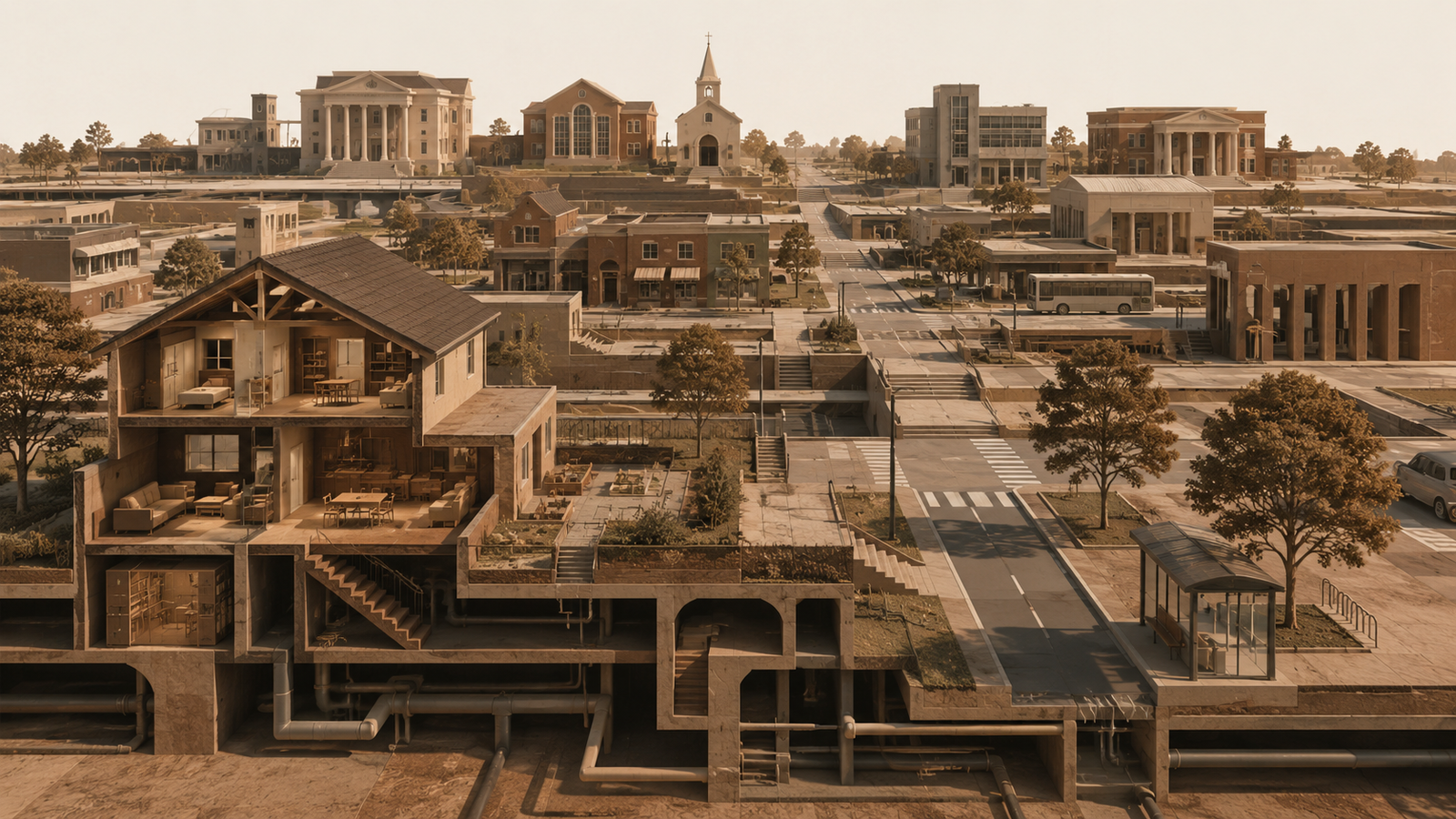
This July roundup examines the institutions that shape us long before we learn to name them.
Some institutions are obvious. Schools, courts, businesses, churches, transit systems, and governments are easy to recognize.
Others are almost invisible.
They live inside household routines, neighborhood expectations, emotional habits, family rules, sidewalks, financial customs, and the standards people repeat without discussion.
June moved the work toward correction. July asked what must exist after correction if progress is expected to last.
The answer was institution building.
This monthly report synthesizes the major ideas Groundwork Daily published during July 2026. Rather than listing articles by date, it identifies recurring themes, connects related work across categories, and highlights the structural patterns that emerged across the month. Each featured article contributes to a broader examination of how institutions influence behavior, opportunity, identity, responsibility, and endurance.
July Roundup: The Structures Beneath Ordinary Life
July’s strongest work did not treat institutions as distant buildings or formal organizations.
Instead, the month revealed institutions as repeated structures that shape behavior over time.
A household can become an institution. A sidewalk can become an institution. A financial norm, family ritual, prayer practice, or community expectation can do the same.
Institutions do more than organize activity. They teach people what is normal, what is protected, what is rewarded, and what must be carried forward.
Before people build civilizations, civilizations begin building people.
What July Taught Us
- Institutions influence behavior long before laws or policies become visible.
- Households are the first governing systems most people experience.
- Public infrastructure quietly determines access, safety, time, and opportunity.
- Wealth depends on ownership systems, inheritance, valuation, and starting capital.
- Community requires participation before formal governance can succeed.
- Civic literacy helps people navigate institutional power without surrendering judgment.
- Faith and ritual create structure when certainty is unavailable.
- Culture survives when institutions preserve memory across generations.
The Institutions Within Us
July began with the systems closest to the individual.
Emotional regulation, rest, consistency, and attention are often described as personal traits. That framing is incomplete.
These are internal institutions. They are repeated rules for interpreting pressure, responding to discomfort, and deciding what deserves attention.
When those internal systems are weak, every external structure becomes harder to maintain. However, when they are reinforced, people become more capable of carrying responsibility without being ruled by every passing emotion.
→ Emotional Regulation vs Emotional Suppression: What Most People Get Wrong
→ Why Slowing Down Feels So Difficult
→ Why Consistency Matters More Than Motivation
→ Why Rest Does Not Feel Restful Anymore
The lesson was not that people need more motivation.
People need inner structures strong enough to govern motivation when it disappears.
The Institutions Inside the Home
July’s family work made another point clear: households are not merely collections of people who share an address.
Every household establishes rules, rituals, expectations, and consequences. Some are spoken. Many are not.
Children inherit those patterns as normal. Adults repeat them as culture. Over time, the home becomes the first institution most people ever experience.
That makes household structure more consequential than household appearance.
→ The Ritual Audit: Five Questions Every Household Should Ask
→ Children Inherit Normal
→ Love Needs Structure
→ Family Meetings Change Everything
Love matters. Presence matters. Intention matters.
Still, none of them can replace structure.
A stable household does not rely on everyone remembering what matters at the same time.
The Institutions We Walk Through
Some institutions are so ordinary that people stop seeing them.
Sidewalks, street trees, crosswalks, transit stops, and commute patterns may look like background features. In practice, they govern access, movement, health, safety, time, and economic opportunity.
July’s urban infrastructure work showed that public design is never neutral.
A neighborhood teaches people what kinds of movement are expected. It shows whose time matters, whose safety has been considered, and which forms of participation have been made possible.
→ The Hidden Cost of Long Commutes
→ Sidewalks Are Economic Infrastructure
→ Street Trees Are Public Infrastructure
→ Bus Stops Are Public Infrastructure
Infrastructure does not simply support life after decisions are made.
Infrastructure shapes which decisions are available in the first place.
Wealth Is an Institutional Outcome
July also sharpened the distinction between earning, spending, owning, and transferring wealth.
That distinction is necessary because wealth is often presented as the result of isolated personal choices. Personal choices matter, but they operate inside systems of property, credit, inheritance, valuation, ownership, and access to starting capital.
In other words, wealth is not merely accumulated. It is institutionally supported or institutionally obstructed.
→ The Hidden Cost of Appraisal Bias
→ Who Owns the Neighborhood? The Economics Behind Every Community
→ Heirs’ Property and Black Land Loss
→ Why Starting Capital Changes Everything
This work rejected a shallow economic story.
Consumer activity may circulate money, but institutions determine who owns the systems through which that money moves.
Community Exists Before Government Arrives
July’s community and civic work exposed another weak assumption: governance creates community.
Usually, the sequence runs the other way.
Communities develop norms, trust, responsibility, participation, and informal systems before those practices become formal rules.
When those foundations are absent, government can administer a place without creating belonging. When they are strong, governance has something durable to organize and protect.
→ Communities Are Built Before They Are Governed
→ System Design Power: How Structure Determines Outcomes
→ Rules Are Not Neutral: Why Incentives Shape Human Behavior
→ System Updates: Public Conversation Collapse
This is where July’s thesis became unmistakable.
Strong communities are not produced by announcements. They are formed through repeated participation.
Civic Literacy Is Institutional Protection
Rights do not protect people merely because they exist in legal language.
People must understand when those rights apply, how institutions interpret them, and what power can legally demand.
July’s institutional literacy work therefore served a practical purpose. It translated constitutional protections into situations people may encounter in ordinary life.
→ Your Rights During a Police Stop
→ Terry Stop Rights Explained
→ Fourth Amendment Rights Explained
→ Fifth Amendment Rights Explained
Civic literacy is not trivia.
It is part of the infrastructure required to operate inside institutions without surrendering judgment to them.
Culture Preserves What Institutions Forget
July also explored identity through names, language, migration, and the experience of living between cultural worlds.
This work showed that institutions do not only regulate power. They also preserve memory.
Families, languages, rituals, stories, and naming traditions carry geography across generations. However, those inheritances can weaken when translation becomes permanent and preservation becomes accidental.
→ The Geography Inside Our Names
→ The Children of Translation: Growing Up Between Two Worlds
→ The Language We Lose Before We Notice
→ We Don’t Hate Small Talk. We Hate Performing
Identity is not sustained by declaration alone.
It survives through institutions capable of carrying memory forward.
Faith Builds Capacity for Uncertainty
July’s spiritual work stayed with silence, discernment, unanswered prayer, and the difficulty of trusting what cannot yet be understood.
That work belongs in the larger institutional argument.
Faith practices create structure during uncertainty. They establish ways to wait, interpret, endure, and continue when immediate results are unavailable.
→ Do Not Mistake Silence for Absence
→ Why Does God Feel Silent?
→ How Can I Know God Is Speaking?
→ Why Doesn’t God Answer Every Prayer?
The throughline was not certainty.
It was faithful structure when certainty is unavailable.
Character Is the Institution People Carry Everywhere
July’s character and leadership work returned repeatedly to care, consistency, responsibility, and the difference between visible status and private weight.
Character becomes institutional when repeated choices form reliable expectations.
That is why small habits matter. They reveal what a person protects when recognition is absent.
→ What Work Ethic Really Looks Like
→ The Small Habits That Reveal Character
→ Leadership Is Weight Before It Is Status
→ You Can Tell Who Someone Is by What They Take Care Of
Leadership does not begin when authority is granted.
It begins when someone becomes trustworthy enough to carry what others depend on.
Institutional Themes at a Glance
| Institution | Central Question | July Insight |
|---|---|---|
| Internal life | What governs behavior when motivation fades? | Repeated internal rules become systems of self-government. |
| Household | What do children inherit as normal? | Family rituals and standards become the first institutional culture. |
| Public space | Who can move, participate, and belong? | Infrastructure quietly determines access, safety, time, and opportunity. |
| Economy | What creates durable wealth? | Ownership and transfer systems compound more than consumption alone. |
| Community | What creates belonging before governance? | Participation and shared responsibility precede formal authority. |
| Civic life | What protects people inside systems of power? | Institutional literacy strengthens judgment and participation. |
| Faith | What sustains people during uncertainty? | Practice provides structure when immediate answers are unavailable. |
What This July Roundup Set Forth
This July roundup clarified the institutional layer beneath Groundwork Daily’s wider body of work.
- Internal discipline is an institution of self-government.
- Households teach normal before children can evaluate it.
- Public infrastructure shapes access, safety, health, and economic participation.
- Wealth depends on ownership systems, inheritance, valuation, and starting capital.
- Community is built through participation before it is formalized through governance.
- Civic literacy helps people navigate institutional power.
- Culture survives through systems capable of preserving memory.
- Faith provides structure when certainty is unavailable.
- Character becomes visible through what people repeatedly protect.
July did not argue that institutions are automatically good.
It argued something more useful:
Institutions are always shaping outcomes, whether their design is examined or ignored.
Receipts: External Context
The July synthesis draws from Groundwork Daily’s published work. Readers who want broader public data and institutional context can continue with the following sources:
→ Federal Highway Administration
→ Consumer Financial Protection Bureau
→ Pew Research Center
→ Urban Institute
Continue Through Groundwork Daily
The institutional questions raised in July extend across Groundwork Daily’s core territories.
→ Explore Culture, Media & Leadership
→ Read the May 2026 Roundup
→ Join the Groundwork Daily Newsletter
The 2026 Roundup Arc
- February: Pressure becomes visible.
- March: Maintenance protects progress.
- April: Capacity must precede expansion.
- May: Systems reveal themselves under pressure.
- June: Correction follows exposure.
- July: Institutions preserve what must endure.
- August: Identity emerges from repeated institutional influence.
August Preview: When Institutions Shape Identity
August begins where July ended.
If institutions teach people what is normal, then they also influence who people believe they are.
The opening August work is already moving toward home, trust, generational discipline, rights, and inheritance.
→ Where Home Begins When It Isn’t a Place
→ Miranda Rights Explained
→ How Do I Trust God When I Don’t Understand?
→ The Discipline Children Remember
The next month will push deeper into ownership, trust, family legacy, public space, cultural power, and the systems that influence identity before identity becomes conscious.
July identified the institutions.
August will examine the people those institutions produce.
Institutions rarely announce themselves while they are working.
You notice them when they fail, disappear, or stop carrying what people assumed would always be there.
July showed that stable lives are rarely built from extraordinary moments.
They are built from ordinary structures repeated long enough to become almost invisible.
Build better. Every day.
Groundwork Daily’s monthly roundups are editorial syntheses. They identify recurring patterns, questions, and structural themes across the month’s published work. The goal is not merely to preserve an archive. It is to connect individual articles into a larger body of knowledge that readers can use, revisit, and build upon.
The structures shaping tomorrow are being repeated today.
Subscribe to Groundwork Daily
